
How Much Does a Custom Web App Cost in Australia? A 2026 Price Guide
 Jignesh Vagadiya
14/10/2026
21 min read
A client came to us last year with a one-page brief: “we need a portal where our trade customers can log in, check stock and place orders.” Three quotes came back. One was $18,000. One was $65,000. One was $140,000. All three agencies had read the same brief and all three had quoted honestly. The gap wasn’t dishonesty, it was that “a portal” means almost nothing on its own — it’s a label, not a specification, and the specification is where the real number comes from.
So how much does a custom web app cost in Australia in 2026? We’re going to give you real ranges rather than one number, because a web app isn’t priced like a brochure website. It’s priced like software, which means the cost is set by what the thing actually has to do — how many workflows, how many user types, how many systems it needs to talk to — not by how many pages it has or how polished the design looks in a mockup. That’s also why web app quotes vary more wildly than website quotes: the underlying product is genuinely more variable.
This guide sets out the bands we see hold up across the Australian market, the specific things that push a build from the cheap end to the expensive end, the pricing models you’ll be offered, and the questions a proper quote needs to answer before you can compare it against anyone else’s. If you want to see where your own project lands rather than a market average, our web app development pricing page walks through how we scope and quote. Everything below is the broader market, so you can use it to sanity-check any quote currently sitting in your inbox.
How Much Does a Custom Web App Cost in Australia?
“Web app” covers a huge range of actual products — a client portal, a booking engine, an internal operations tool, a SaaS product with paying subscribers. What separates the cheap end from the expensive end isn’t the category, it’s the number of distinct things the software has to do and the number of systems it has to stay in sync with. Below are the three bands that current Australian cost guides, agency rate cards and build data converge on for 2026, treating the top of each range as fully featured and the bottom as lean but genuinely usable.
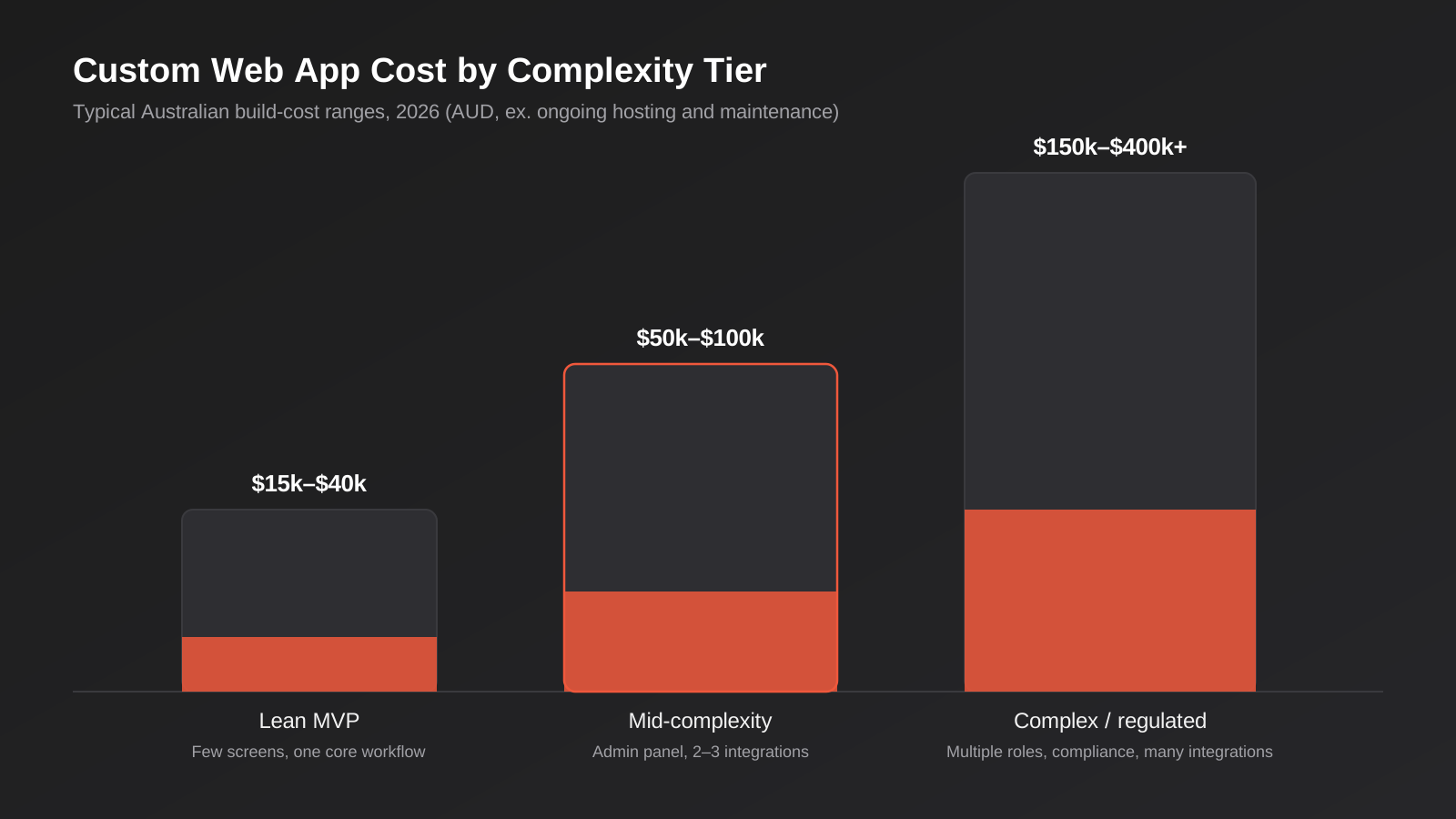
- Lean MVP or proof of concept (a handful of screens, one core workflow, basic authentication, no admin panel to speak of): roughly $15,000–$40,000. This is the tier for validating whether the idea works commercially before you spend real money building it out properly.
- Mid-complexity web app (10–15 screens, role-based logins, an admin or back-office panel, two or three integrations with systems like a CRM, payment gateway or accounting platform): roughly $50,000–$100,000, which is where most genuinely useful business tools and early-stage SaaS products land.
- Complex or regulated platform (multiple user roles with different permissions, real-time data, payments or sensitive personal information in scope, many integrations, audit requirements): $150,000–$400,000 and up, scoped entirely on functionality rather than any fixed template.
None of these figures include what it costs to keep the thing running. Hosting for a genuine web application — a database, a backend, often some background processing — runs higher than a static website, typically $50–$400 a month depending on traffic and data volume. Ongoing maintenance, bug fixes and small feature work on top of that is usually budgeted as a percentage of the build cost rather than a flat fee: 15–25% of the original build cost per year is the rule of thumb that holds up across most Australian guides, which means a $70,000 app carries something like $10,000–$17,000 a year in care and feeding even before you add new features.
The honest way to work out which tier you’re actually in is to count workflows, not pages. A booking system that lets a customer pick a time slot and pay is one real workflow, even if it touches five or six screens. A trade portal that handles browsing, ordering, account-specific pricing, order history and a sync back to an ERP is four or five workflows wearing a single-page-count disguise. If your brief reads like a sentence (“customers log in and place orders”) but the sentence is doing a lot of hidden work, that’s usually a sign you’re closer to the mid-complexity tier than the MVP tier, whatever the page count suggests.
What Drives the Price Up
A handful of factors account for almost all of the spread between a $20,000 app and a $200,000 one. None of them are arbitrary — each one represents real engineering time — but they’re rarely spelled out before the quote lands, which is why the number can feel disconnected from the brief until you see what’s actually driving it.
Number of distinct user roles
An app with one type of user — everyone sees the same thing and can do the same things — is simpler to build and test than an app with a customer view, a staff view and an admin view, each with different permissions and different screens. Every additional role roughly multiplies the testing surface, because you’re no longer checking that the app works, you’re checking that it works correctly for each role and fails safely when someone tries to do something they shouldn’t.
Integrations with existing systems
Connecting to a CRM, an accounting platform, a payment gateway or an ERP sounds like a single line item until someone has to handle what happens when that system is slow, returns an unexpected response, or changes its API without much notice. A single well-documented integration might add $3,000–$8,000. Several integrations that all need to stay in sync with each other — inventory in the app, inventory in the ERP, pricing in both — are usually the single biggest reason a mid-complexity app costs what it costs, and this kind of work is often scoped and staffed separately from the app build itself even when it ships at the same time.
Real-time data and live updates
An app that refreshes when the user reloads the page is a different engineering problem to one that needs to show live stock levels, a live map, or a live chat thread without the user doing anything. Real-time behaviour means websockets or polling infrastructure, more careful state management, and testing scenarios that simply don’t exist in a request-and-refresh app. It’s a legitimate feature for plenty of products, but it’s rarely free, and it’s one of the more common places a quote jumps once the brief is properly scoped.
Payments and sensitive data
Taking payments inside the app, or storing anything that falls under the Australian Privacy Principles as sensitive or health information, brings compliance work that doesn’t show up as a visible feature at all: PCI DSS scope reduction, encryption at rest, access logging, data retention policies, and usually a security review before launch. This is real, necessary work, and it’s a common reason a seemingly simple app costs noticeably more than a competitor’s app that looks identical on the surface but handles money or personal data less carefully.
Admin and back-office tooling
The part of the app your customers never see is often where the budget actually goes. A proper admin panel — user management, content editing, reporting, the ability to override or correct something without touching the database directly — is a second application sitting behind the first one. Businesses frequently under-scope this because it isn’t the part they’re excited about, then discover six months after launch that staff are stuck emailing a developer every time something needs changing.
Native mobile versus web
If the brief includes “and it needs an app for the App Store,” that’s a meaningfully different and more expensive build than a responsive web app, partly because of the extra platform-specific work and partly because of the ongoing cost of maintaining two app store listings, two review processes and two sets of OS updates to track. A progressive web app is frequently the right middle ground: installable on a phone’s home screen, capable of push notifications and offline access on most devices, built once rather than twice, at a fraction of the cost of native iOS and Android builds. It’s not a universal substitute — some hardware access and App Store distribution genuinely need native — but it’s worth ruling out before you price native as the default.
Where the build team is based
Senior developer rates in 2026 run roughly $180–$250 an hour in Sydney and Canberra, $150–$210 in Melbourne and Brisbane, and somewhat lower again in regional centres and with blended offshore-delivery teams. Location isn’t the biggest lever in the overall price — scope matters far more — but it explains part of why two agencies with comparable local reputations can land several thousand dollars apart on the same brief, and why an offshore-heavy quote can come in well under a fully local one for the same stated scope without either being dishonest about their rates.
What matters more than the headline rate is who’s actually project-managing the build. A cheaper offshore-delivery quote with a local Australian lead handling communication, requirements and quality control can work very well. The same offshore rate with no local layer at all tends to show up later as misunderstood requirements, time zone lag on anything urgent, and QA that misses the specific edge cases an Australian user base will hit — things like local payment methods, GST handling or state-based business rules that a generic international team hasn’t been briefed to think about.
What Brings the Price Down
If budget is the binding constraint, these are the genuine, non-cosmetic ways to bring a web app quote down, roughly in order of impact:
- Cut to one core workflow for launch. Almost every over-budget app we’ve seen started as a long feature list instead of one job the software has to do well. Ship that one job, prove it works commercially, then fund the rest from the business case it creates.
- Use an off-the-shelf tool for the boring 80%. Authentication, payments, email sending and basic reporting all have mature, cheap building blocks. Custom development time should go toward the 20% of the app that’s actually unique to your business, not toward rebuilding a login form from scratch.
- Delay the native app. Launch as a responsive web app or PWA first, and only commit to native iOS and Android builds once you have real usage data proving the demand is there. Building native twice for a product nobody has used yet is one of the more expensive mistakes we see.
- Reduce the number of roles at launch. If the long-term vision has five user types but only two are needed to prove the concept, build for two and add the rest once the core product is validated.
- Bring your own content and data migration. If you can supply clean, well-structured data for import rather than asking the development team to clean it up, that’s real hours saved, though it only helps if the data is genuinely ready, not “mostly fine.”
- Fix the scope in writing before you ask for quotes. The single biggest cause of a web app running over budget isn’t a bad quote, it’s requirements that keep growing after development starts. A written specification, even a rough one, keeps every quote comparable and keeps your own requests from quietly inflating the project.
A phased build is usually the most effective version of all of this at once: scope and fund the MVP properly, learn from real users, then scope phase two with actual evidence instead of guesses. We’ve written more on how that staging works in our MVP development guide, including what’s safe to cut and what isn’t.
Pricing Models Explained
How a development team charges matters as much as the headline number, because it determines who carries the risk if the project runs long or the scope shifts. Four models show up repeatedly in the Australian market.
Fixed-price for a defined scope
You get one number for a specified set of features, delivered by an agreed date, usually with a defined number of revision or testing cycles. This suits an MVP or a well-understood mid-complexity app where the requirements are genuinely stable. The risk sits with the development team if the job runs long, which is exactly why a fixed-price web app quote should come with a detailed specification and a formal change-request process — without one, “fixed price” quietly becomes “fixed price for whatever we originally guessed,” and every genuine change becomes a dispute.
Time and materials (hourly or day rate)
You pay for actual hours worked, at rates that generally track the city-based ranges above. This is the standard model for web apps with evolving scope, because software requirements routinely change once real users start touching the product, and a fixed-price model doesn’t handle that gracefully. The risk sits with you as the client; a competent team manages that with sprint-based reporting, a rolling estimate and regular demos, so you can stop or redirect the work early if it’s not tracking the way you expected, rather than discovering the overrun at the end.
Dedicated team retainer
Rather than pricing a single project, you retain a developer or small team on a monthly rate, commonly $7,500–$11,000 per developer per month in the Australian market, sometimes less with an offshore-blended arrangement. This suits ongoing product development — a SaaS platform, an internal tool that keeps growing — where there’s no real “finish line” and you need sustained capacity rather than a one-off delivery. It only makes financial sense once you have a genuine pipeline of work; a retainer sitting partly idle is an expensive way to build a small app.
Milestone-based payment
Common inside both fixed-price and time-and-materials engagements, this splits payment across project phases — typically a deposit to start, a payment at a design or architecture sign-off, one or two payments through development milestones, and a final payment at launch. It protects both sides: you’re not funding the entire build before you’ve seen working software, and the development team isn’t carrying the full cost of the project until the very end. Be wary of any arrangement that asks for the bulk of payment upfront on a large build; it removes the main financial incentive to hit the dates they promised.
None of these models is inherently better than the others. A fixed price on a product with genuinely unstable requirements produces constant change-order friction. Time and materials on a tightly defined MVP produces budget anxiety for no good reason. The right question isn’t “which model sounds safest,” it’s “how well-defined is what I’m actually asking for” — and answering that honestly before you request quotes saves a lot of friction later.
What a Proper Web App Quote Should Include
A web app quote that’s a single number next to a one-line description tells you almost nothing, and it’s the main reason two quotes for “the same” project can look wildly different. Before comparing quotes, check that each one actually answers the same set of questions.
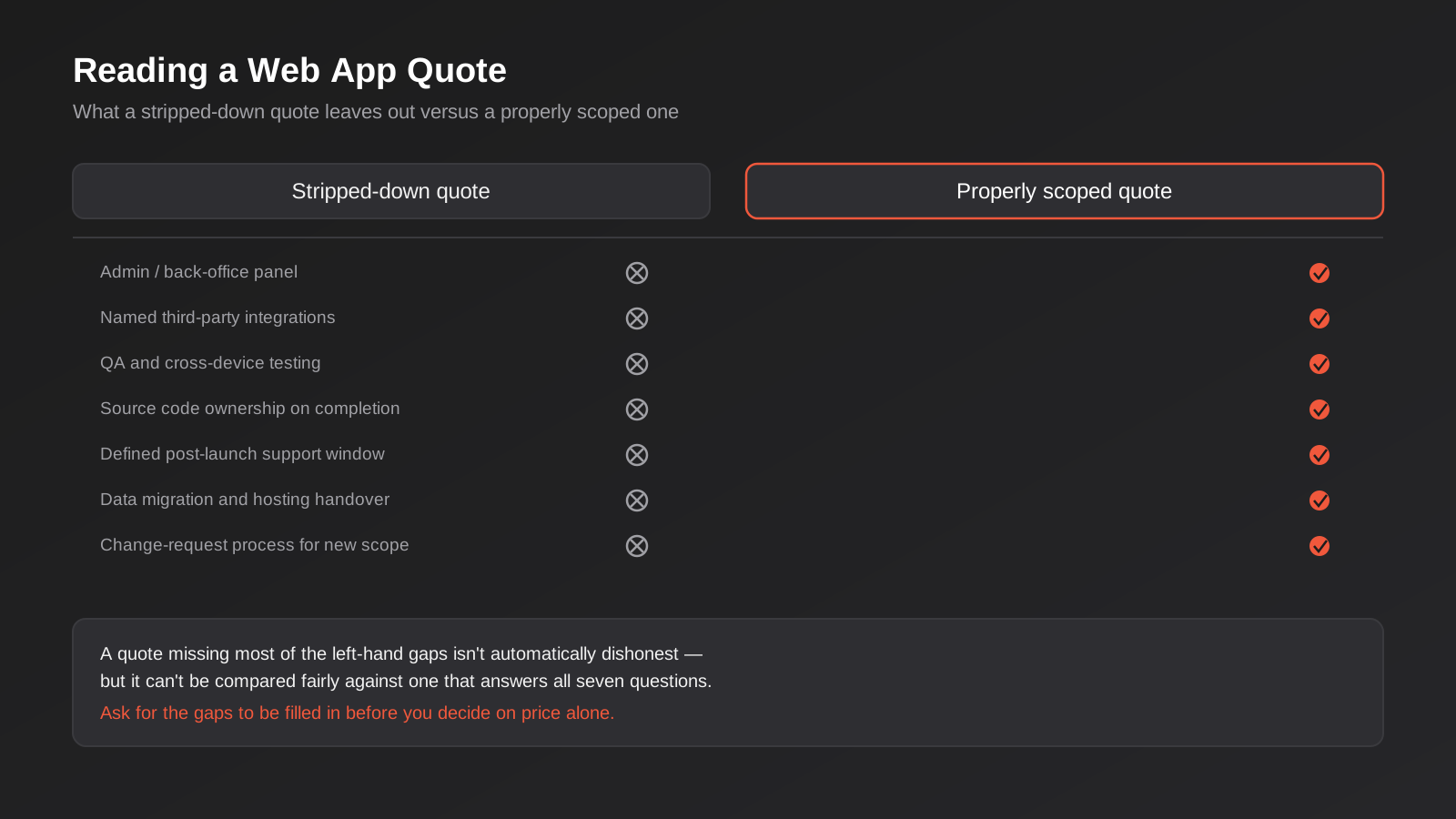
- A defined feature list, not a vibe. “User accounts and an admin area” means something different to every developer; ask exactly what the admin area can and can’t do, and what happens if a feature you assumed was included turns out not to be.
- Named integrations, not “we can connect to anything.” Every third-party system you need to talk to should be named and scoped individually, because each one carries its own risk and its own cost, and “anything” pricing is a sign the integration work hasn’t actually been scoped yet.
- Who owns the code and the infrastructure once it’s built. You should own the source code, the hosting account and the domain outright at the end of a standard project unless you’ve specifically agreed to a different arrangement. If an agency retains control of any of these by default, ask why, and understand what it costs to leave if you ever need to.
- The testing and QA process. Ask what devices and browsers are actually tested, not just “it’s responsive,” and whether there’s a staging environment you can review before launch rather than seeing the finished product for the first time in production.
- A defined post-launch support window and a clear line between what counts as a free bug fix and what counts as new, billable work.
- Data migration and hosting handover, spelled out explicitly if you’re replacing an existing system, since this is one of the most commonly underestimated parts of a web app project.
- A change-request process for anything that comes up outside the original scope, so “can we also add…” has an agreed path rather than becoming a point of friction mid-project.
A quote missing several of these isn’t automatically a red flag on its own — some teams genuinely prefer to fill in detail during a kickoff workshop rather than in the proposal document. But it does mean you can’t yet compare it fairly against a more detailed quote, and it’s worth asking for the gaps to be filled in before the price alone decides anything.
Common Mistakes When Budgeting for a Web App
- Treating “web app” and “website” as the same budgeting exercise. A website is priced on pages and design; a web app is priced on workflows, data and logic. Using website-style thinking to budget a web app almost always under-shoots the real number.
- Comparing a fixed-price quote to a time-and-materials estimate as if they’re the same kind of number. One is a ceiling, the other is a starting estimate for ongoing work. Treating an hourly estimate as a hard cap is how “surprise” overruns happen, even when the development team never promised a cap in the first place.
- Skipping the specification to save time upfront. A vague brief gets a vague quote, and a vague quote is the single biggest cause of scope disputes once development starts. The hours spent writing a proper spec are cheap compared to the cost of rebuilding something that was built to the wrong understanding.
- Under-scoping the admin panel. Businesses consistently budget generously for the customer-facing half of the app and treat the internal tooling as an afterthought, then find staff can’t actually run the thing without constant developer intervention after launch.
- Forgetting that launch is the start of the cost, not the end of it. Hosting, monitoring, security patching and the inevitable round of post-launch fixes are real, ongoing costs that a one-off build price never covers, and they need a line in next year’s budget, not a surprise in month two.
- Building all the “nice to have” features before launch. Every feature added before you have real users is a guess. Launch with the core workflow, get the product in front of actual users, and let real usage data decide what phase two actually needs — it’s usually not what the original wishlist assumed.
- Choosing custom development when an off-the-shelf tool would do the job. Not every internal problem needs bespoke software. If a configured CRM, a no-code tool or an existing SaaS product covers 90% of what you need, custom development is the expensive option for the remaining 10%, and it’s worth reading a genuine decision framework before committing either way.
- Picking the cheapest quote without asking what it leaves out. The gap in a dramatically cheaper quote is almost always in testing depth, admin tooling, documentation or post-launch support, not in anything visible during a demo — which is exactly why it’s easy to miss until after the contract is signed.
If you’re still weighing whether a custom build is the right call at all versus configuring something that already exists, our guide to custom software versus off-the-shelf tools walks through that decision in more depth, including where the break-even point usually sits for a growing Australian business.
Frequently Asked Questions
How much does a custom web app cost in Australia?
A lean MVP with one core workflow typically costs $15,000–$40,000 in Australia in 2026. A mid-complexity app with an admin panel, role-based logins and two or three integrations usually runs $50,000–$100,000, and a complex or regulated platform with multiple user roles and extensive integrations can run $150,000–$400,000 or more. The number that matters is the one that comes back once your specific workflows, integrations and user roles have been scoped, not a figure from any single guide, including this one.
Why do web app development quotes vary so much more than website quotes?
A website is priced largely on pages and design complexity, which is relatively easy to estimate consistently. A web app is priced on workflows, data handling, integrations and user roles, which vary enormously even between projects that sound similar in a one-line brief. Two “customer portal” projects can differ by a factor of five or more in genuine engineering effort, which shows up directly in the quote.
Should I build an MVP first or go straight to the full product?
For most businesses, starting with an MVP that proves the core workflow works commercially is the lower-risk and ultimately cheaper path, because it means phase two is funded by evidence rather than guesswork. The exception is when the “MVP” version genuinely can’t demonstrate anything useful without most of the full feature set already in place, which does happen for some regulated or integration-heavy products — in that case, a staged build inside a single project is usually a better fit than a true MVP-first approach.
Is it cheaper to build a progressive web app instead of a native mobile app?
Generally yes. A progressive web app is built once and runs on both iOS and Android through the browser, with most of the installability and offline features users expect from a native app, at a meaningfully lower cost than building and maintaining two separate native codebases. Native is still the right call when you need deep hardware access, background processing the browser can’t do, or App Store and Play Store presence specifically, but it’s worth ruling a PWA in or out before pricing native as the default.
How much should I budget for a web app after it launches?
Budget roughly 15–25% of the original build cost per year for ongoing maintenance, bug fixes and small improvements, on top of hosting, which typically runs $50–$400 a month for a genuine web application depending on traffic and data volume. A $70,000 build, for example, carries something like $10,000–$17,000 a year in care and feeding before you add any new features, and that figure should be budgeted from day one rather than discovered after launch. Businesses that skip this line item tend to either let security patches and dependency updates slide until something breaks, or come back to the original developer for “quick” changes that get billed at a rate they didn’t plan for.
Should I pay fixed price or hourly for a custom web app?
Fixed price suits a well-defined scope, typically an MVP or a mid-complexity app where requirements genuinely aren’t going to change mid-build, because it transfers the risk of overruns to the development team. Time and materials suits an evolving product where requirements are expected to shift once real users are involved, which describes most software past the MVP stage. If a team insists on fixed price for what’s clearly an evolving product, or insists on open-ended hourly billing for a tightly scoped MVP, it’s worth asking why, since either mismatch tends to produce friction later.
Where to Start
If you came here asking how much a custom web app costs in Australia for your specific idea, the honest answer is still “it depends on the workflows, the integrations and the roles,” but you now know what those variables actually are and how they move the number. The figure that matters isn’t a market average from a blog post, it’s the number that comes back once someone has properly scoped your actual requirements against real engineering effort, which is the only way to tell whether a $30,000 quote is a sensible MVP or a stripped-down version of something that actually needed to be $80,000.
If you’d like to see where your project lands against a real scope rather than a market range, our MVP development page covers what a lean first build looks like specifically if you’re validating an idea rather than building the full version on day one. Whichever stage you’re at, the same principle from this guide holds: a properly scoped brief is what makes a quote trustworthy, and it’s worth getting that right before the pricing conversation starts, not after.
One more thing worth knowing: because we run lean as a specialist agency rather than carrying a large account-management layer, our fixed quotes typically come in below the Australian averages covered in this guide for comparable scope. If you’ve already got a written quote from another developer or agency, send it through and we’ll do our best to beat it.
Keep reading
Related posts
How Much Does a WooCommerce to Shopify Migration Cost in Australia? A 2026 Price Guide
What a WooCommerce to Shopify migration costs in Australia in 2026: real price ranges by store complexity, hidden costs and how to…
How Much Does an AI Chatbot Cost in Australia? A 2026 Pricing Guide
What an AI chatbot costs in Australia in 2026: three pricing tiers, the running costs people miss, and how to compare quotes…
How Much Does Custom Software Development Cost in Australia? Build Cost vs Five Years of Licences (2026)
What custom software development costs in Australia in 2026: ranges by project type, integration costs, running costs, and how the build compares…
Got a project you'd like to talk through?
Tell us what you're working on — we'll come back with a plan.
