
YouTube Ads for Australian Businesses: Costs, Formats and Targeting That Actually Convert (2026)
 Jignesh Vagadiya
20/09/2026
21 min read
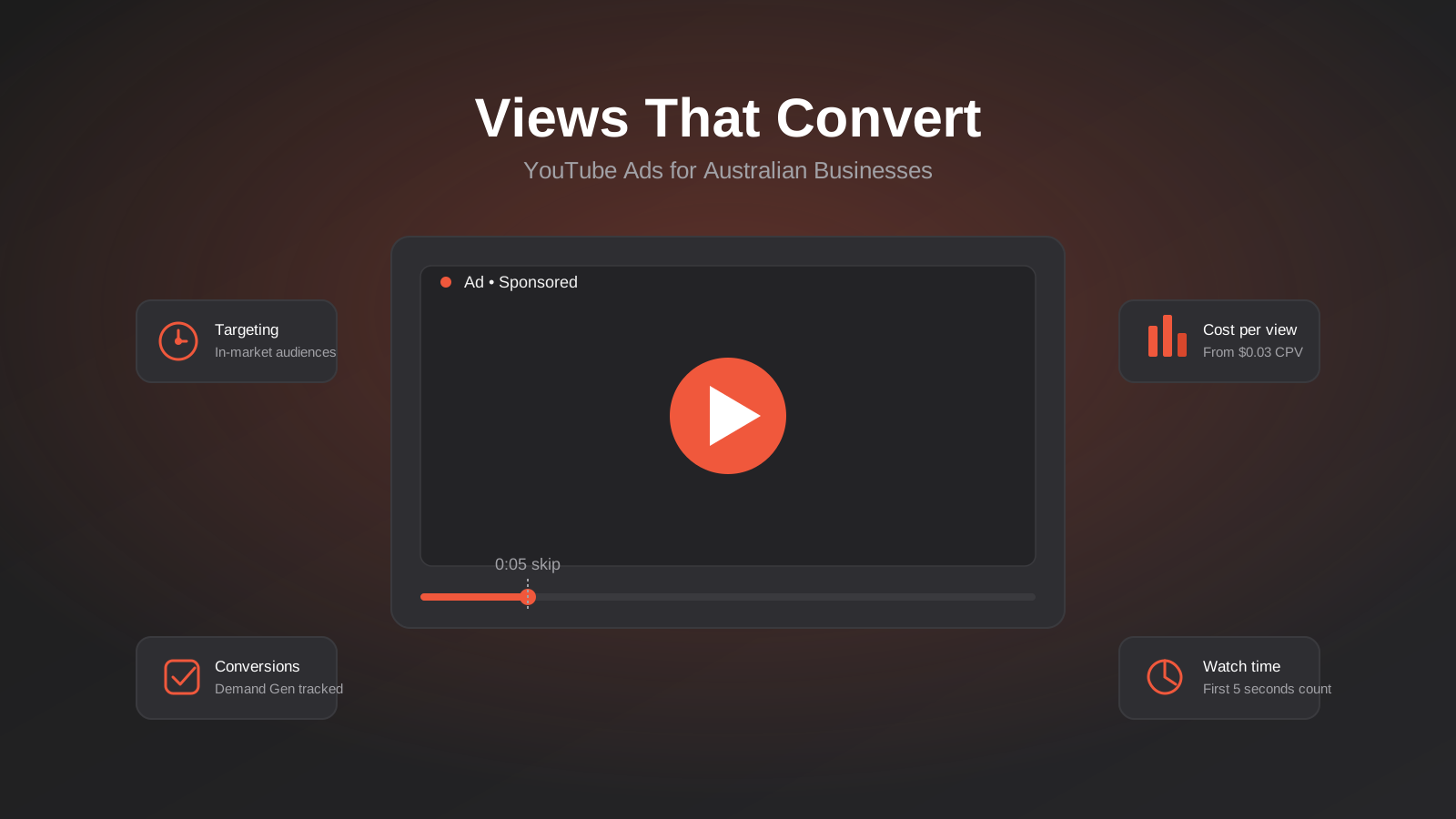
Most Australian business owners still think of YouTube ads the way they thought of TV commercials a decade ago: expensive to make, hard to target, and something you run for brand awareness while crossing your fingers about ROI. That description stopped being accurate a while back. YouTube now runs on the same auction infrastructure as Search, uses the same conversion tracking as the rest of Google Ads, and lets you launch a campaign with a $20 daily budget and a video shot on a phone.
What hasn’t changed is that most businesses still get it wrong. They either treat it as a vanity channel and measure success in views, or they throw a 30-second brand video at a cold audience and wonder why nobody bought anything. The businesses getting real results from YouTube in 2026 are doing something more specific: matching ad format to funnel stage, using intent-based targeting instead of broad demographics, and building creative that’s designed to survive the first five seconds — because that’s the only five seconds most viewers guarantee you.
This YouTube ads Australia guide covers what campaigns actually cost right now, which campaign type and format fits which goal, how targeting really works once you get past age and gender, and the creative and measurement mistakes that quietly burn budget. If you’ve already read our LinkedIn Ads cost and targeting breakdown or our TikTok Ads guide, this sits alongside them — same honesty about real numbers, different platform, different mechanics.
Why YouTube Ads Behave Differently to Search and Social
YouTube sits in an odd spot. It’s owned by Google and bought through the Google Ads platform, so it inherits Google’s targeting data, Smart Bidding algorithms and conversion tracking. But it’s a video platform where people are watching, not searching, so the intent signal is weaker than Search and the ad experience is closer to social. That combination is exactly why it’s worth understanding on its own terms rather than treating it as “Google Ads with video” or “social with a bigger screen.”
A few things make YouTube distinct:
- It’s the second-largest search engine in the country in practice, because people search YouTube directly for how-to content, reviews and comparisons — which means in-feed and Shorts ads can be shown against genuine purchase-research intent, not just passive scrolling.
- Watch time is the core currency. Google’s algorithm optimises the whole platform around keeping people watching, and your ad is competing with that incentive, not working alongside it.
- You get a genuine reach advantage. YouTube’s Australian audience skews broader than TikTok’s and overlaps less with LinkedIn’s professional base, so it’s often the channel that reaches people your other paid channels miss.
- Cost per result is usually lower than Meta or LinkedIn for equivalent reach, but the creative bar to convert cold traffic is higher because video demands more attention than a static feed post.
None of that makes YouTube better or worse than other channels — it makes it a different tool for a different part of the job. Businesses that get burned on YouTube usually got burned by using it for the wrong job, like expecting a 6-second bumper ad to close a $10,000 B2B sale, or running a direct-response campaign with creative built for a TV spot.
YouTube Ad Formats in 2026
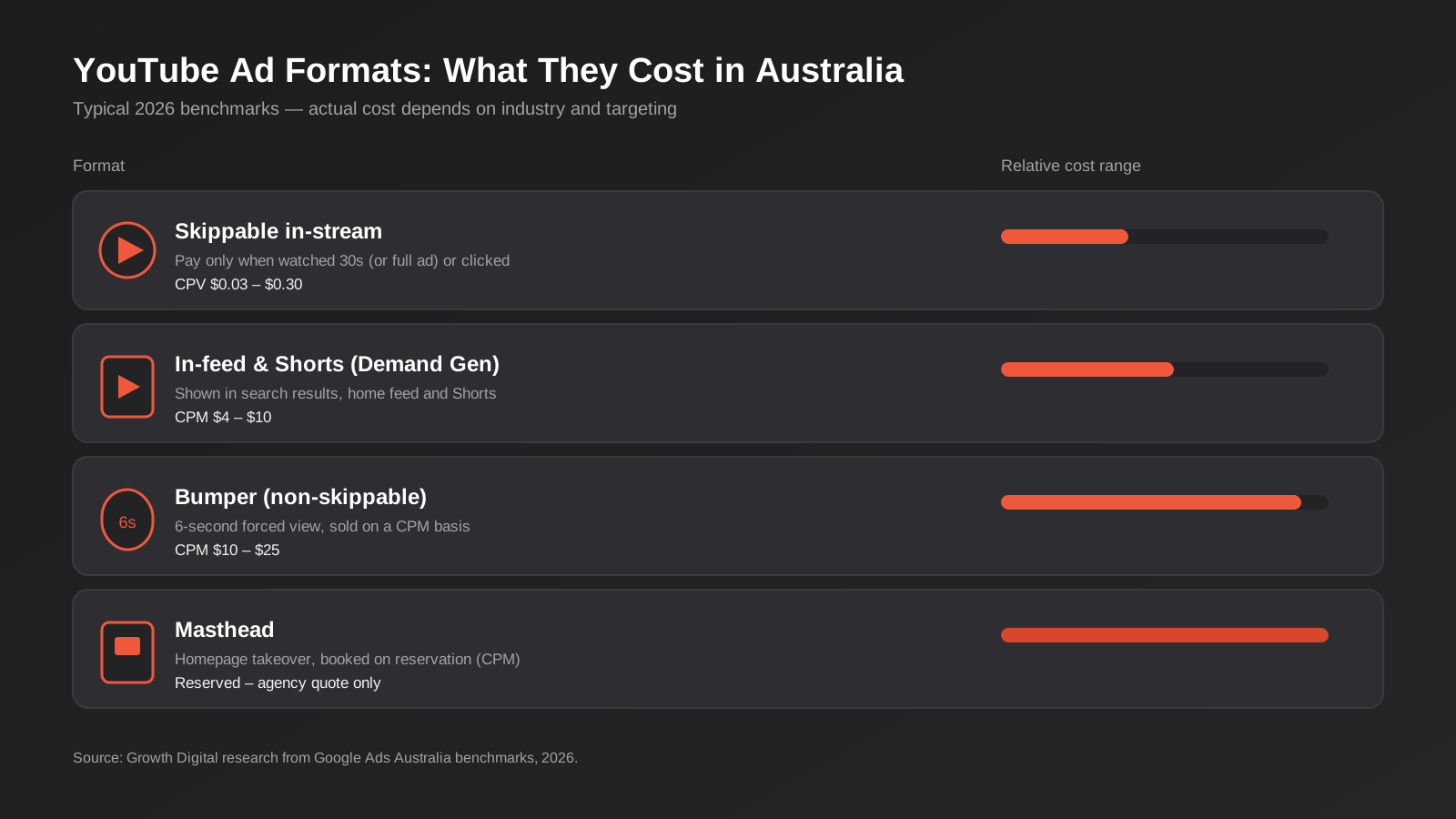
Format choice is the first decision that actually matters, because it sets your pricing model, your creative constraints and roughly what part of the funnel you’re playing in. Here’s what’s actually available to Australian advertisers right now.
Skippable in-stream ads
These play before, during or after another video, and the viewer can skip after five seconds. You’re charged on a cost-per-view (CPV) basis — you only pay when someone watches 30 seconds, watches the whole ad if it’s shorter, or clicks on it. This is the most flexible format and the one most small-to-medium Australian businesses should start with, because you’re not paying for the people who bail in the first five seconds, which is most of your cold audience the first time they see you.
Non-skippable in-stream and bumper ads
Non-skippable in-stream ads run up to 15 or 20 seconds and force a full view. Bumper ads are a 6-second non-skippable format designed for quick, memorable messages — a single offer, a brand tagline, a launch date. Both are sold on a CPM basis (cost per thousand impressions), which means you’re paying for guaranteed impressions rather than engaged views. They’re a reach and frequency tool, not a direct-response one, and they work best layered on top of a skippable or in-feed campaign rather than run alone.
In-feed and Shorts ads (Demand Gen)
These show up in YouTube search results, the home feed, related videos, and — increasingly — in the Shorts feed. They look like organic content with a thumbnail and headline, and the viewer chooses to click through, so they carry an intent signal skippable in-stream ads don’t. Since Google folded Discovery and Video Action campaigns into Demand Gen, this is now where most conversion-focused YouTube activity lives, and it’s worth understanding that consolidation before you set anything up, which we cover in the next section.
Masthead
The homepage takeover slot, sold on a reservation basis rather than auction. It’s a mass-reach, big-budget play that’s realistically out of scope for most SMBs and mid-market businesses — we mention it here for completeness, not as a recommendation.
Campaign Types: What Demand Gen Actually Changed
If you set up YouTube ads a couple of years ago and haven’t touched the account since, the campaign picker will look different. Google has been consolidating: Discovery campaigns and Video Action campaigns (VAC) have been migrated into Demand Gen, which is now the standard campaign type for conversion-focused video and image ads across YouTube (including Shorts), Discover, Gmail and Maps. If you’re setting up a new account, you’ll generally be creating a Demand Gen campaign for anything conversion-related rather than a standalone VAC.
That leaves three broad campaign families worth knowing:
- Video campaigns (reach, views, ad sequence) — the workhorse for awareness and consideration. Reach subtype maximises unique viewers on a CPM basis; views subtype optimises for CPV; ad sequence lets you tell a story across multiple ads in a set order (see one ad, then a follow-up, then a retargeting close).
- Demand Gen — built for conversions, using visually rich video and image creative across YouTube, Shorts, Discover and Gmail, with lookalike-style “similar audiences” and strong creative testing tools. This is where most performance-driven YouTube spend should sit today.
- App campaigns — if your conversion goal is app installs or in-app actions, these use YouTube inventory alongside Search, Play and Display automatically, and you don’t hand-pick placements.
The practical takeaway: if someone quotes you a “Video Action Campaign” in 2026, ask whether they mean the legacy format or are using the term loosely for Demand Gen — it affects which reporting and audience tools you’ll have access to.
Ad sequencing is underused
Most businesses run one ad and hope it does everything — grabs attention, explains the offer and closes the sale in fifteen seconds. Ad sequence campaigns let you break that into a deliberate story: show a short problem-focused hook to a cold audience, then serve a second ad explaining the solution only to people who watched a meaningful portion of the first, then follow with a direct offer or testimonial to anyone who engaged with either. It takes more setup than a single-ad campaign, but for considered purchases — renovations, B2B software, professional services — it consistently outperforms asking one video to do the whole job. The trade-off is volume: you need enough traffic moving through each stage for the sequencing to actually trigger, so it’s better suited to an account that’s already spending a few thousand dollars a month than a brand-new $500 test.
Bidding Strategies: How Google Actually Spends Your Budget
Format and campaign type decide where your ad can show. Bidding strategy decides how aggressively Google chases each opportunity, and getting this wrong is one of the quieter ways Australian accounts waste money — usually by asking Smart Bidding to optimise for a goal before there’s enough conversion data for it to do that well.
- Maximise conversions spends your full daily budget trying to get as many conversions as possible, with no target cost per result. It’s a reasonable starting point when you don’t yet know what a realistic cost per conversion looks like for video traffic, but it can spend unevenly while it’s still learning.
- Target CPA (cost per acquisition) asks Google to hold your average cost per conversion near a number you set. This needs conversion history to work well — setting a Target CPA on day one, before the algorithm has real data, usually throttles delivery or produces wildly inconsistent results.
- Target ROAS (return on ad spend) is the ecommerce version of the same idea, optimising for revenue per dollar spent rather than raw conversion count. It needs even more historical conversion value data than Target CPA to perform reliably, so it’s rarely the right choice for a brand-new account.
- Manual CPV (cost per view) gives you direct control over what you’re willing to pay per engaged view on skippable in-stream campaigns. It’s more hands-on and less common now that automated bidding has matured, but it’s still useful when you want tight control over spend on a small test budget rather than handing the wheel to an algorithm with thin data to learn from.
The practical sequence we recommend for a new Australian account: run Maximise Conversions (or Maximise Conversion Value for ecommerce) for the first few weeks to build a real conversion history, then move to a Target CPA or Target ROAS once you’ve got at least 30–50 conversions to give the algorithm something to learn from. Switching to a tight target too early is one of the more common reasons a YouTube campaign looks like it “stopped working” in week two — it didn’t stop working, it got starved of the data it needed.
Is YouTube the Right Channel for Your Business?
YouTube isn’t universally the next channel to add, and it’s worth being honest about where it earns its budget and where it doesn’t.
It tends to work well for businesses with a story or process worth showing — trades and construction firms demonstrating a job, professional services explaining a complex offer, ecommerce brands showing a product in use, and any business already producing video content for organic reach that can be repurposed into paid creative. It also earns its keep as a remarketing layer even for businesses whose primary channel is Search or Meta, because a short follow-up video to warm site visitors is usually cheap relative to the lift it produces.
It tends to underperform for businesses with no video assets and no appetite to create any, extremely niche B2B offers where the addressable audience is a few hundred people better reached through LinkedIn or direct outreach, and businesses expecting immediate last-click sales from a cold audience with no remarketing or sequencing plan behind it. If that sounds closer to your situation, a narrower short-form platform might fit a tighter niche or a lower production budget better.
What YouTube Ads Actually Cost in Australia
Cost is the question we get asked first, and the honest answer is “it depends on your industry and your targeting precision” — but that’s not useful without numbers, so here are the ranges we see in Australian accounts:
- Skippable in-stream CPV: roughly $0.03 to $0.15 for broad targeting, climbing to $0.15–$0.30 for tightly targeted or high-competition audiences (finance, legal, real estate, insurance).
- In-feed and Shorts (Demand Gen) CPM: typically $4 to $10, though this varies with creative quality and audience overlap with other advertisers.
- Bumper CPM: $10 to $25, reflecting the guaranteed-impression, non-skippable nature of the format.
- Minimum viable daily budget: $10–$50/day is enough to start testing and gathering signal for small-to-medium Australian businesses; $200–$1,000/month is a realistic range to properly test a new audience or format before scaling.
Two things push cost up regardless of format. The first is targeting precision — narrowing to specific suburbs, in-market segments or remarketing lists raises the price per person you reach because you’re competing in a smaller, more contested auction, even though it usually lowers your cost per actual result. The second is industry competition: finance, legal and real estate advertisers bid aggressively for YouTube inventory in Australia, which pushes up costs for everyone bidding in adjacent categories, while trades, hospitality and local retail generally compete in a cheaper auction.
If you’re comparing this to what you’re paying on other channels, the Google Ads pricing guide is a useful reference point — YouTube generally undercuts both on cost per impression, but the creative investment to convert cold video traffic is real and shouldn’t be ignored when you’re comparing total cost of a campaign, not just the media spend line.
Targeting Options That Actually Move the Needle
Most businesses stop at age, gender and location and wonder why performance is mediocre. YouTube’s real targeting power is in intent and behaviour layers, and understanding how they stack matters more than any single setting.

Demographics and affinity audiences
The broadest, cheapest layer: age, gender, parental status, household income band, and affinity segments built from long-term interests (like “fitness enthusiasts” or “small business owners”). Good for top-of-funnel reach when you genuinely don’t know who converts yet, but weak on its own for anything performance-driven.
In-market audiences
Google groups people showing active shopping signals for a category — researching CRM software, comparing tradie insurance, looking at renovation quotes — based on recent browsing and search behaviour. This is a meaningful step up from affinity because it’s behavioural, not just demographic.
Custom intent audiences
You build these yourself by entering the actual search terms, URLs and apps your ideal customer would be using right now. It’s the closest YouTube gets to Search-level intent targeting, and it’s underused — most accounts we audit either skip it entirely or set it up once and never refresh the term list as the market moves.
Remarketing
Site visitors, past video viewers, app users, YouTube channel subscribers — anyone who’s already interacted with you. This is consistently the highest-converting layer because you’re not introducing yourself, you’re following up. If your remarketing list is small, this is often the format worth pairing with a longer-form explainer video rather than a short bumper.
Customer Match
Upload your own CRM or email list and Google matches it to signed-in users, letting you target (or exclude) known customers directly, and build similar/lookalike audiences off the back of it. This needs a reasonably sized list to be useful and comes with Google’s standard data-handling requirements, but it’s the sharpest tool available for reactivation and upsell campaigns.
In practice, most well-run Australian campaigns combine two or three of these layers — broad affinity or in-market for reach, custom intent for consideration, remarketing for close — rather than picking one and hoping it carries the whole funnel.
Creative That Actually Works on YouTube
Targeting gets you in front of the right person. Creative decides whether they watch, and on YouTube the two are more tightly linked than on most channels, because a weak first few seconds directly increases your cost — skipped views (under the threshold) don’t count as billable on CPV campaigns, but they do burn through your reach and hurt the signal Google’s algorithm uses to optimise delivery.
Win the first five seconds
On skippable in-stream, you have five seconds before the viewer can leave. That’s not enough time for a logo animation or a slow establishing shot. Lead with the hook — the problem, the surprising claim, the visual that stops a thumb or a remote — and put your branding and offer early rather than saving it for a big reveal at the end.
Build for sound-off and vertical
A meaningful share of YouTube viewing happens with captions on and sound off, especially on mobile and in Shorts placements. If your message only lands through voiceover, you’re losing a chunk of your audience before they even process what you’re offering. Burn in captions, and make sure the visual alone tells most of the story. For Shorts inventory specifically, shoot or crop vertically — a horizontal ad squeezed into a vertical frame looks amateur and performs like it too.
Use the ABCD framework as a checklist, not a formula
Google’s own creative research (Attention, Branding, Connection, Direction) holds up reasonably well as a sense check: grab attention early, make the brand recognisable without relying on the end card, connect emotionally or practically with the viewer’s actual situation, and give a clear single direction for what to do next. Treat it as a checklist to run your finished ad against, not a script to follow beat-for-beat — the best-performing Australian YouTube ads we’ve seen still feel like something a person made, not a template.
Test more variants than you think you need
Demand Gen campaigns support multiple creative assets per campaign and will rotate and learn which combinations perform. Feed it three to five genuinely different hooks or angles rather than one polished video and a couple of minor colour variants — the algorithm needs real variation to find a winner, and a single hero asset gives it nothing to compare against.
Measuring YouTube Ads Properly
This is where a lot of Australian YouTube campaigns get quietly written off as “not working” when the problem is actually the measurement, not the media. Video ads influence purchases that happen later, on a different device, sometimes weeks after the view — and if you’re only counting last-click conversions in the same session, you’re structurally blind to most of what YouTube is doing.
- View-through conversions count someone who saw (but didn’t click) your ad and later converted, within a set attribution window. These are directionally useful but should be reported separately from click-through conversions, not blended into one number that overstates direct response.
- Brand lift studies measure awareness, consideration and favourability shifts directly, which matters if a chunk of your campaign is genuinely top-of-funnel and won’t show up in a last-click report at all.
- Google Analytics and Search Console cross-referencing can catch the pattern where branded search volume climbs during and after a YouTube flight — a real signal even when the platform-reported conversions look thin.
Consent Mode v2 and Australia’s tightening privacy environment have also made conversion data noisier across every paid channel, not just YouTube — if your numbers have looked stranger over the past year, that’s likely part of why. We go into this in detail in our guide to why your conversion tracking data is wrong, and it’s worth reading alongside any YouTube reporting you’re building, because the fixes (server-side tracking, modelled conversions, first-party data) apply across your whole account.
Common Mistakes We See in Australian YouTube Campaigns
- Running one video across every format and placement. A 30-second brand story cut down to fit a 6-second bumper slot rarely works in either length — each format needs creative built for its own constraints, not a resize of the same asset.
- Skipping custom intent audiences entirely. Relying only on demographics and broad affinity leaves the highest-intent, most controllable targeting layer on the table.
- Judging performance from view count alone. Views are a vanity metric on their own; watch time, click-through rate on in-feed formats, and downstream conversions tell you whether the spend is actually working.
- No captions or sound-off version. Losing your message to a silent scroll is one of the most common and easiest-to-fix creative failures.
- Setting and forgetting custom intent term lists. Search behaviour shifts; a term list built six months ago is quietly targeting yesterday’s customer.
- Ignoring frequency capping. Bumper and reach campaigns without a frequency cap can burn through budget hammering the same small audience while missing everyone else.
- Treating last-click as the whole story. Especially for considered purchases, ignoring view-through data and branded search lift leads businesses to cut channels that were actually working.
- Under-budgeting the test phase. A $200 total spend split across five audiences and three creatives won’t generate enough signal for Google’s algorithm, or for you, to learn anything reliable.
Frequently Asked Questions
How much should a small Australian business budget for YouTube ads?
Enough to generate real signal, not just a token test. $10–$50 a day is workable to start, but plan for at least $500–$1,000 over your first month if you want to properly test two or three audiences against a couple of creative variants. Below that, you’re mostly paying to learn the platform rather than to see meaningful results.
Do I need a professionally produced video to run YouTube ads?
No, but you do need a clear hook and clean audio. Plenty of well-performing Australian YouTube ads are shot on a phone with a lapel mic and edited in a basic app. What matters more than production value is whether the first five seconds earn attention and the message is easy to follow with sound off.
What’s the difference between YouTube ads and Demand Gen?
YouTube is the inventory (the placements where your ad can appear); Demand Gen is a campaign type that can serve across YouTube, Shorts, Discover, Gmail and Maps in a single campaign, optimised for conversions using visually rich video and image creative. Most conversion-focused YouTube activity in 2026 runs through Demand Gen rather than a YouTube-only campaign type.
Are YouTube ads better than Meta or TikTok ads for my business?
It depends on where your audience actually spends attention and what stage of the funnel you’re targeting. YouTube tends to reach a broader, slightly older audience than short-form platforms and offers stronger intent-based targeting through in-market and custom intent audiences. Meta usually wins on granular interest and lookalike targeting for ecommerce. Most Australian businesses we work with run YouTube alongside another paid channel rather than choosing one exclusively.
Can YouTube ads drive direct sales, not just brand awareness?
Yes — Demand Gen campaigns are built specifically for conversions, with in-feed and Shorts placements carrying a stronger click intent than pre-roll formats. That said, video generally supports a longer consideration cycle than Search ads, so track view-through conversions and branded search lift alongside direct conversions, not instead of them.
How long does it take to see results from YouTube ads?
Expect two to four weeks before Google’s Smart Bidding has enough conversion data to optimise reliably, and longer again if your conversion volume is low. Early weeks should focus on gathering signal and testing creative variants rather than judging final ROI — pulling a campaign after four days of data is one of the more common ways Australian businesses waste their initial test budget.
What video length works best for YouTube ads?
There’s no single correct length — it depends on format and funnel stage. Bumper ads are fixed at 6 seconds. Skippable in-stream ads can run much longer, but the first five seconds carry the most weight since that’s all a skippable viewer guarantees you; many well-performing Australian ads run 15–30 seconds for cold audiences and stretch to 60–90 seconds for warm remarketing audiences who already know the brand and are ready for more detail.
Where to Start
If you’re starting from zero, the sequence that tends to work is: pick one clear conversion goal, build two or three short creative variants aimed at that goal, layer custom intent and remarketing audiences rather than going broad, and give it a genuine month before judging results. If you’re already running Google Ads through Search, YouTube is usually a natural next channel to add, since your conversion tracking, audiences and account structure are already half-built.
We run YouTube and broader Google Ads campaigns for Australian businesses who want this handled properly — from creative direction through to the measurement setup that actually tells you what’s working. If you’re weighing up whether YouTube fits your current marketing mix, happy to have a conversation about where it would sit alongside what you’re already running.
Keep reading
Related posts
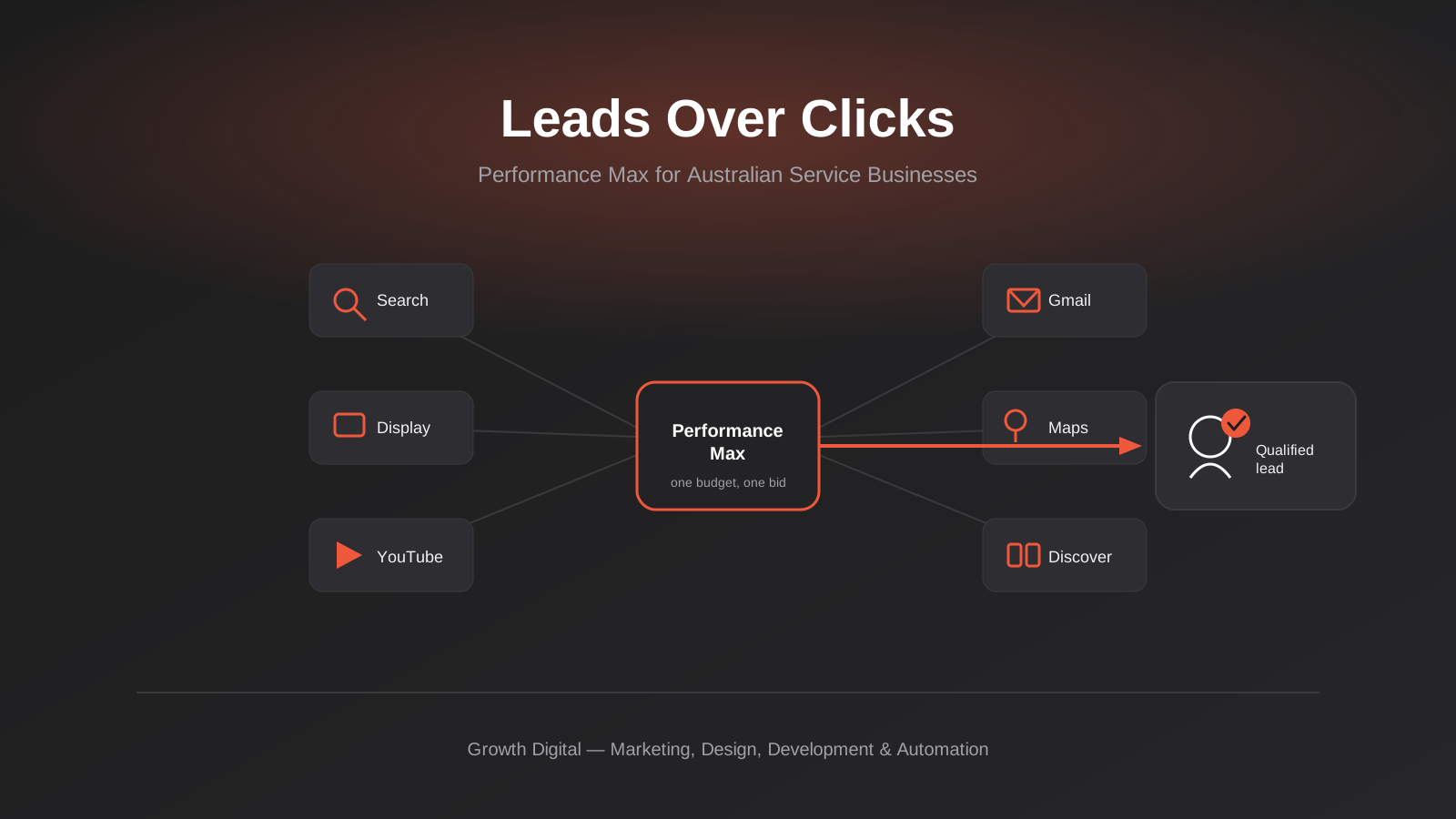
Performance Max for Lead Generation: A 2026 Guide for Australian Service Businesses
Performance Max for lead gen needs different conversion tracking and asset groups than ecommerce PMax. How Australian service businesses should set it…
Microsoft Advertising (Bing Ads) for Australian Businesses: Cost, LinkedIn Profile Targeting and the Google Ads Import Trap (2026)
What Microsoft Advertising actually costs in Australia, how LinkedIn profile targeting works for B2B, and what breaks when you import from Google…
Google Ad Grants for Australian Non-Profits: Eligibility, Application and the Rules That Keep It Alive (2026)
A practical guide to Google Ad Grants for Australian non-profits: who qualifies, how to apply, and the compliance rules that keep the…
Got a project you'd like to talk through?
Tell us what you're working on — we'll come back with a plan.
