
How Much Does Website Maintenance Cost in Australia? A 2026 Price Guide
 Jignesh Vagadiya
29/10/2026
22 min read
Most people price a website once, at the build stage, and then forget that the thing has to be kept alive. Then a plugin update breaks the contact form, or the SSL certificate lapses, or someone in Google Search Console mentions that the site is serving a warning page, and a bill turns up that nobody budgeted for. Website maintenance is the line item that quietly decides whether the money you spent on the build keeps earning or slowly rots.
The trouble with pricing it is that the market is all over the place. Published Australian care plans run from about $30 a month to well over $1,000, and two plans at the same price can cover completely different work. One includes daily off-site backups and a human reading the security alerts; the other is a monthly button-press on the update screen and an invoice. This guide walks through what website maintenance genuinely costs in Australia in 2026, what you should expect each tier to include, what pushes the price up, and how to read a quote so you are comparing like with like.
A note on the numbers. Most published pricing in this space comes from agencies and freelancers selling the service, so the figures below are indicative market ranges drawn from plans and guides those providers publish, not an independent survey. GST treatment also varies between providers, so check whether a quoted number includes it. Where we could not find a defensible figure, we give you the drivers and the questions to ask instead.
What Website Maintenance Actually Costs in Australia
Across the Australian plans and cost guides we reviewed, a standard care plan for a small business website sits somewhere around $100 to $300 a month. That is the figure most owners of a brochure-style site should anchor on. Below that, you are usually buying a stripped-back service. Above it, you are paying for more frequent backups, active monitoring, support hours or a more complicated site.
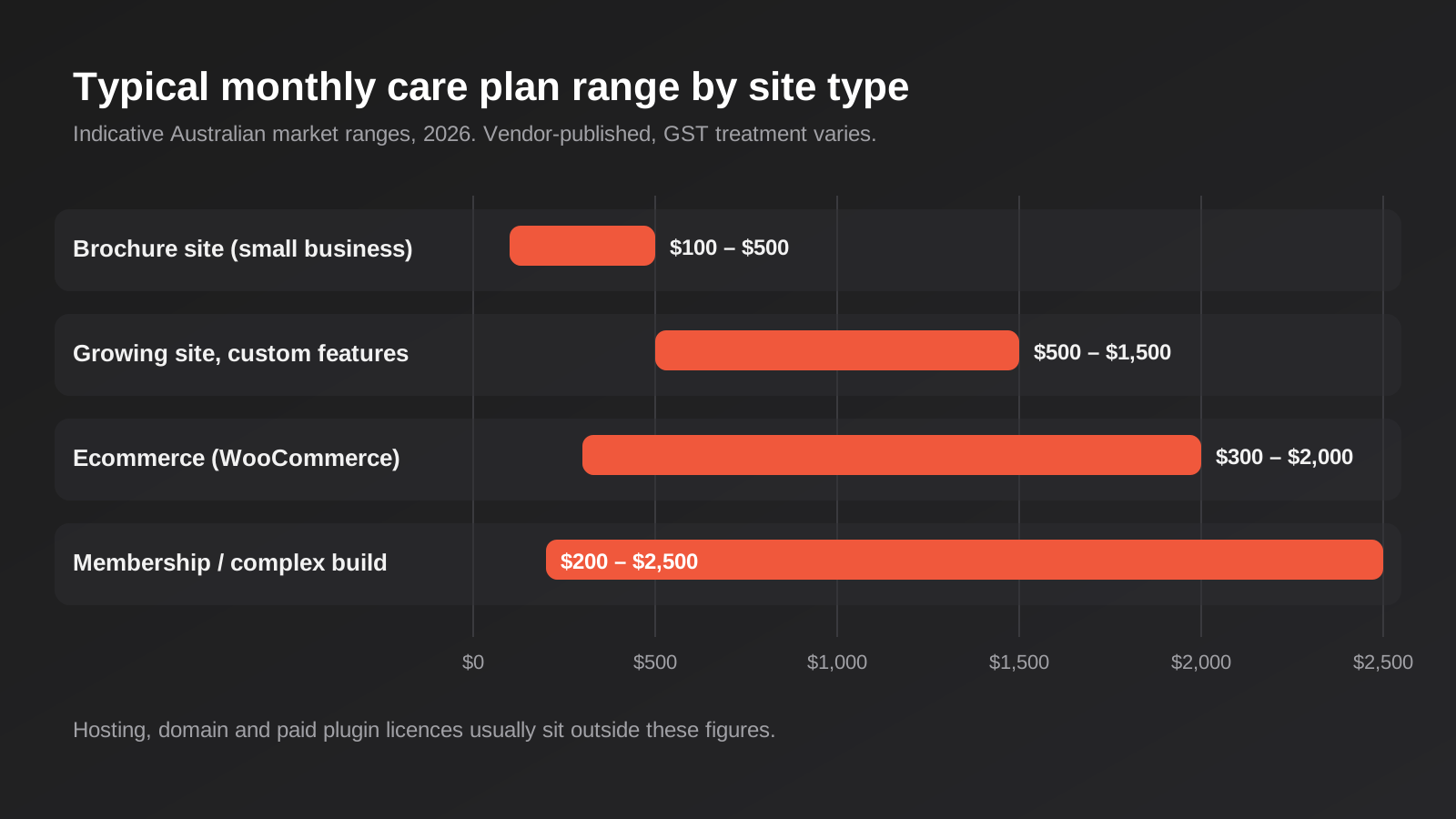
Here is how the published ranges break down by the kind of site you run:
- Small brochure or service-business site: roughly $100 to $500 a month for a proper plan. Budget plans exist from about $30 to $100, and they are worth reading closely because they are often the minimum viable version (more on that below).
- Growing business site with custom features: roughly $500 to $1,500 a month once the site has bespoke functionality, integrations, or content that changes weekly.
- Ecommerce on WooCommerce: published ranges are wide, from a few hundred dollars up to $2,000 a month, and some sources go higher for busy stores. Anything that touches orders and payments needs more attention than a brochure site.
- Membership sites, portals and complex builds: $200 to $2,500 a month for a proper care plan, and enterprise-level arrangements can exceed $10,000 a month.
Another way to sanity-check a quote is to look at it against the build. One Australian guide puts annual maintenance at 15 to 25 per cent of the original build cost. That rule of thumb works better for custom sites than for a template-based site that cost very little to put together, but it is a useful cross-check if a quote looks wildly out of proportion to what the site cost you.
What the entry-level plans really are
You will find Australian plans advertised at $29, $49 and $98 a month. They are not scams, but they are not the same product as a $250 plan. A typical $29 plan covers weekly backups and monthly updates. That is genuine value for a simple site that rarely changes, and a poor fit for anything that takes enquiries or payments, where a failed update on a Tuesday needs fixing on Tuesday rather than at the next monthly cycle.
The mid-range of published plans clusters in the $150 to $400 band: Digitalon lists $149, $199, $399 and $999 tiers, Web Blend starts at $170 plus GST, Chillybin from $147, and 3 Phase Marketing at $195, $495 and $895. The names differ, the structure is the same. You pay more as the backup frequency goes up, as monitoring gets tighter, and as support hours and reporting get added.
One-off fixes cost more than they look
If you do not have a plan, you pay at the moment of failure. Hourly rates for Australian web work in 2026 generally land around $50 to $90 an hour for a mid-level freelancer and $100 to $200 an hour for an agency, and at least one published plan prices on-demand support at $199 an hour. A one-off hacked-site cleanup is quoted in the range of $500 to $3,000 in at least one Australian cost guide, with the final figure depending on how deep the infection goes. Those numbers are one reason a $100 to $200 monthly plan is often cheaper than ad hoc help over a year, especially if the site matters to your revenue.
What a Website Maintenance Plan Should Include
The headline price tells you very little. The line items tell you everything. Here is what a competent plan covers, roughly in the order of how much it matters:
- Core, theme and plugin updates. The unglamorous centre of the service. Ask how often they run, whether they are tested on a staging copy first, and what happens if an update breaks something.
- Off-site backups. Backups stored on the same server as the site are not backups, they are a copy that disappears with the site. Ask where they live, how often they run, how long they are kept, and whether anyone has actually tested a restore.
- Security scanning and monitoring. Malware scans, firewall rules, login protection and someone who reads the alerts. A scanner that emails you a report nobody acts on does not count.
- Uptime monitoring. A check every few minutes that tells you when the site is down, so you hear about it before your customers do.
- Performance and speed checks. Not a rebuild, but a regular look at whether the site is slowing down as plugins and content pile up. If you care about how it scores, our guide to Core Web Vitals explains what is worth fixing.
- Support hours. Small content edits, a new landing page section, a form tweak. Check how many hours are included and what the rate is once you exceed them.
- Reporting. A short monthly summary of what was updated, what was blocked and how the site is performing.
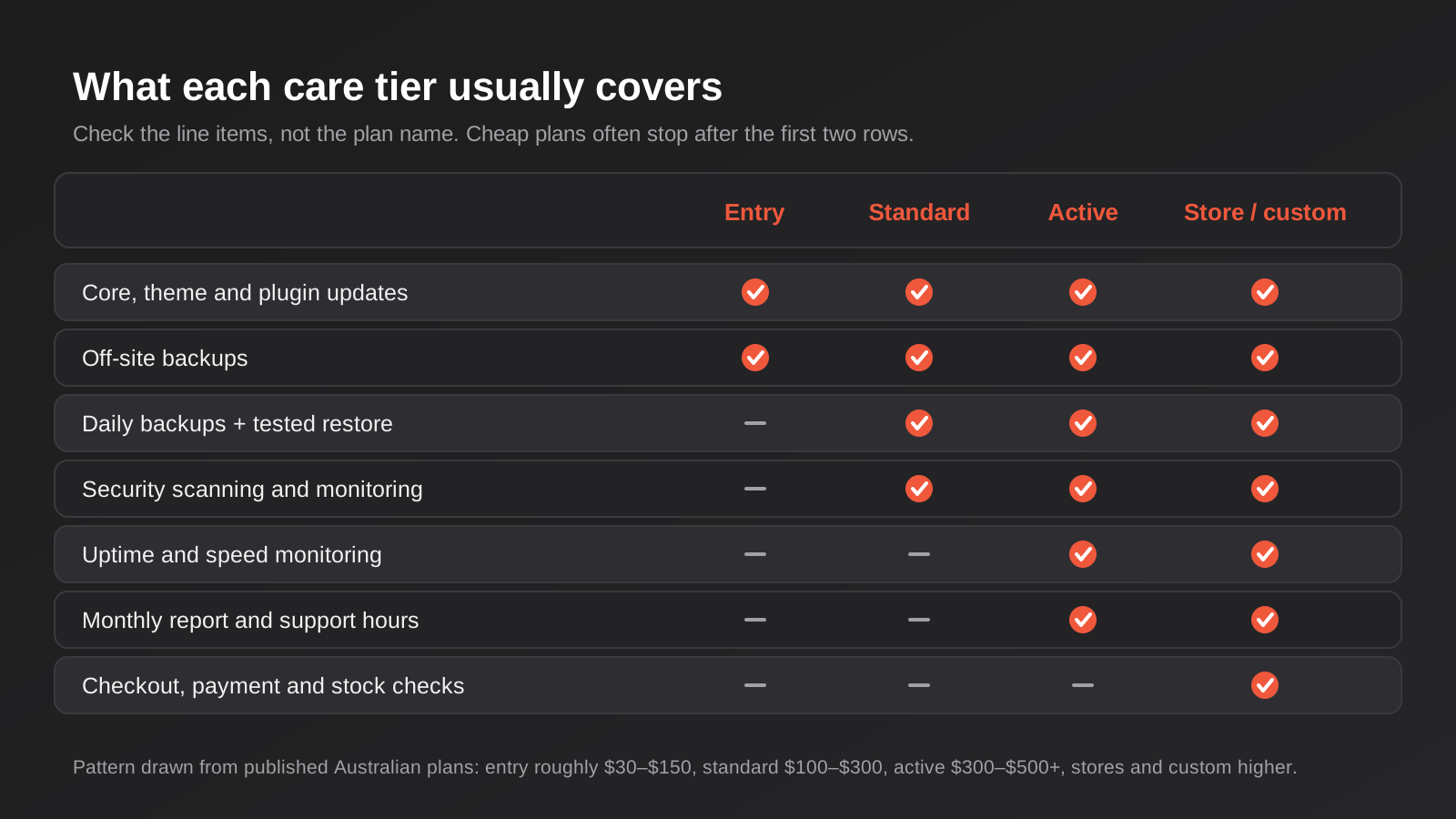
Entry plans usually cover the first couple of items and not much else. Mid-range plans add daily backups, security scanning and monitoring. The higher tiers add support hours, reporting and, for stores, checks on checkout and payment flow. The next diagram shows how that pattern generally plays out.
What Pushes Website Maintenance Costs Up or Down
The platform and how it is built
A small WordPress site built on a well-supported theme with a handful of plugins is the cheapest kind to maintain. Every extra plugin, every custom function and every third-party integration adds something that can conflict with the next update. A site with forty plugins and a heavily modified page builder costs more to look after than a clean build with ten, and a decent provider will say so.
Hosted platforms change the equation again. If you run on Shopify, the platform handles hosting, security patching and core updates for you, so the ongoing work shifts to your apps, theme and content. We cover the build and platform-fee side in our guide to what a Shopify store costs in Australia, and it is worth knowing that a Shopify care plan is a different shape from a WordPress one rather than just a cheaper one.
How much the site changes
A site that publishes weekly, adds products daily or runs campaigns needs more hands-on time than a five-page site that has not changed since launch. More change means more testing, more chances for something to go sideways and more support requests. If your content team is already competent at editing, you need less of that included.
What the site is worth to you when it is down
This is the real driver and the one most people avoid saying out loud. A brochure site that sends you two enquiries a month can sit broken for a day without a disaster. A store taking orders all day, or a booking site that is your main source of leads, cannot. The higher the cost of an hour of downtime, the more it is worth paying for monitoring, fast response times and daily backups with a tested restore.
Response times and who actually does the work
Some plans promise a response within one business day, others within a few hours, and a few offer emergency cover outside business hours. A higher monthly fee often buys the guarantee rather than the labour. Ask who does the work too. A plan delivered by a local developer who knows your site differs from one that runs on offshore automation with a ticket queue, and neither is automatically worse, but they are not the same product.
Compliance and data requirements
If you handle personal information, payments or health data, you may need audit trails, access controls, encrypted off-site backups kept in specific locations and a documented incident process. That is a different scope from keeping a brochure site patched, and it is priced accordingly. Be upfront about it when you ask for quotes, because it changes what a sensible plan looks like.
Costs That Sit Outside the Care Plan
A care plan rarely includes the underlying running costs of the site, and a surprising number of quotes blur the line. Keep these separate in your head:
- Hosting. Australian managed WordPress hosting ranges widely: cheap shared plans advertise a few dollars a month on promotional pricing, managed WordPress plans from local providers commonly run roughly $10 to $50 a month, and higher-performance setups are priced from there up into the hundreds. Introductory rates often rise on renewal, so check the renewal price. We compare options in our round-up of the best website hosting for Australian businesses.
- Domain. A domain name is typically around $20 a year for a common extension, though pricing varies by registrar and extension.
- Paid plugin and theme licences. Many premium plugins (page builders, forms, SEO, security, membership tools) renew annually per site. A heavy site can quietly carry several hundred dollars a year in licences.
- SSL certificates. Free certificates are included by most hosts these days, but some providers still sell them. You should not be paying a premium for a basic certificate.
- Third-party tools. Email marketing, booking software, CRM connectors and analytics tools have their own subscriptions that are unrelated to your care plan.
Who owns these accounts matters as much as what they cost. Hosting, domain and licences should sit in your name, not the agency’s, so you can move provider without negotiating for your own website. A provider who insists on holding the keys is not necessarily dishonest, but you should know that is the arrangement before you sign.
Pricing Models for Website Maintenance
Fixed monthly care plans
The most common model, and the easiest to budget. You pay a set amount each month for a defined list of work, and anything outside it is billed at a stated hourly rate. The risk is paying for hours or services you never use, so check what is actually included and how unused support time is handled. Month-to-month with no lock-in is common among published plans, and for a service this easy to deliver badly, it is worth insisting on.
Hourly or pay-as-you-go
You call when something breaks and pay the hourly rate. For a very simple site this can be cheaper, particularly if you are comfortable doing small things yourself. The downside is that nobody is watching in between. Updates pile up, the site drifts out of date, and the first time anyone looks is when something has already gone wrong. With agency rates at $100 to $200 an hour, a single afternoon of unplanned work can cost more than several months of a plan.
Annual or block-of-hours retainers
Some providers sell a prepaid block of hours, or an annual retainer at a discount to monthly billing. A few of the published plans offer a percentage off for annual payment. This suits sites with predictable ongoing development work alongside maintenance, but it ties up cash and you should check what happens to unused hours.
Bundled with the build or with hosting
Some agencies bundle maintenance into a managed hosting package. That can simplify things, but you should still see each component itemised, so you know what you pay for hosting and what you pay for care. Bundles are also where lock-in tends to creep in.
How to Compare Three Quotes Side by Side
Put the quotes into one table, and for each one fill in the same rows. If a provider has not said, treat it as a no until they confirm.
- Monthly price, and whether it includes GST.
- Backup frequency, location and retention, and whether restores are tested.
- Update frequency, and whether updates are tested on staging first.
- Security scanning, firewall and login protection, and who responds to alerts.
- Uptime monitoring interval.
- Included support hours and the rate beyond them.
- Response time commitments and out-of-hours cover.
- Who owns the hosting, domain and licences.
- Contract length and exit terms, including what you get if you leave.
- What happens if the site is hacked: is cleanup included, capped or billed separately?
The last one separates a real plan from a marketing page. Some providers include cleanup of a hacked site as part of the plan, others charge hourly for it, and the difference can be the $500 to $3,000 range mentioned earlier. If you are comparing a $99 plan against a $199 plan, it is quite possible that the extra $100 is the price of the cleanup being covered.
What a Good Maintenance Quote Should Say
A quote you can rely on is boring and specific. It should name the platform and version, list every inclusion, give the number of support hours and the rate after that, state the response time, and say who holds the accounts. It should describe the backup arrangement in a sentence rather than the word “backups”. It should tell you the notice period for cancelling, and what you receive when you do.
It should also be honest about what is not covered. Fixing a layout problem caused by a new design request, building new pages, rebuilding a broken integration and adding features are all development work, not maintenance, and a clear provider will say where that line sits. If the quote reads as though the plan covers everything and the site never needs paid work again, somebody is being optimistic.
If you want to check what a website build costs before layering a care plan on top, our guide to what a website costs in Australia sets out the build ranges and how to compare those quotes.
What to Expect at Each Business Stage
What you should pay changes as the site goes from a placeholder to a revenue channel. These are not hard rules, just the pattern that falls out of the published ranges.
Just launched, low traffic
A new five or ten page site that mostly acts as a digital business card does not need a heavy plan. A lower-tier plan with off-site backups, regular updates and basic security is a reasonable fit, and the published range for that is roughly $30 to $150 a month at the budget end and $100 to $200 for a plan with daily backups and monitoring. The thing to protect at this stage is the basics: your contact form works, the site loads, and you have a backup somewhere other than the server.
Established, lead-generating site
Once the website is a real source of enquiries, an hour offline costs you leads. This is where the $150 to $500 a month band earns its price: daily backups, security monitoring, uptime alerts and a few support hours a month for small edits. If you are also running paid campaigns or SEO to the site, broken landing pages waste that spend directly. A broken form on a page you are paying to send traffic to is the sort of failure that makes the plan pay for itself.
Store or high-transaction site
For WooCommerce and other transactional sites, the work widens to include checkout testing, payment gateway updates, stock and shipping integrations, and plugin compatibility around anything that touches an order. The published range runs from a few hundred dollars to $2,000 a month, and the spread reflects how much of that checking is manual. If you are weighing platforms partly on upkeep, our Shopify cost guide covers what you pay on the hosted side.
Custom, integrated or regulated sites
Membership platforms, portals, custom plugins and sites wired into a CRM or ERP sit in a different category. The work is closer to software support than website care: monitoring integrations, handling API changes from vendors, managing environments and releases. Published figures for this tier start in the low hundreds and go into the thousands, but they are the least comparable of all, and a scoped quote is the honest answer rather than a price list.
A Realistic Way to Budget a Year
Most owners remember the monthly plan and forget everything around it. A simple way to budget is to add up the four buckets and put them in one place.
- The care plan: 12 times the monthly fee, using a tier that matches how much the site matters.
- Running costs: hosting, domain and certificates, using the renewal price rather than the first-year promotion.
- Licences: paid plugins and themes that renew annually, plus any third-party tool subscriptions connected to the site.
- A contingency for the unexpected: a set-aside for development work that is not maintenance, such as a form rebuild, an integration change or a redesign of a key page.
To make that concrete with market figures rather than anyone’s price list: a small business site on a $150 monthly plan, $30 a month hosting and about $20 a year for the domain lands near $2,200 a year before licences and contingency, which is in line with the 15 to 25 per cent of build cost rule of thumb for a site that cost somewhere around $9,000 to $15,000 to build. For a cheaper template site the percentage will look higher, because maintenance costs do not shrink in proportion to the build. That is an illustration of how the pieces add up, not a prediction for your site.
How to Tell if You Are Overpaying or Underpaying
Overpaying looks like a high fee with a short deliverables list, vague wording about “support”, a long contract, or a monthly figure that has never been reconciled against actual work done. Ask for a short monthly summary of what was updated and what was blocked. If the answer is the same boilerplate every month and nothing about your site in particular, you are paying for a retainer rather than care.
Underpaying is harder to spot because it feels like a saving until it fails. Warning signs are weekly backups on a site that changes daily, no stated response time, no mention of a staging environment, and updates applied straight to the live site without testing. A very low price combined with a promise of “unlimited support” usually means a thin service that gets stretched when you actually need it.
Fair pricing tends to be unexciting. The scope is written down, the hours are defined, the rate beyond them is stated, the accounts are in your name and the contract can be cancelled with a month’s notice. If a provider is comfortable with all of that being written into the agreement, the price is usually the least of your worries.
What You Can Reasonably Do Yourself
Not everything needs to go to a provider, and a good one will tell you so. Content edits, new blog posts, swapping images and updating opening hours are normal tasks for a competent staff member once they are trained, and it makes little sense to pay specialist rates for them. What you should not do yourself is the technical layer: updating plugins on a live site with no backup, changing PHP versions, editing theme files, or touching DNS without knowing what each record does. Those jobs are quick when they work and expensive when they do not.
A sensible split is that your team owns the content and the provider owns everything underneath it. That is also an easy way to bring the plan price down, because you can ask for fewer included support hours if you are not going to use them.
Common Mistakes When Paying for Website Maintenance
- Buying on price alone. The cheapest plan often has the thinnest scope. A $29 plan is fine for a static site and inadequate for a store, and the headline number will not tell you which one you are looking at.
- Assuming hosting includes maintenance. Managed hosting often covers server-level security and sometimes core updates. It rarely covers plugins, themes, testing or anyone looking at your site on your behalf. Ask what the host does not do.
- Never testing a restore. A backup that has never been restored is a hope. Ask for proof that a restore works, at least once a year.
- Letting the agency own the accounts. If the hosting account, domain registrar login or licence keys are in the provider’s name, leaving becomes a negotiation. Keep them in your name from day one.
- Treating updates as optional. Skipping updates saves nothing. Outdated plugins are the usual way small sites get compromised, and cleanup costs far more than the update ever would have.
- Not budgeting for licences. Premium plugins renew every year. Add them to the budget alongside the plan, or the invoice will surprise you.
- Ignoring the exit terms. Long contracts with early-termination fees turn a monthly service into a commitment. Month-to-month is the norm for a reason.
- Paying for maintenance on a site that needs a rebuild. If the site is slow, dated and held together by a dozen unsupported plugins, a care plan keeps a failing asset on life support. Sometimes the honest answer is to replatform or rebuild, and a good provider will tell you that.
- Skipping the question of who responds. A monitoring alert that goes to an inbox nobody reads is not monitoring. Ask who acts on it and how quickly.
Frequently Asked Questions
How much does website maintenance cost in Australia?
For a typical small business website, most published Australian care plans fall between about $100 and $300 a month, with budget plans from $30 to $100 and growing or ecommerce sites reaching $500 to $2,000 or more. The figure depends on how often backups run, how closely the site is monitored, how many support hours are included and how much the site earns for you.
Do I actually need a monthly maintenance plan?
If your site takes enquiries, bookings or orders, yes, in some form. Someone needs to apply updates, keep tested backups and watch for problems. A very simple site that rarely changes can get by on a budget plan or occasional hourly help, but the cost of one outage or cleanup usually exceeds a year of basic care.
Is website maintenance the same as hosting?
No. Hosting keeps the server running and, on managed plans, may handle server-level security and sometimes backups. Maintenance covers the site itself: core, theme and plugin updates, testing, security monitoring, backups you control, and someone responding when something breaks. Some providers bundle the two, but you should see them priced separately.
What does it cost to fix a hacked website?
At least one Australian cost guide puts hacked-site rescue and repair at $500 to $3,000, depending on how deep the infection runs and how clean the backups are. Some care plans include cleanup, while others bill it hourly, so check which applies before you need it. Prevention through regular updates and monitoring is considerably cheaper.
Is maintenance cheaper on Shopify than WordPress?
Usually the platform side is, because Shopify handles hosting, security patching and core updates. Your ongoing work moves to apps, theme changes, content and integrations. You may still want someone to look after those, but the scope is different from patching a WordPress site, and the monthly figure is often lower for a comparable store.
Should hosting, the domain and licences be in my name?
Yes. Keeping hosting, domain registration and paid licences under your own accounts means you can change provider without asking permission, and nobody can hold your site hostage over an invoice dispute. A provider can still manage them for you with delegated access.
Where to Start
Start by deciding what an hour of downtime costs you, because that sets how much cover you need. Then work out what is on the site: the platform, the plugins, the integrations and how often the content changes. With those answers, ask three providers to quote the same scope, using the comparison list above. If you are still at the build stage, our website pricing page sets out what our builds cost, one-time with no monthly licence fee to us, and hosting, your domain and any paid plugins are separate costs that stay in your own name.
Because we run lean as a specialist agency rather than carrying a large account-management layer, our fixed quotes typically come in below the Australian averages covered in this guide. If you’ve already got a written quote from another agency for comparable scope, send it through and we’ll do our best to beat it.
Keep reading
Related posts
How Much Does System Integration Cost in Australia? A 2026 Price Guide
What API and ERP integration really costs in Australia in 2026: market ranges by tier, what drives the price, and how to…
How Much Does a WooCommerce to Shopify Migration Cost in Australia? A 2026 Price Guide
What a WooCommerce to Shopify migration costs in Australia in 2026: real price ranges by store complexity, hidden costs and how to…
How Much Does an AI Chatbot Cost in Australia? A 2026 Pricing Guide
What an AI chatbot costs in Australia in 2026: three pricing tiers, the running costs people miss, and how to compare quotes…
Got a project you'd like to talk through?
Tell us what you're working on — we'll come back with a plan.
