
Google Ads for Real Estate Agencies in Australia: Costs, Targeting and Campaigns That Actually Generate Listings (2026)
 Jignesh Vagadiya
09/09/2026
21 min read
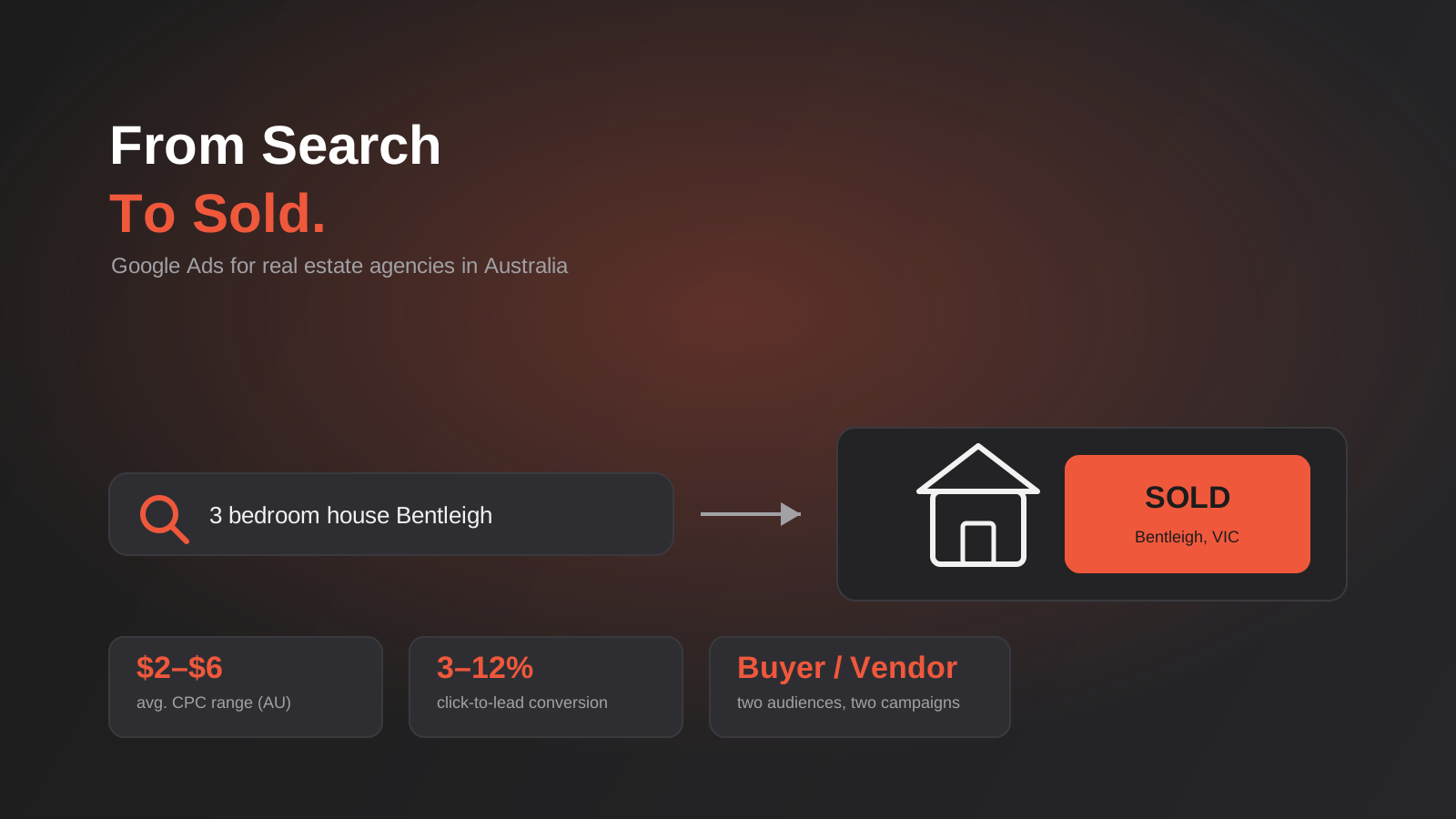
A house goes on the market on a Thursday, gets fourteen groups through the Saturday open, and is under contract by the following Wednesday. The listing that made that happen might have run for nine days. Most Google Ads accounts are built and tuned on a much slower rhythm than that — weekly bid reviews, monthly reporting cycles, campaigns that settle into a groove after a few months of data. Real estate doesn’t give you that luxury. By the time a campaign has “learned” what works, the property it was built around has usually sold.
That mismatch is the real reason so many agency Google Ads accounts underperform, and it’s not really a Google Ads problem at all — it’s a structural one. Buyers and vendors search completely differently, budgets get spent trying to serve both from the same campaign, and half the traffic an agency pays for is chasing a listing that’s already sold subject to finance. We manage paid search for a mix of Australian businesses, and the accounts that come from real estate agencies consistently need a different starting structure to the ones we build for trades, ecommerce or professional services.
This is a practical guide to Google Ads for real estate agencies in Australia: realistic cost-per-click and cost-per-lead numbers, how to structure campaigns around buyers and vendors separately, the keyword and negative keyword lists that stop budget leaking to job-seekers and renters, and where Performance Max genuinely helps versus where it just muddies the water. If you want the broader mechanics of Google Ads — conversion tracking, Smart Bidding, account structure fundamentals — our guide to maximising Google Ads ROI covers that ground in more depth than we’ll repeat here.
Why real estate is a different Google Ads problem
Most industries running Google Ads are selling one thing to one type of buyer. A plumber sells emergency callouts to homeowners. An ecommerce store sells products to shoppers. A real estate agency is running what amounts to two separate small businesses through one Google Ads account — helping people find a home to buy, and helping people find someone to sell theirs — and those two audiences have almost nothing in common beyond both eventually needing a real estate agent.
Two audiences, one account
A buyer searching “3 bedroom house Bentleigh under 900k” is deep in research mode, comparing suburbs, comparing agents’ listings, probably has a pre-approval sitting in their inbox already. A vendor searching “how much is my house worth Bentleigh” or “best real estate agent to sell my house” is making a completely different decision — they’re not comparing properties, they’re comparing agents, and the thing that convinces them is different too: recent sales results, marketing approach, commission structure, local reputation. Send both audiences to the same generic “contact us” landing page and you’ll convert neither particularly well.
The agencies that get real value from Google Ads treat buyer acquisition and vendor acquisition as genuinely separate campaigns with separate goals, separate ad copy, separate landing pages and usually separate budgets. It sounds like more work than it is — in practice it just means not defaulting to one broad “real estate agency” campaign and hoping Google’s automation sorts out the rest.
The listing lifecycle problem
The second thing that makes real estate different is time pressure most other industries don’t deal with. A campaign built around a specific listing has a shelf life measured in weeks, not months. By the time Google’s bidding algorithms have gathered enough conversion data to optimise properly — usually two to four weeks, per Google’s own guidance on Smart Bidding — a hot listing might already be under contract. This is exactly why agency-level (not listing-level) campaigns tend to outperform one-off “boost this listing” campaigns run through ad platforms: an evergreen campaign for “houses for sale in [suburb]” keeps accumulating data and improving, while a campaign built around 14 Smith Street resets to zero every time a new listing goes live.
That doesn’t mean individual listings shouldn’t get paid promotion — a genuinely standout property often deserves it — but it should sit as a smaller, time-boxed layer on top of an always-on agency and suburb-level campaign structure, not replace it.
What Google Ads actually costs for real estate in Australia
Real estate sits in an odd spot on the cost-per-click spectrum. It’s not as brutally expensive as personal injury law or emergency plumbing, but it’s far from cheap, and the range is wide depending on exactly what you’re bidding on. Broad, generic terms like “real estate agent” carry high competition because every agency in the area is bidding on them. Long-tail, suburb-specific and address-adjacent terms cost considerably less and convert at a much higher rate, because the person typing them is further along in their decision.
Cost-per-click benchmarks by campaign type
As a general guide for the Australian market in 2026, expect cost-per-click somewhere in the $2–$6 range for real estate search terms, with branded and hyper-local suburb searches at the lower end and broad, high-competition terms like “real estate agent [city]” pushing toward the top or beyond it in the most contested metro markets. Sydney and inner Melbourne generally carry the highest CPCs of any Australian real estate market; regional centres and outer suburbs are meaningfully cheaper, which is worth factoring into how you set expectations for a multi-branch agency operating across different price tiers.
Those are click costs, not lead costs, and the gap between the two is where most of the real budget conversation should happen. A well-targeted, suburb-specific vendor campaign with a strong landing page can convert clicks to enquiries at somewhere between 3% and 12%, according to industry benchmarking on real estate paid search — wide range, and mostly explained by how well the negative keyword list is doing its job and how relevant the landing page actually is to what was searched. A generic campaign sending every click to the homepage will sit at the bottom of that range or below it; a tightly scoped campaign sending “sell my house [suburb]” clicks to a suburb-specific appraisal page will sit toward the top.
Working out cost per lead
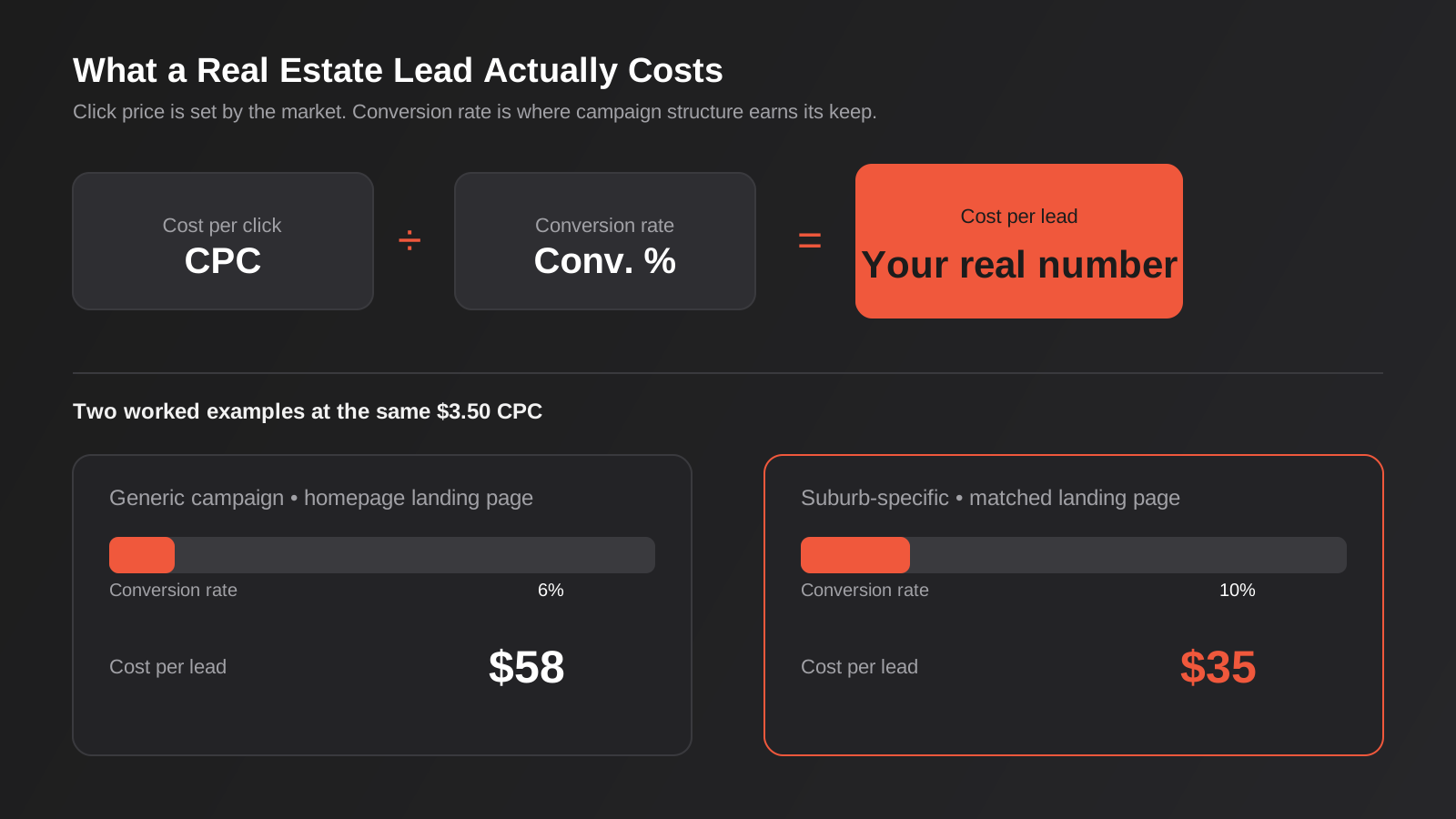
The formula that actually matters for budgeting is simple, even if the inputs take some real data to pin down accurately:
Cost per lead = Cost per click ÷ Conversion rate
At a $3.50 average CPC and a 6% conversion rate, that’s roughly $58 per enquiry. Push the conversion rate to 10% through better targeting and landing pages, and the same click cost drops the cost per lead to $35. This is why campaign structure and landing page relevance matter more in real estate than in almost any other industry we manage — the click price is largely out of your control, but the conversion rate is almost entirely a function of how well-matched the ad, keyword and landing page are to each other. For a deeper breakdown of this and the other formulas worth having on hand — ROAS, break-even ROAS, CAC, LTV:CAC — our PPC formulas reference guide goes through the maths in full.
Setting a realistic starting budget
For a single-office agency wanting a genuine test of Google Ads — enough spend to gather meaningful data within a month or two rather than a token amount that never leaves the learning phase — $1,500 to $3,000 a month in media spend is a realistic starting point, split roughly two-thirds toward vendor acquisition and one-third toward buyer-side visibility, though that split should shift based on which side of the business needs the growth. Multi-office agencies or those in high-CPC metro markets should expect to need considerably more to run separate suburb-level campaigns properly rather than one thin, spread-too-wide account. On top of media spend, budget for a management fee, whether that’s in-house time or an agency — our own Google Ads pricing page breaks down how those fees typically work.
Campaign structure that works for agencies
Once the buyer/vendor split is accepted as the starting principle, campaign structure follows fairly naturally. Here’s the framework we build from for most agency accounts.
Splitting buyer and seller campaigns
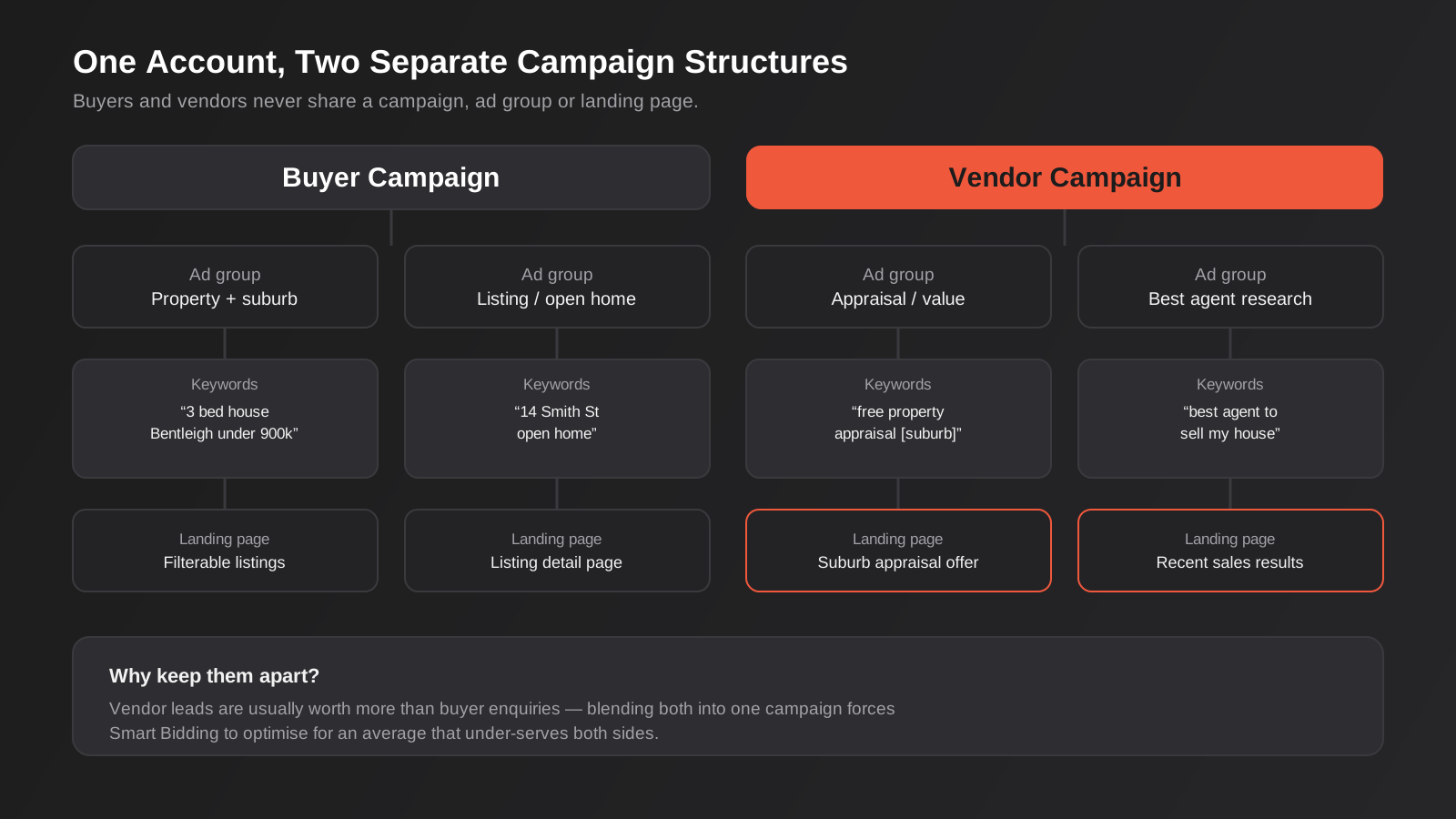
Run two campaigns (or two tightly scoped campaign groups) from the start: one built entirely around people looking to buy, one built entirely around people looking to sell. Each gets its own ad groups, its own keyword lists, its own ad copy and its own landing page. This isn’t just an organisational nicety — it’s what lets you set genuinely different bid strategies and budgets for each side. Vendor leads are usually worth considerably more to an agency than buyer leads (a listing generates ongoing marketing revenue and a commission on sale; a buyer enquiry might just be someone browsing three agencies’ sites in one afternoon), so treating them identically in the bidding algorithm wastes money on both sides.
Suburb-level targeting beats broad metro campaigns
A campaign targeting “Melbourne” broadly competes with every agency in a thirty-suburb radius and burns budget on searches from areas you don’t service. Structuring ad groups (or, for larger agencies, whole campaigns) around the specific suburbs you actually operate in lets you write ad copy that names the suburb directly — which consistently lifts click-through rate, because it signals local relevance faster than generic copy ever can — and lets you set location bid adjustments toward your strongest patches once you have a few months of performance data by suburb.
This matters more in Australian real estate than it might elsewhere, because agency reputation is genuinely hyper-local. An agency that dominates one suburb’s listings has a real trust advantage there that a scattergun metro-wide campaign completely wastes.
Listing ads vs appraisal and vendor ads
Within the buyer campaign, there’s a further split worth making between people searching for property types (“townhouse for sale [suburb]”) and people searching for your specific listings or open homes (“[address] open home” or branded searches for a listing they’ve already seen on a portal). The second group converts far more easily — they already know what they want — and deserves tighter, higher-bid ad groups even though the search volume is small.
On the vendor side, separate general “how much is my house worth” style research queries from higher-intent “best agent to sell my house in [suburb]” or “free property appraisal” queries. The research-stage searches are worth bidding on for brand-building and remarketing list growth, but they shouldn’t be judged against the same conversion rate benchmark as someone actively comparing agents to list with.
Keyword and targeting strategy
High-intent keyword types worth prioritising
For buyer campaigns, the keywords that convert best are usually specific rather than broad: property type plus suburb plus a qualifier (bedrooms, price range, or a feature like “pool” or “renovated”), and address or listing-specific searches for people who’ve already seen a property on a portal and are searching for more information. Broad category terms like “houses for sale” without a location attached are rarely worth the spend — the intent is too vague and the competition is national.
For vendor campaigns, the highest-converting terms tend to combine an action (“sell”, “appraisal”, “value”) with a location and sometimes a timeframe (“sell my house fast [suburb]”). “Free property appraisal [suburb]” and “how much is my house worth [suburb]” are consistently strong performers because they match almost exactly what a vendor is thinking at that stage of the decision, and the offer (a free appraisal) is a low-friction next step that’s easy to convert on a landing page.
Negative keywords that actually save budget
This is where real estate accounts leak the most money, and it’s almost always avoidable. Build a substantial negative keyword list at the campaign level from day one rather than waiting to discover problems in the search terms report weeks later. At minimum, exclude:
- Employment-related terms — “real estate agent jobs”, “how to become a real estate agent”, “real estate courses”
- Rental terms, if you don’t manage rentals — “rent”, “rental”, “for rent”, “apartments to rent”
- Research and education terms that signal early-stage browsing rather than buying or selling intent — “how does real estate work”, “real estate investing for beginners”
- Competitor portal brand terms you don’t want to pay to appear alongside, unless deliberately running a competitive conquesting campaign
- “Free” and “cheap” where they’re attached to services you charge properly for, unless the term is specifically your appraisal offer
Beyond that starting list, the search terms report is where the real negative keyword list gets built — check it weekly for the first month of a new campaign and monthly after that, adding anything irrelevant that’s slipped through on broad or phrase match. Accounts left unchecked for months almost always drift toward lower-intent, more expensive traffic, because Google’s matching systems optimise for spend and reach rather than for your specific definition of a qualified lead.
Audience signals and remarketing for a long consideration cycle
Both buying and selling a home involve genuinely long decision cycles — often months between first search and signed contract — which makes remarketing unusually valuable in this category compared to lower-consideration purchases. Someone who visited a suburb’s listings page three times without enquiring is a stronger remarketing audience than a cold search click will ever be. Layer in-market and affinity audience signals (property-related interests, recent movers, life-event signals where available) onto Search campaigns as observation-only targeting to sharpen bidding, and build a dedicated remarketing audience of site visitors who didn’t convert for a lighter-touch nurture campaign — open home reminders, new listing alerts, market update content — rather than repeating the same hard “enquire now” ad indefinitely.
Ad copy, landing pages and tracking
Landing pages that don’t waste the click
The single most common real estate landing page mistake is sending every paid click to the homepage or a generic “contact us” page. If someone searched “free property appraisal Brighton”, the landing page should be about a free property appraisal in Brighton — ideally with recent local sales results, a clear single call to action, and a form that asks for the minimum information needed to follow up (address and contact details, not a ten-field qualification form that feels like more effort than it’s worth). Buyer-side landing pages perform best as a live, filterable listings view for the specific area or property type searched, not a static “about our listings” page.
This is genuinely a design and development problem as much as a marketing one — building fast, suburb-specific landing pages at scale needs either a well-built CMS template system or dedicated landing page builds. If your current site can’t spin up a new suburb or campaign landing page without a developer ticket, that’s worth fixing before scaling ad spend; our guide on landing page design vs development covers what each side of that actually involves.
Ad copy that outperforms generic real estate copy
Most real estate ad copy reads like every other agency’s ad copy — “your local real estate experts”, “exceptional service, exceptional results” — which means it does nothing to earn the click over a competitor bidding on the same term. Specificity beats polish here. Naming the actual suburb in the headline consistently lifts click-through rate over a generic city-wide claim, because it answers the searcher’s first unspoken question (do these people actually work where I am?) before they’ve even clicked. A recent, real number — days on market, a sale result, listings currently under offer in that suburb — does more work than an adjective ever will, provided it’s genuinely current and you’re comfortable standing behind it.
On the vendor side, the offer matters as much as the copy around it. “Free property appraisal” is a low-friction, specific ask that converts far better than a vague “get in touch” call to action, because it tells the vendor exactly what happens next and that it costs them nothing to find out. On the buyer side, ad copy that references specific property features being searched for (bedrooms, price bracket, land size) rather than the agency’s general value proposition tends to hold attention longer, simply because it matches what the person actually typed rather than talking past it. Test headline variations by suburb rather than assuming one version works everywhere — a script that lands well in a family-heavy suburb often falls flat in an inner-city apartment market, and the data will show that within a few weeks if you’re watching it.
Call tracking and form tracking that reflect reality
A meaningful share of real estate enquiries still happen by phone, particularly on the vendor side where people want to talk through their situation rather than fill in a form. If conversion tracking only counts form submissions, the account is systematically undercounting vendor leads and the bidding algorithm will quietly shift budget away from the campaigns actually producing appraisal calls. Set up call tracking (Google’s call extensions plus a dedicated tracking number, or a third-party call tracking platform) alongside form tracking, and make sure both feed into the same conversion action so Smart Bidding has the full picture, not half of it.
It’s also worth separating conversion actions by value where your CRM allows it — a booked appraisal is worth more than a general enquiry, and a genuine buyer enquiry with a pre-approval mentioned is worth more than a request for a brochure. Value-based bidding needs that distinction to actually optimise toward the outcomes that matter, not just the volume of form fills.
Performance Max and Shopping — do they apply to real estate?
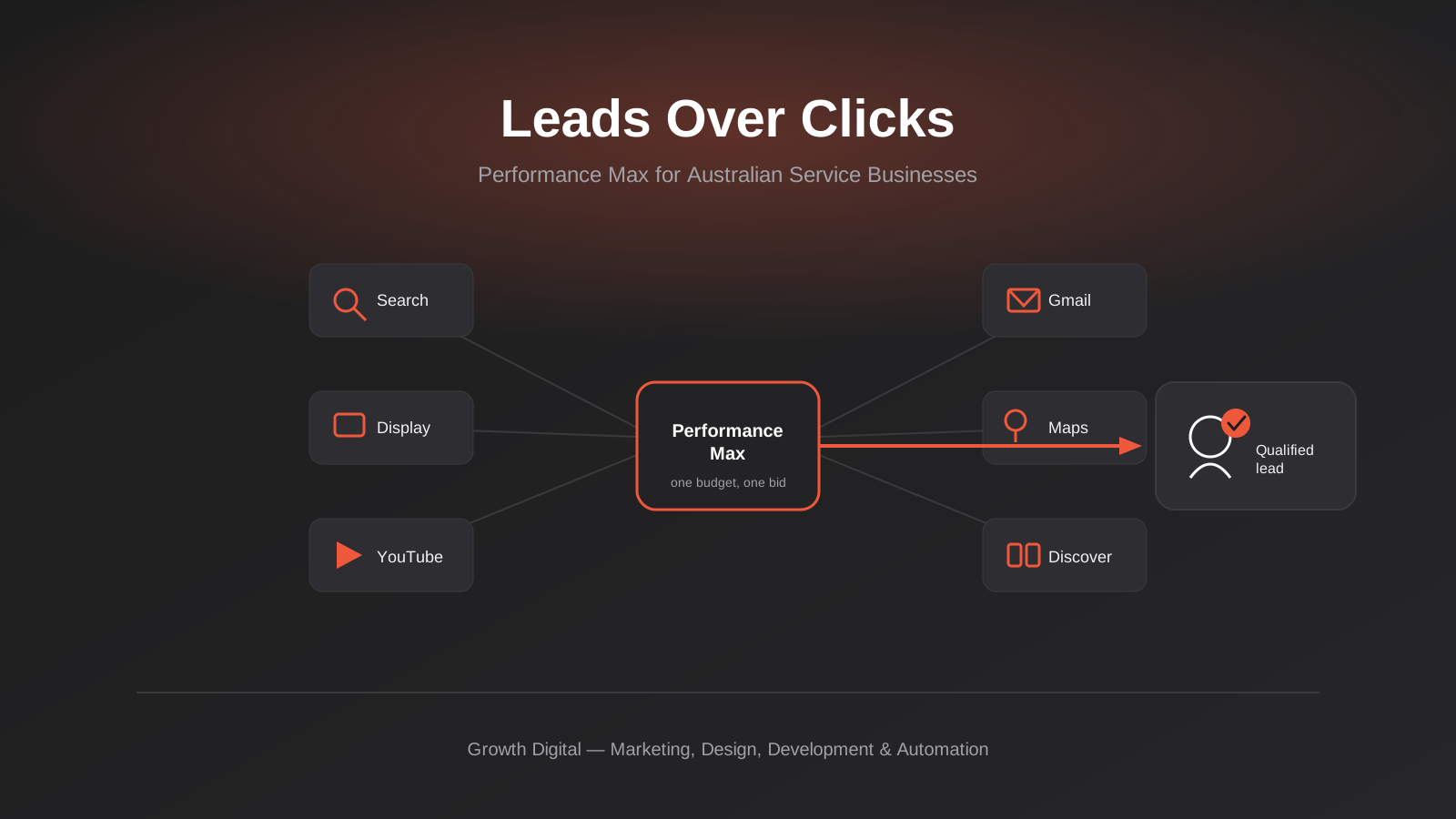
Performance Max can work for real estate, but it needs guardrails that a lot of accounts skip. Because PMax pools Search, Display, YouTube, Gmail and Discover into one automated campaign, it needs enough conversion data to learn from before it performs well — generally two to four weeks minimum — and it works far better once Search campaigns have already established which keywords, audiences and creative actually convert. Turning on PMax as the first and only campaign for a brand-new agency account tends to produce broad, unfocused spend while the algorithm figures out what “a good lead” even looks like.
Where it genuinely earns its place is running alongside an established Search campaign, using strong audience signals (existing customer lists, remarketing audiences, in-market property segments) to give Google’s automation a head start, and with clear asset groups split by buyer versus vendor intent rather than one generic asset group covering the whole agency. Google Shopping doesn’t have a natural fit here — there’s no product feed to run — though some larger agencies experiment with listing feeds through Performance Max’s dynamic remarketing features to show recently viewed properties back to site visitors, which functions similarly to ecommerce dynamic remarketing.
Common mistakes real estate agencies make with Google Ads
- Running one campaign for both buyers and vendors. Different intent, different value, different landing page needs — combining them means the bidding algorithm optimises for an average that serves neither well.
- Sending every click to the homepage. A search for a specific suburb or appraisal offer deserves a landing page that matches it, not a generic contact form three clicks deep in the site.
- Building campaigns around individual listings instead of the agency. Listing-level campaigns reset their learning every time a property sells; an evergreen suburb or agency campaign keeps compounding data and performance.
- Skipping call tracking. If phone enquiries aren’t counted as conversions, the account is bidding on incomplete data and will underinvest in whatever’s actually driving your best vendor leads.
- Bidding broadly on “real estate agent” without a location. High competition, high cost, and it competes with agencies you have no interest in being compared against, in suburbs you don’t service.
- Ignoring the search terms report. Left unchecked, spend drifts toward job-seekers, renters and browsers within a few weeks — a five-minute weekly check catches most of it before it becomes a real budget problem.
- Turning on Performance Max before Search has any data. PMax needs a foundation of conversion history to automate well; used too early it just spends broadly while it learns.
Frequently Asked Questions
How much should a real estate agency budget for Google Ads each month?
For a genuine test with enough data to actually judge performance, $1,500–$3,000 a month in media spend is a realistic starting point for a single-office agency, split toward vendor acquisition first since those leads are usually worth more per conversion. Multi-office agencies or those competing in high-CPC metro markets like inner Sydney or Melbourne should plan for more, particularly if running separate suburb-level campaigns rather than one broad metro campaign.
Should buyer and seller campaigns really be kept completely separate?
Yes, as a rule. Buyers and vendors search differently, respond to different ad copy, need different landing pages, and are usually worth different amounts to the agency. Running them through one combined campaign forces the bidding algorithm to optimise toward an average outcome that under-serves both sides.
Is Google Ads better than Meta Ads for real estate lead generation?
They serve different stages. Google Ads captures people already searching with intent — someone typing “free appraisal [suburb]” has effectively raised their hand. Meta Ads is better suited to building awareness and generating interest among people who weren’t actively searching yet, particularly for listing promotion with strong photography or video. Most agencies that get real value from paid media eventually run both, with Google handling active-intent capture and Meta handling awareness and listing reach.
How long before a new real estate Google Ads account starts producing leads?
Search campaigns can generate clicks and enquiries from day one since they’re capturing demand that already exists — the first one to two weeks are mostly about confirming tracking is accurate and the negative keyword list is catching irrelevant traffic. Give the account four to six weeks before judging cost per lead properly; that’s roughly how long it takes for both the account and Google’s bidding systems to have enough data to be reliable.
Can Google Ads work for a single agent, not just a full agency?
Yes, though the structure needs to scale down sensibly — a single agent doesn’t need six suburb-level campaigns competing for a limited budget. Usually the better approach is one tightly scoped vendor campaign around the agent’s core patch (two or three suburbs, not a whole city), with a smaller buyer-side or remarketing layer once the vendor side is proven out.
What’s the difference between running Google Ads for individual listings versus the agency brand?
Listing-level campaigns promote a specific property and naturally wind down when it sells — useful for a standout property that deserves extra visibility, but they reset all their learning data with every new listing. Agency or suburb-level campaigns (“houses for sale in [suburb]”, “sell my house [suburb]”) run continuously and keep compounding performance data over time, which is why they should form the core of the account, with listing-specific campaigns layered on top as time-boxed additions rather than the whole strategy.
Where to start
If you’re running Google Ads for a real estate agency right now and it feels like it’s producing clicks without producing listings, the fix is rarely “spend more” — it’s almost always structure: separating buyer and vendor intent, tightening the negative keyword list, and making sure the landing page actually matches what was searched. Those changes cost time and attention rather than budget, and they’re usually where the biggest gains sit in an account that’s been running unchanged for a while.
We manage Google Ads for agencies and other property businesses across Australia, and we’re happy to look at an existing account and tell you plainly where it’s leaking before you commit to anything. If you’re starting from scratch, our Google Ads management page covers how we structure and run accounts, and our real estate industry page goes into more detail on how we work with property businesses specifically. Either way, a conversation costs nothing and usually clarifies more than another month of guessing.
Keep reading
Related posts
Performance Max for Lead Generation: A 2026 Guide for Australian Service Businesses
Performance Max for lead gen needs different conversion tracking and asset groups than ecommerce PMax. How Australian service businesses should set it…
Microsoft Advertising (Bing Ads) for Australian Businesses: Cost, LinkedIn Profile Targeting and the Google Ads Import Trap (2026)
What Microsoft Advertising actually costs in Australia, how LinkedIn profile targeting works for B2B, and what breaks when you import from Google…

Google Ad Grants for Australian Non-Profits: Eligibility, Application and the Rules That Keep It Alive (2026)
A practical guide to Google Ad Grants for Australian non-profits: who qualifies, how to apply, and the compliance rules that keep the…
Got a project you'd like to talk through?
Tell us what you're working on — we'll come back with a plan.
