
How Much Does Google Ads Management Cost in Australia? Fees vs Ad Spend Explained (2026)
 Jignesh Vagadiya
12/10/2026
21 min read
A client came to us last year with two Google Ads proposals on the table. One agency wanted $1,200 a month flat. The other wanted 15% of ad spend, which on a $6,000 monthly budget worked out to $900. Same business, same industry, same rough campaign brief — and depending on how the client’s budget moved over the next year, either number could end up being the better deal. Nobody had explained that to them. They’d just been handed two prices and asked to pick.
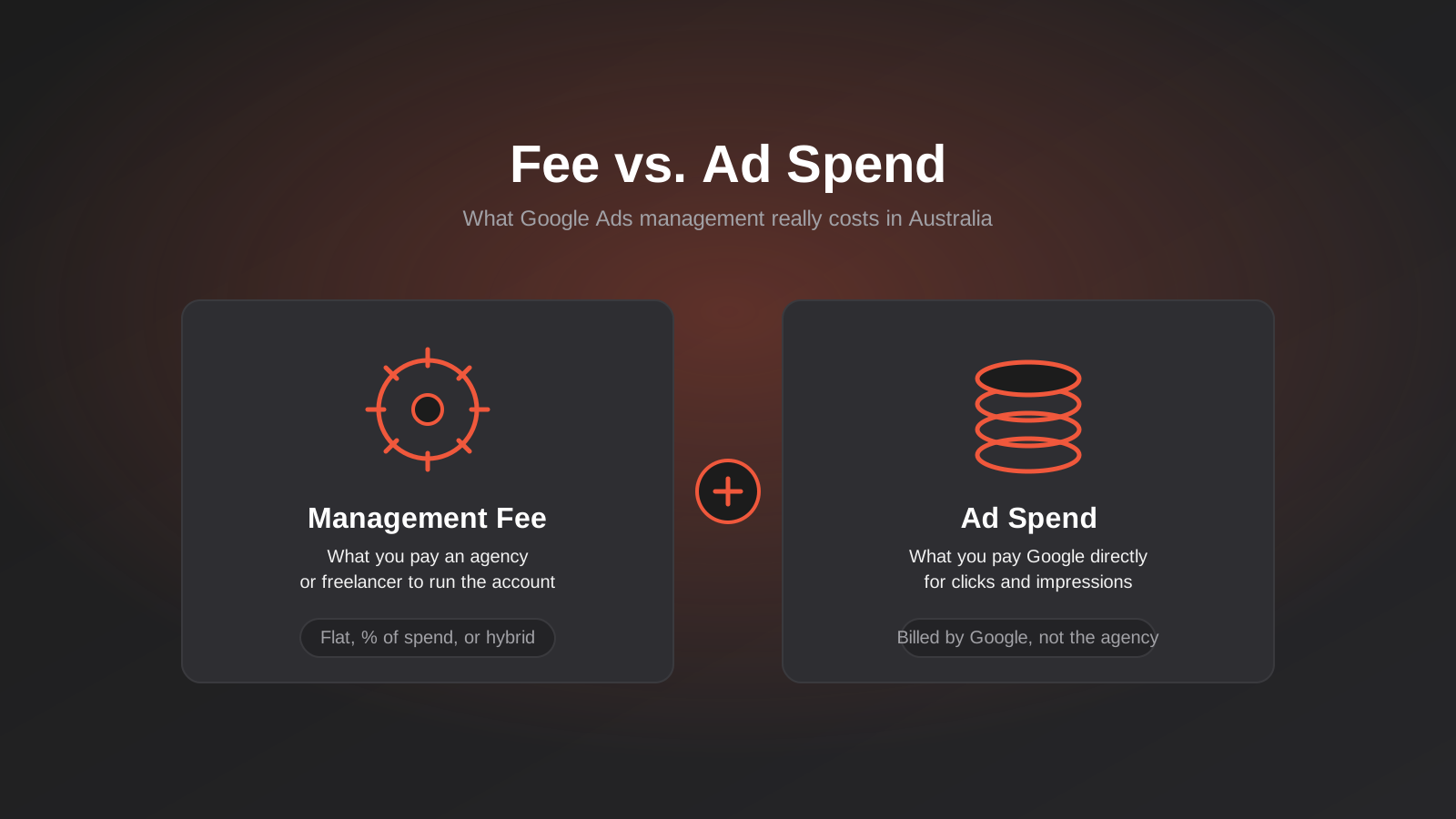
We hear some version of how much does Google Ads management cost in Australia almost every week, and the honest answer is complicated by a problem SEO pricing doesn’t have in quite the same way: with Google Ads, there are genuinely two separate bills. One is what you pay an agency or freelancer to build, run and optimise the account. The other is what you pay Google directly for the clicks and impressions those campaigns generate. Mixing the two up, or assuming a quote covers both, is probably the single most common misunderstanding we see from business owners running ads for the first time.
This guide separates the two numbers properly, sets out what genuinely drives Google Ads management pricing up or down in Australia in 2026, and walks through the pricing models you’ll actually be offered. We’ve left Growth Digital’s own management pricing out of the figures below — you’ll find that scoped against your specific account on our Google Ads pricing page — because the point here is to give you the market context to judge any quote fairly, including ours.
What Google Ads Management Actually Costs in Australia Right Now
Start with the distinction that matters most: management fee and ad spend are not the same line item, and a quote that doesn’t separate them clearly is already a yellow flag. The management fee is what you pay for the work — strategy, campaign build, bid and budget management, ongoing optimisation, reporting. The ad spend is the money Google actually takes for the auction, and it goes to Google whether you’re managed by an agency, a freelancer, or nobody at all.
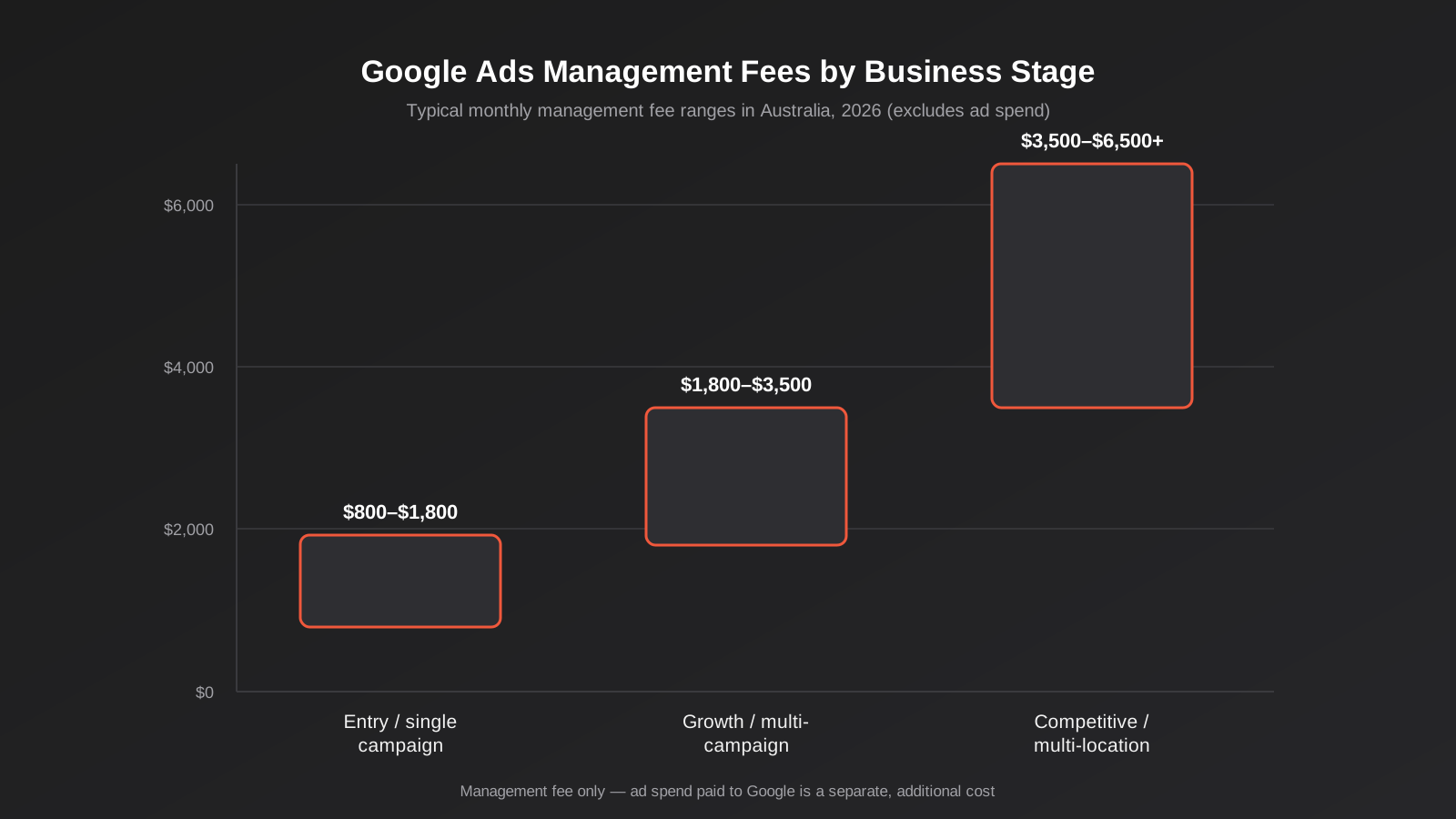
For the management side, most small Australian businesses running one or two campaign types — Search plus maybe a basic Shopping feed — land somewhere between $800 and $1,800 a month in management fees. That buys genuine account oversight: keyword and search term review, bid and budget adjustments, conversion tracking maintenance, and a monthly reporting conversation with someone who’s actually looked at the account rather than skimmed an automated dashboard.
Growing businesses running multiple campaign types — Search, Shopping, Performance Max and maybe a Display or Demand Gen layer — typically sit in a $1,800 to $3,500 a month management band. The jump isn’t arbitrary: more campaign types means more structures to maintain, more creative assets to refresh, and genuinely more hours of strategic attention to keep each channel pulling its weight rather than cannibalising the others.
Competitive categories and multi-location accounts — legal, finance, home services franchises, ecommerce brands running feed-heavy Shopping and Performance Max campaigns across a wide product range — commonly see management fees from $3,500 up to $6,500 a month or more. At this level you’re usually paying for a small team rather than one generalist: someone focused on feed and Shopping health, someone on search and bidding strategy, and genuine account-level reporting tied to revenue rather than clicks.
Outside the monthly retainer, a one-off account audit or campaign build typically runs from $800 to $3,000 depending on account size and how much structural rebuilding it needs, and hourly consulting from a genuine PPC specialist sits roughly between $140 and $300 an hour. None of these figures are a quote you should expect to pay — they’re a sense check, drawn from a mix of published Australian agency pricing and independent cost guides, both of which skew the numbers in different directions and should be read as orientation rather than gospel.
One honest caveat worth sitting with: nearly every published Google Ads pricing figure, ours included, comes from a party with some stake in where that number lands. Agencies publish ranges that make their own pricing look reasonable; independent cost-comparison sites sometimes skew lower to look consumer-friendly. Treat any number you read, on this page or anywhere else, as context for a conversation rather than a price you’re owed.
Management Fee vs Ad Spend: Two Separate Numbers That Get Treated as One
It’s worth labouring this point because so much buyer confusion in Google Ads traces back to it. When a business says “we’re spending $3,000 a month on Google Ads,” that figure sometimes means $3,000 in ad spend plus a separate management fee on top, and sometimes means a $3,000 all-in retainer that includes a chunk of ad spend baked into it. Those are wildly different arrangements, and conflating them is how a business ends up comparing a $1,500 “management fee” quote against a $1,500 “all-inclusive” quote and wrongly assuming they’re the same offer.
Ad spend itself has no fixed floor, but it does have a practical one. Below roughly $1,000 to $1,500 a month in actual spend, most Australian accounts simply don’t generate enough click volume for Google’s auction and your own conversion data to produce a statistically meaningful signal — campaigns stay stuck in a kind of permanent learning phase, bid strategies can’t calibrate properly, and the cost per click you pay ends up less efficient than it would be with a steadier volume of data. This is less a rule than a pattern we see consistently: a business trying to run competitive Search campaigns on $600 a month in spend is usually fighting an uphill battle regardless of how good the management is.
Cost per click varies enormously by industry, and this is where a lot of “Google Ads is too expensive” complaints actually originate — not from bad management, but from a genuinely expensive auction. Ecommerce and retail keywords often sit under $2 a click. Home services and trades usually run $3 to $6. Legal, finance and insurance keywords can run well past $10 a click in competitive metro markets, and some high-intent finance and legal terms push into the $20s. If your management fee looks reasonable but your overall Google Ads bill feels high, it’s worth checking which of the two numbers is actually driving that — a lean management fee paired with an expensive auction is a completely different situation to an inflated management fee on a cheap one.
It’s also worth noting the GST treatment, since it trips people up. Management fees from an Australian-registered agency attract the standard 10% GST, same as any other service. Ad spend billed directly through a business’s own Google Ads account under an Australian billing address also attracts GST, which Google adds to the invoice. Keeping the two separate on your own books, not just on the agency’s invoice, makes it much easier to actually see what you’re paying for work versus what you’re paying for media.
What Drives the Management Price Up or Down
Account complexity is the single biggest lever, and it’s mostly about the number of moving parts rather than the size of the budget. A single-location business running one Search campaign targeting a tight list of service keywords is a fundamentally simpler account to manage than an ecommerce store running Search, Shopping and Performance Max across a product catalogue of several thousand SKUs, even if the two accounts spend a similar amount. More campaign types, more product feeds, more audience segments and more conversion events all add genuine ongoing work, independent of the dollar figure flowing through the account.
Industry and auction competitiveness matter almost as much, because a competitive, high-CPC category simply demands more active bid and budget management to avoid wasting spend. An account bidding on $15 legal keywords needs far tighter negative keyword discipline, search term auditing and bid strategy tuning than an account bidding on $2 retail keywords, because the cost of a wasted click is proportionally so much higher. That extra vigilance is real labour, and it’s one of the more legitimate reasons a legal or finance account’s management fee sits above a trades account of similar spend.
Conversion tracking and data quality is a quieter but significant driver. An account with clean, reliable conversion tracking — proper offline conversion imports if there’s a sales cycle, enhanced conversions, server-side tagging where it’s warranted — gives an agency genuinely useful data to optimise against. An account where conversion tracking is broken, double-counting, or simply absent means a chunk of the early management fee is really being spent rebuilding the measurement foundation before any real optimisation can happen, which is invisible to the client but very real as a cost driver.
Feed management is its own category of complexity for ecommerce accounts specifically. Running Shopping campaigns and Performance Max well depends on product feed health — accurate GTINs, current pricing and stock levels, well-structured product titles and categories feeding through Google Merchant Center. A messy feed with disapprovals and data gaps needs real remediation work that shows up as management time rather than ad spend, and it’s a common reason ecommerce management fees run higher than a similarly sized service-business account.
Finally, the number of campaign types and channels in play multiplies the work roughly linearly, not proportionally to spend. Adding a Display remarketing layer or a Demand Gen campaign on top of Search doesn’t just mean more spend to manage — it means an entirely separate set of creative assets, audience definitions and performance benchmarks to maintain, which is why a business running four campaign types on a modest combined budget can reasonably pay more in management fees than a business running one campaign type on a much larger budget.
Why Quotes for the Same Account Vary So Wildly Between Agencies
Send the same brief to several Australian agencies and the management fee quotes can differ by a factor of three or more, and the gap is rarely about one agency being simply better or worse than another. A handful of structural reasons explain most of it. The first is pricing model mismatch — comparing a flat fee quote against a percentage-of-spend quote without converting both to the same basis tells you almost nothing, because the percentage quote’s dollar value depends entirely on the spend figure it’s calculated against.
The second is how much strategic work is actually bundled into “management.” Some quotes include conversion tracking setup, landing page conversion rate advice and ongoing creative testing as part of the fee. Others treat the management fee as covering bid and budget adjustments only, with everything else billed separately or simply not offered. Two quotes that look close on price can represent genuinely different scopes of service, and the only way to tell is to ask what specifically is included rather than assuming “Google Ads management” means the same list of deliverables everywhere.
The third is account minimum thresholds. Many agencies set a minimum monthly ad spend before they’ll take an account on, often somewhere between $1,500 and $3,000, because below that threshold the management fee needed to do the work properly starts to look disproportionate against the spend itself, and the agency either has to charge a management fee that feels expensive relative to the budget or decline the account. A quote that seems unusually cheap for a small ad spend is worth checking against this reality — it may mean the account is getting far less attention than the quote implies.
The fourth, and the one we’d flag most directly to a business owner comparing quotes: watch for a percentage-of-spend model pitched without a cap or a minimum, on an account where spend is expected to grow quickly. A 15% fee that looks reasonable at $3,000 a month in spend becomes a much larger absolute dollar figure at $15,000 a month, without the actual management workload scaling anywhere near as steeply. That’s not necessarily dishonest, but it’s a structural incentive worth understanding and negotiating against before, not after, your spend grows.
Pricing Models Explained
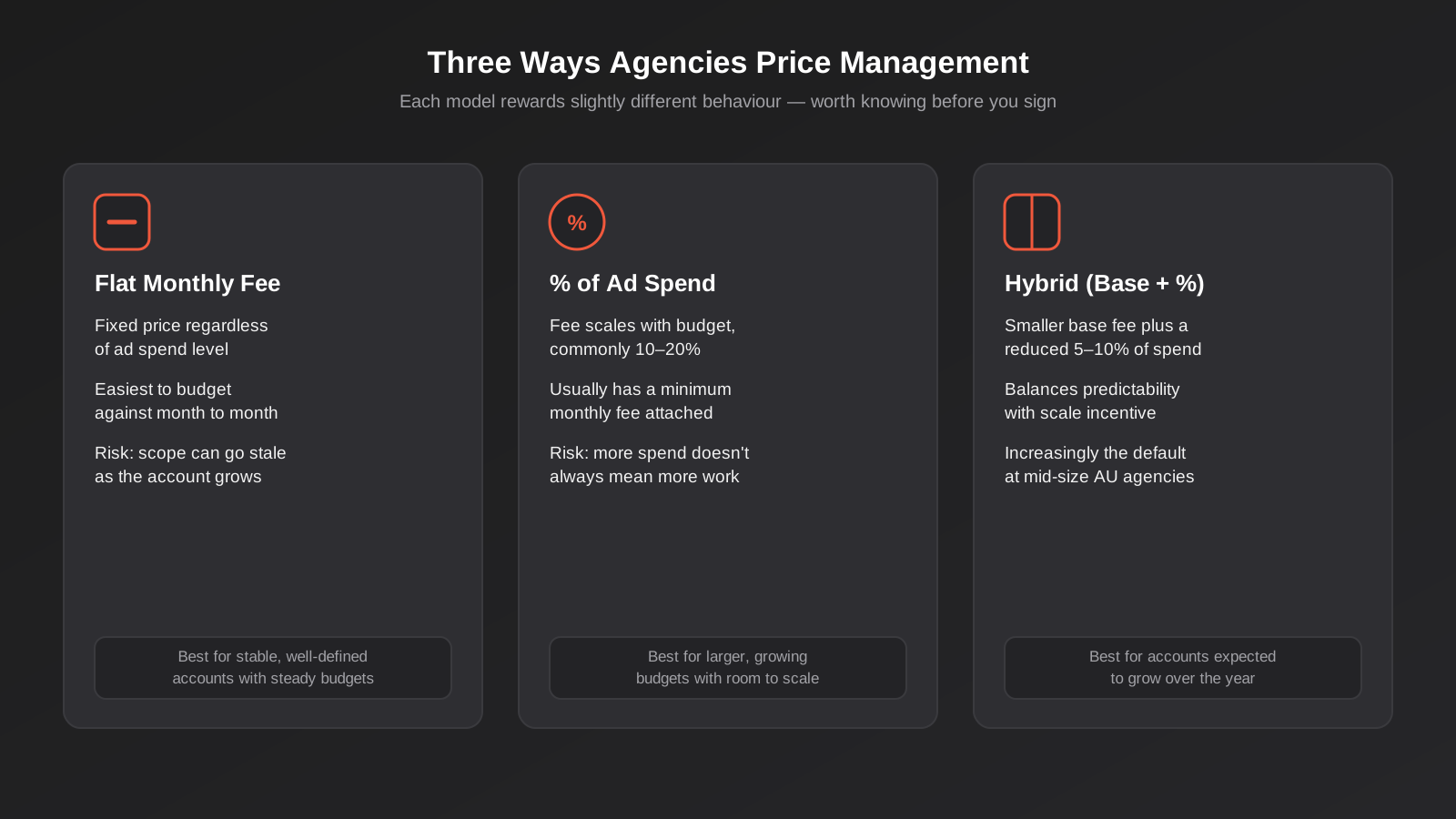
Flat monthly fees are the simplest model to budget against, and they suit accounts with a reasonably stable scope — a consistent number of campaigns, a budget that isn’t expected to swing wildly month to month. The risk sits on the agency’s side more than the client’s in the early months, and on the client’s side later: if the account genuinely grows in complexity — more campaign types, more products, more markets — a flat fee negotiated for a simpler account can quietly become underpriced for the work actually being done, which either erodes service quality or triggers a renegotiation down the track.
Percentage-of-spend pricing, commonly somewhere between 10% and 20% depending on the spend tier, scales naturally with budget and is common at agencies managing a wide range of account sizes. It usually comes with a minimum monthly fee attached, since a 10% fee on a $1,000 spend wouldn’t cover the baseline hours needed to run an account properly. The structural weakness is the one noted above — management workload doesn’t scale linearly with spend, so this model can become expensive relative to actual effort at higher budgets unless it steps down or caps out.
Hybrid pricing — a smaller base fee plus a reduced percentage, often 5% to 10% rather than the full 10% to 20% — has become the more common default at mid-size Australian agencies specifically because it addresses the worst of both single models. The base fee covers the baseline work regardless of spend; the smaller percentage still gives some natural scaling as the account grows, without the fee ballooning disproportionately to the extra workload a bigger budget actually creates.
Hourly or project-based pricing suits narrower, bounded work rather than ongoing management — a one-off account audit, a campaign build before handing day-to-day running back in-house, a Shopping feed cleanup project. It’s a poor fit for sustained optimisation, since there’s no natural “done” point to bill against and the incentive to keep testing and refining disappears once the billable hours run out.
Performance-based pricing, where the fee is tied to leads, cost per acquisition or return on ad spend rather than a flat amount, gets pitched occasionally and deserves real scrutiny. It sounds appealing because it looks risk-free, but genuine performance pricing is uncommon for good reason — results depend on factors well outside pure account management, including your landing page, your sales team’s follow-up speed, your offer, and your market’s seasonality. An agency willing to tie its fee entirely to outcomes it only partly controls has usually built a generous margin into the base structure to absorb that risk, or is planning to optimise toward the easiest version of the metric rather than the version that actually grows your business.
What a Proper Google Ads Management Quote Should Include
A quote worth signing should separate the management fee from the recommended ad spend explicitly, as two distinct numbers, not a single bundled figure. If a proposal gives you one all-in monthly cost without breaking out what portion is work and what portion is media, ask for the split before you compare it against anything else — you can’t judge value for money on a number you can’t decompose.
It should name the campaign types actually included — Search, Shopping, Performance Max, Display, Demand Gen — and which of those are genuinely recommended for your business versus included because they’re part of a standard package regardless of fit. Not every business benefits from every campaign type, and a quote that recommends the same five-campaign-type bundle to every prospective client regardless of their product or sales cycle is a sign of a templated pitch rather than a scoped one.
Conversion tracking setup and ownership should be explicit: what’s being tracked, whether it’s offline conversion import or on-site events only, and critically, who owns the tracking configuration if you leave. Losing access to your own conversion history and tracking setup when switching agencies is a genuinely disruptive, avoidable problem that a clear quote heads off early.
Reporting cadence and content matter as much here as in any other channel. A report built around impressions and clicks alone tells you almost nothing about business impact. A useful report connects spend to conversions, cost per conversion, and ideally to actual revenue or lead quality — not just the volume of clicks an account generated, which is the easiest metric to make look good and the least connected to whether the spend is actually working.
Finally, check for account ownership and access terms. A properly run engagement gives you full admin access to your own Google Ads account from day one, not a sub-account the agency controls and could restrict access to if the relationship ends. If a prospective agency is reluctant to set the account up under your own Google Ads manager account with full visibility, that’s worth raising before signing, not discovering after a dispute.
How to Compare Three Quotes Side by Side
Put every proposal into the same simple table before deciding anything. Down the left, list: the management fee, broken out from any recommended ad spend; the pricing model (flat, percentage, hybrid) and, if percentage-based, the rate and whether there’s a minimum or a cap; the campaign types explicitly included; what’s covered in the fee versus billed separately, such as landing page work or creative production; the reporting cadence and the specific metrics reported; the contract length and notice period; and who actually does the day-to-day work on the account.
Converting a percentage fee to a dollar figure against your actual expected spend is the step people skip most often, and it’s the one that makes an apples-to-apples comparison possible at all. A 15% fee on a $4,000 monthly spend is $600 — compare that figure directly against a competing flat-fee quote of $1,200, rather than comparing “15%” to “$1,200” as if they’re expressed in the same units, because they’re not until you do the conversion.
It’s also worth asking each agency, directly, what they’d recommend for your ad spend specifically, independent of their management fee structure. An agency recommending a spend level that happens to maximise their own percentage-based fee, without a clear rationale tied to your market size and conversion economics, is worth a harder look than one that recommends a spend level and can explain exactly why that figure and not a higher or lower one.
Common Mistakes When Buying Google Ads Management
- Comparing a flat-fee quote against a percentage-of-spend quote without converting both to the same dollar basis, which makes the comparison meaningless.
- Assuming a cheap management fee means a cheap total bill, when the real cost driver might be an expensive, competitive auction rather than the management itself.
- Signing a percentage-of-spend agreement with no cap, then being surprised when the management fee balloons as the business scales up its ad spend for a seasonal push.
- Running ad spend below the level needed for Google’s bidding systems and your own conversion data to calibrate properly, then blaming the management for underwhelming results.
- Not checking who owns the Google Ads account and the conversion tracking history, which can turn a simple agency switch into a messy data-loss problem.
- Judging an account’s first month of performance before the learning phase has settled, which for Smart Bidding strategies and Performance Max campaigns typically takes two to six weeks before results genuinely stabilise.
Frequently Asked Questions
How much does Google Ads management cost in Australia?
Most small Australian businesses pay between $800 and $1,800 a month in management fees for one or two campaign types, separate from ad spend. Growing accounts running multiple campaign types typically see $1,800 to $3,500 a month, while competitive or multi-location accounts commonly run from $3,500 to $6,500 a month or more. Ad spend is always an additional cost on top of these figures, and the two should never be quoted as a single bundled number.
Is Google Ads management fee separate from ad spend?
Yes, and this is the single most common source of confusion for first-time advertisers. The management fee goes to whoever runs your account — an agency or freelancer — for strategy, campaign building and ongoing optimisation. Ad spend goes directly to Google for the actual auction, regardless of who’s managing the account. Some all-inclusive packages bundle a notional ad spend into one headline price, but that’s a packaging choice, not evidence that the two costs are somehow the same thing.
Should I pay a flat fee or a percentage of ad spend for Google Ads management?
A flat fee suits a stable account where spend and campaign complexity aren’t expected to change much, and it’s the easier of the two to budget against. A percentage of spend suits an account expected to scale, since the fee grows roughly alongside the budget, but it’s worth asking for a cap or a declining rate at higher spend tiers, since management workload doesn’t scale as steeply as spend does. A hybrid model — a smaller base fee plus a reduced percentage — is increasingly the more balanced option at Australian agencies for exactly this reason.
What’s a reasonable minimum ad spend for Google Ads in Australia?
Most accounts need somewhere between $1,000 and $1,500 a month in actual spend before Google’s bidding algorithms and your own conversion data have enough volume to optimise reliably, though this varies by industry and cost per click. A legal or finance business bidding on $10-plus clicks needs considerably more spend to generate the same click volume as a retail business bidding on $2 clicks, so the right minimum is really a function of your category’s auction cost, not a flat number that applies everywhere.
Why did two agencies quote such different management fees for the same account?
Usually one of a few structural reasons: the quotes use different pricing models (flat versus percentage) that aren’t directly comparable without converting them to the same basis, they include different scopes of work under the same “management” label, or one agency has a higher account minimum that pushes its baseline fee up regardless of your specific spend. The number alone rarely explains the gap — the deliverable list and pricing structure behind it usually do.
Does a more expensive Google Ads agency get better results?
Not automatically, though a higher fee often correlates with more senior attention and a broader skill set across campaign types, which can genuinely matter for a complex account. Price is shaped by an agency’s cost structure, account minimums and sales process as much as by skill, so a well-scoped mid-range agency focused on fewer accounts can outperform a larger, more expensive one spreading senior staff thin. The clearest signal is whether the agency can explain specifically what they’d do differently on your account and why, not the headline number on the proposal.
Where to Start
If you’ve got Google Ads quotes sitting in your inbox, the fastest useful step is converting every one of them to the same two numbers — management fee and recommended ad spend — before comparing anything else. A quote that can’t be cleanly split into those two figures, or that gets vague when you ask for the split, is telling you something worth noting before you sign.
Our own Google Ads pricing is scoped the same way we’ve described above — against your actual account complexity and spend level, not a flat rate card — and you can see the full scope of what we cover on our Google Ads management page. If you’re weighing Google Ads against an SEO investment instead of alongside it, our guide to SEO vs Google Ads: which should you start with walks through that trade-off directly, and our broader SEO pricing breakdown is useful context if you’re comparing the two channels’ cost structures side by side. You can also see the full range of what things cost across our services on the main pricing page. If you’d rather just send through a quote you’ve already received and get a straight second opinion on what it actually covers, that’s a conversation we’re glad to have, whether or not it ends with us managing the account.
Worth putting a number on it: our own Google Ads management starts from $550 a month plus a one-off setup fee — below the $800–$1,800 a month most small Australian businesses pay in management fees alone. We keep our overheads lean as a specialist agency and pass that saving on. If you’ve already got a written quote from another agency for comparable scope, send it through and we’ll do our best to beat it.
Keep reading
Related posts
How Much Does a WooCommerce to Shopify Migration Cost in Australia? A 2026 Price Guide
What a WooCommerce to Shopify migration costs in Australia in 2026: real price ranges by store complexity, hidden costs and how to…
How Much Does an AI Chatbot Cost in Australia? A 2026 Pricing Guide
What an AI chatbot costs in Australia in 2026: three pricing tiers, the running costs people miss, and how to compare quotes…
How Much Does Custom Software Development Cost in Australia? Build Cost vs Five Years of Licences (2026)
What custom software development costs in Australia in 2026: ranges by project type, integration costs, running costs, and how the build compares…
Got a project you'd like to talk through?
Tell us what you're working on — we'll come back with a plan.
