
Restaurant and Cafe Marketing in Australia: A Practical 2026 Guide
 Jignesh Vagadiya
18/10/2026
20 min read
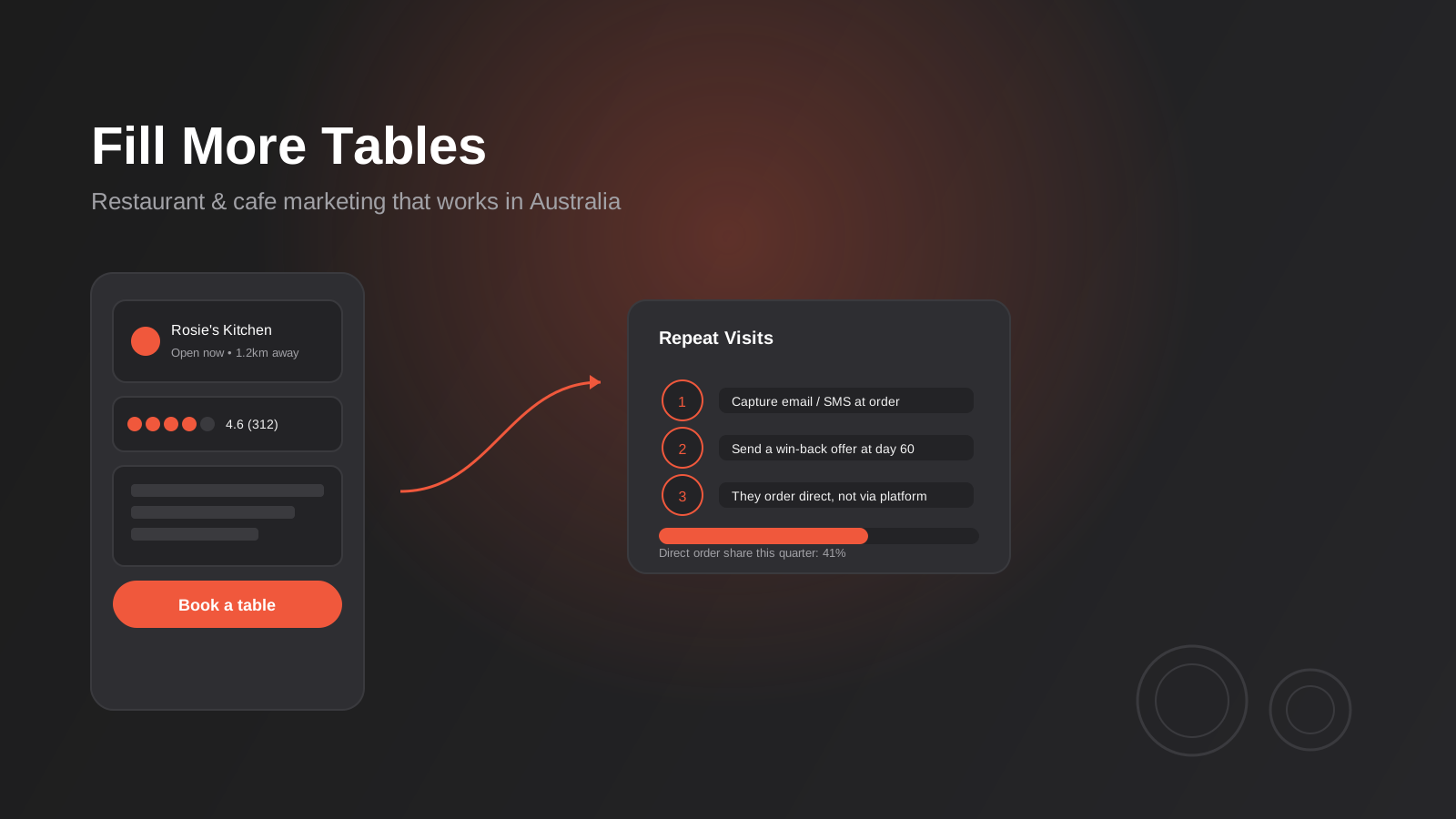
A café in Surry Hills doesn’t lose business because nobody searches for it. Across Australia, something like 368,000 people a month type “restaurants near me” into Google. Add every cuisine-plus-suburb variation and the number of people actively looking for somewhere to eat tonight is enormous. The problem for most restaurants and cafes isn’t visibility — it’s conversion, margin and memory. Whether the people who find you actually book a table. How much of what they spend ends up in your account rather than a delivery platform’s. And whether they come back a second time, or forget your name by Thursday.
It’s a brutal pool to compete in. Café, restaurant and takeaway turnover in Australia sits above $66 billion a year, spread across more than 55,000 venues. Most of them are doing some version of the same five things: a Google listing, an Instagram account, a delivery app presence, maybe a Facebook boost here and there. Good restaurant marketing in Australia doesn’t take a bigger budget than the venue next door. It takes doing the handful of things that actually move bookings and repeat visits properly, instead of doing all of them half-heartedly.
This guide is scoped to food and beverage venues — restaurants, cafes, bars and similar — rather than the accommodation side of hospitality, which has its own very different booking and distribution problems. What follows is specific: what to actually do with your Google Business Profile, your website, your ordering setup, your social content and your repeat-visit marketing, written from what consistently moves the needle for venues rather than generic “post more often” advice.
Why Restaurant Marketing Plays by Different Rules
Most local business marketing advice assumes a considered purchase — someone researching, comparing, deciding over days. Hospitality doesn’t work like that most of the time. Someone decides they’re hungry, or they need somewhere for Friday night, and they make a decision inside a few minutes, usually on a phone, usually influenced more by photos and star ratings than by anything you’ve written about your brand. That changes what’s worth investing in.
The margin problem delivery platforms create
Delivery platforms solve a real discovery problem — people genuinely browse UberEats and Menulog the way they used to browse a drawer full of takeaway menus. But commission rates typically run from the mid-20s to mid-30s in percentage terms once you include marketing fees and payment processing, and the platform keeps the customer relationship, not you. You don’t get their email, their phone number, or any ability to market to them directly next time they’re hungry. Every marketing dollar you spend driving demand to a platform listing is a dollar spent growing someone else’s customer database at a 25–35% discount on your own revenue.
That doesn’t mean come off the platforms. For a lot of venues they’re a genuine incremental revenue stream, particularly for delivery-only dayparts. It means your own marketing should be deliberately pointed at direct bookings and direct ordering, because that’s the channel where every dollar of marketing spend actually compounds into a customer you own.
Reviews move faster, and hurt more, in hospitality
A software company can absorb a bad review quietly. A restaurant can’t. Food, service and atmosphere are judged in real time by people sitting in your dining room with a phone in hand, and a bad Friday night can show up in your Google rating within the hour. Review velocity — how often you get reviewed, not just your average score — is also a meaningful local ranking signal, which means review generation isn’t just reputation management for restaurants. It’s a core part of the SEO and conversion strategy, which is why it gets its own section below rather than a passing mention.
Google Business Profile: The Single Highest-Leverage Asset You Have
We’ve written a full, platform-wide guide to optimising and defending a Google Business Profile that covers the setup fundamentals in depth, so we won’t repeat all of that here. This section is specifically about what changes when the profile belongs to a restaurant or cafe rather than, say, a plumber or a dental clinic.
Menu, photos and attributes that actually drive clicks
The menu link and the attributes section (outdoor seating, licensed, wheelchair accessible, good for groups, dog-friendly) do more conversion work than most owners realise, because Google surfaces these as filterable chips in local search and Maps. A venue with the right attributes ticked shows up in filtered searches a competitor without them never appears in, regardless of ranking position.
Photos matter disproportionately for food businesses specifically. Google’s own data on category benchmarks consistently shows hospitality listings get more photo views, proportionally, than almost any other business category, because people are deciding on food appeal before anything else. The mistake we see most often is photos uploaded once at opening and never refreshed. Seasonal menu items, new fit-outs and event nights should all get new photos added regularly — it keeps the profile active, which Google’s algorithm reads as a signal of a real, operating business, and it gives potential diners current information rather than a photo of a dish you stopped serving eighteen months ago.
Reserve with Google and direct booking links
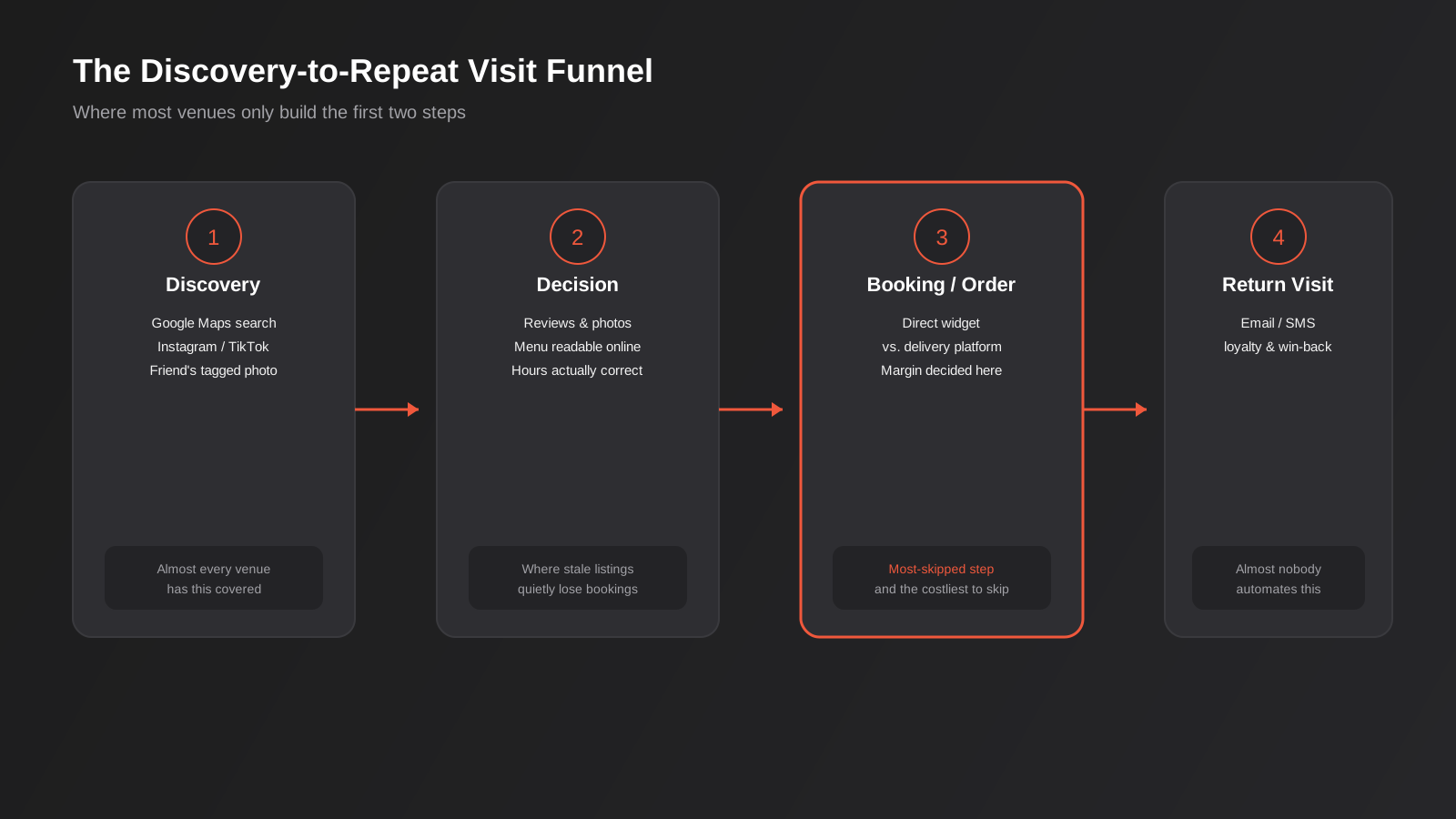
If you use a booking system that integrates with Reserve with Google — most of the major Australian platforms do — turning it on removes a step between someone finding you and someone booked. The alternative is a diner tapping through to your website, hunting for a booking widget, and abandoning halfway because their phone signal dropped out in the Maps app. Every tap you remove between discovery and a confirmed booking measurably reduces the number of people who give up along the way.
Managing review volume without it eating your evenings
The practical system that works for most venues: a short, simple ask at the end of service (a printed QR code on the receipt or at the table works better than a verbal ask, because it doesn’t put staff in the position of fishing for praise) and a response written within 24–48 hours to every review, good or bad. Responding to negative reviews calmly and specifically — acknowledging what went wrong, stating what you’ve changed — does more for a prospective diner reading it later than the original review damages you, because it shows the business is actually run by someone paying attention. Responding to every five-star review with the same copy-pasted “thanks for the kind words!” does very little either way, but leaving them unanswered looks worse than answering briefly.
Local SEO Beyond the Google Business Profile
Your website still matters, even though most of your bookings will come via Google’s local results or a booking platform. Search engines use the website to validate what’s on the profile, and a weak website is one of the more common reasons an otherwise well-reviewed venue underperforms in local rankings.
Put your menu in actual text, not just a PDF or a photo
This is the single most common technical mistake on hospitality websites. A menu embedded as an image or locked inside a PDF is invisible to search engines and to the growing share of searches that pull answers directly into results — someone searching “best gnocchi [suburb]” can’t find a dish that only exists as pixels in a flyer graphic. Put the actual menu text on the page as real HTML content, use a PDF or image as a secondary, printable version if you want one, and add Menu schema markup so search engines and AI answer tools can parse dish names, prices and dietary tags directly.
Suburb and cuisine search patterns
The bulk of hospitality search volume clusters around two patterns: “[cuisine] [suburb]” (“Thai Fitzroy”, “brunch Newtown”) and proximity phrases like “near me” or “open now”. You don’t need to build thin, duplicate location pages to chase this — that’s a trap that gets sites penalised rather than ranked, particularly for a multi-site group tempted to spin up a near-identical page per suburb. What you do need is your homepage and about page naming your suburb and cuisine clearly and naturally in real sentences, not keyword-stuffed headers, plus a genuinely useful page about your neighbourhood, parking or transport if that’s a real decision factor for diners choosing you over the venue two doors down.
For a group running two or three venues under one brand, each location still needs its own Google Business Profile and its own dedicated page rather than a shared landing page with a locations table bolted on — shared pages dilute the local relevance signal each individual listing needs to rank for its own suburb.
Owning Your Ordering, Not Just Renting Someone Else’s
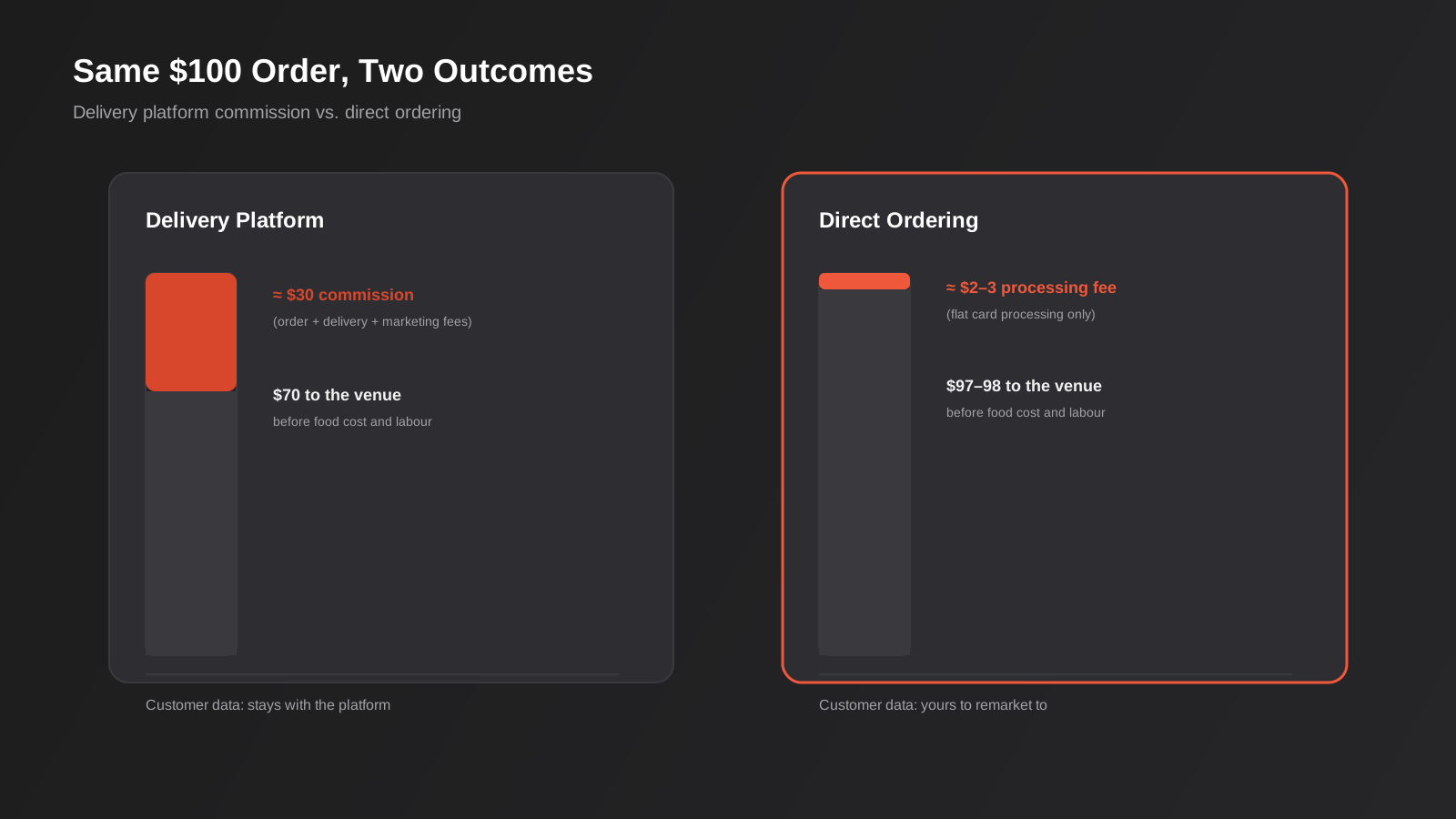
If you take any takeaway or delivery orders at all, the single highest-ROI website change most venues can make is a direct ordering widget — embedded on your own site, taking payment yourself, at a flat processing fee rather than a percentage-of-order commission.
A handful of Australian-friendly direct ordering platforms now plug into most common point-of-sale systems, which matters more than it sounds: if direct orders don’t flow into the same kitchen display and the same stock counts as your dine-in and platform orders, you end up running three separate systems and the kitchen inevitably misses or duplicates something during a busy service. When comparing options, the integration with your existing POS and the ability to sync menu changes in one place — rather than updating your menu in four different systems every time a price changes — matters more than any individual feature on a sales page.
The maths is straightforward on a $100 order. A third-party delivery platform commission, once marketing fees and payment processing are included, typically lands somewhere between $25 and $35. A direct ordering platform charges a flat transaction fee, commonly in the $1–3 range plus standard card processing, regardless of order size. On high-frequency repeat customers — the ones ordering weekly, not once — that gap compounds fast.
The practical way to shift volume without alienating the platforms you still rely on for discovery: print your direct ordering link on receipts, packaging stickers and table signage with a small, genuine incentive (a free side, a loyalty stamp, 10% off) for ordering direct. Don’t undercut your delivery-platform pricing publicly — most platforms prohibit that in their merchant terms — but a loyalty incentive that only exists on your own channel is both compliant and effective.
Social Media and Visual Content That Actually Sells Tables
We’ve covered platform selection and content pillar strategy generally elsewhere; the hospitality-specific question is which platform earns the effort and what you actually post.
Instagram for the venue, TikTok for the dish
Instagram still works best as your venue’s visual storefront — the feed and Stories are where someone checks what the space and food actually look like before they book, functioning closer to a photo-based menu and ambience preview than a discovery engine. TikTok, by contrast, is where food content gets discovered by people who weren’t looking for you specifically. A fifteen-second clip of a dish being plated, a drink being made, or a genuinely busy Friday service has a real chance of reaching an audience well beyond your existing followers, which Instagram’s algorithm increasingly won’t do for non-advertised content. If you’re weighing whether it’s worth the production effort, our guide to TikTok advertising for Australian businesses covers both the organic and paid sides of the platform, including what boosted food content actually costs to run.
User-generated content beats your own camera
A diner’s own photo of their meal, shared and tagged, consistently outperforms venue-shot content on reach and trust, because it reads as a genuine recommendation rather than advertising. The practical lever here is small and cheap: a well-designed table card or coaster inviting a tag, a hashtag printed somewhere visible, and a habit of resharing tagged content to your Stories. Local micro-influencers — food accounts with a few thousand genuinely local followers, not the big national names — are usually a better investment than a single large influencer post, both on cost and on relevance of the audience that sees it.
Paid Advertising: When It Earns Its Keep
Paid ads for restaurants are situational rather than always-on, and that’s the opposite of how most venues treat them.
Google Ads: narrow use cases, not everyday spend
For most single-site restaurants and cafes, Google Ads isn’t worth running as a permanent, always-on channel — your Google Business Profile already captures most of the high-intent local search volume for free, and paying to show up above your own organic listing is often money spent competing with yourself. Where it earns its budget is around specific, time-boxed events: a new opening, a Christmas function push, a Mother’s Day booking window, or catering enquiries, which are genuinely higher-value and lower-volume searches worth bidding on directly.
Meta and Instagram ads for radius-based awareness
Meta advertising earns its place for different reasons: hyper-local radius targeting (reaching people within a few kilometres who haven’t discovered you organically), retargeting website visitors who looked at your menu but didn’t book, and promoting specific events or limited-run menu items where you need reach fast rather than over months. The creative that performs is almost always video — the same short, appetite-driven clips that work on TikTok tend to outperform static photo ads on Meta too.
Budget-wise, most single-site venues get more out of a modest, always-on radius campaign (enough to stay visible to locals, often a few hundred dollars a month) than an occasional large burst. The exception is a genuine event or opening, where a tighter, higher-spend window for two or three weeks makes sense because the goal is maximum awareness in a fixed timeframe, not steady background visibility.
Email, SMS and Loyalty: Turning First-Timers Into Regulars
This is the piece most hospitality marketing skips entirely, and it’s usually the highest-ROI piece available, because it’s marketing to people who’ve already decided they like you once.
Capturing the data is the first hurdle. Wi-Fi login forms, a simple email field on the direct ordering checkout, and a loyalty program sign-up at the till all work, but they need to be genuinely frictionless — a sign-up that asks for five fields will get a fraction of the completions of one that asks for an email and nothing else. Once you have a list, the campaigns that actually earn repeat visits are specific and occasion-based: a birthday month offer, a win-back message after 60–90 days of no visits, a heads-up to regulars before a popular seasonal item sells out. We go into the mechanics of building these flows properly — including which triggers to automate first — in our guide to email marketing automation. For hospitality, SMS tends to win for anything time-sensitive — a last-minute cancellation opening up a table tonight needs a channel people actually open within minutes, and email rarely gets read that fast.
Branding, Menu Design and Signage
A menu is a conversion document before it’s anything else — it’s guiding a decision, usually under time pressure, usually while someone’s also talking to the people they’re with. Layout, hierarchy and photography on a menu genuinely shift what gets ordered: items placed at natural eye-landing points (top of a column, boxed or highlighted) sell more regardless of whether they’re the best dish on the menu, which is exactly why it’s worth deliberately placing your highest-margin items there rather than leaving it to chance.
The same logic extends to signage, packaging and social templates — a consistent, well-designed visual identity across the physical space and the digital one is what makes a venue look established rather than makeshift, which matters more in hospitality than almost any other category because the decision to walk in is partly aesthetic. If your menu, signage and social content are currently each doing their own thing visually, our graphic design work covers exactly this — building a consistent system across print and digital touchpoints rather than a one-off menu redesign that drifts out of sync with everything else within a year.
Keeping It All Running
Hospitality venues change faster than almost any other business type — menus rotate seasonally, hours shift for public holidays, specials change weekly, and a website that can’t be updated quickly becomes actively misleading rather than just outdated. We see this most often with sites built once at launch and never touched again: a diner shows up at 9pm for a kitchen that closed at 8:30, based on hours the website never updated. A website care and support plan that covers these small, frequent updates — hours, menu changes, holiday trading, a new set of photos each season — is cheap insurance against exactly this kind of lost booking, and it’s a different (and much lower-cost) service than a redesign.
Measuring What Actually Matters for a Restaurant
Most venues either track nothing beyond takings, or they track everything Google Analytics offers and drown in numbers that don’t tell them what to do differently next week. A short list of numbers, checked monthly, is more useful than a dashboard nobody opens.
Start with your Google Business Profile insights: searches (how many people found the listing), profile views, and the split between calls, direction requests and website clicks. A venue with strong search volume but a low click-through to calls or directions usually has a photo or review problem, not a visibility problem — people are seeing you and deciding to keep scrolling. That’s a different fix to not being found at all, and it’s worth knowing which problem you actually have before spending on ads to drive more traffic into the same leaky step.
On the website side, the number worth watching isn’t traffic, it’s menu page engagement relative to booking or ordering clicks. If people are reading the menu and leaving, the booking or ordering step has friction worth investigating — too many clicks, a slow-loading widget, or a form asking for more detail than it needs.
For direct ordering and loyalty, the single number that tells you whether the strategy in this guide is working is the direct-order percentage — what share of total order volume comes through your own channel versus third-party platforms, tracked monthly. It’s the clearest proxy for whether marketing spend is actually building an asset you own, or just renting more visibility on someone else’s platform. A venue that moves that number from 20% to 40% over a year has meaningfully changed its margin structure, even if total order volume barely moved at all.
Common Mistakes We See
- Treating delivery platforms as the whole marketing strategy, with no parallel push toward direct bookings or direct ordering that the venue actually owns.
- Letting the Google Business Profile sit untouched after opening week — no new photos, no updated attributes, no response to reviews for months at a time.
- Publishing the menu only as a PDF or image, making it invisible to search and to anyone trying to check a dish or price quickly on their phone.
- Posting on Instagram and TikTok with no plan for what each platform is actually for, so the content is generic and gets ignored on both.
- Running Google Ads as an always-on channel for a single-site venue, competing for clicks the Google Business Profile would have earned for free.
- Never capturing email or phone details from diners, which means every marketing dollar has to find a brand-new customer instead of reselling to an existing one.
- Responding to negative reviews defensively, publicly, or not at all — all three read worse to a future diner than a calm, specific reply.
- Redesigning the menu for looks without thinking about which items the layout is actually pushing people toward ordering.
Frequently Asked Questions
How much should a restaurant or cafe spend on marketing in Australia?
There’s no single rule, but a reasonable working range for an established venue is 3–6% of revenue once you include paid ads, content production and any agency or software fees, trending toward the higher end during a launch period or a slow trading patch. For most single-site restaurants, the bigger lever than raw spend is simply redirecting budget away from boosting delivery-platform visibility and toward owned channels — Google Business Profile, direct ordering and email or SMS — where the same dollar does more.
Is it worth being on UberEats and Menulog if the commission is that high?
For most venues, yes, particularly for delivery-only dayparts or cuisines with genuine delivery demand — the discovery value and incremental order volume usually outweigh the commission cost. The mistake isn’t being on the platforms; it’s having no parallel strategy to shift repeat customers toward direct ordering once they already know and like you, where the margin is dramatically better.
Should a small cafe bother with TikTok, or is that only for big restaurant groups?
Reach on TikTok isn’t follower-gated the way Instagram’s is, which is exactly why small, single-site cafes can and regularly do get disproportionate reach from one genuinely good clip. It takes time and a willingness to post consistently rather than budget, which makes it one of the more accessible channels for a venue without a marketing budget to speak of yet.
How do we get more Google reviews without feeling pushy?
A printed QR code on the receipt or table, asked for consistently rather than only after a great service, outperforms a verbal ask because it removes the social awkwardness for both staff and diner. Timing matters too — asking as someone’s paying, when the meal is still fresh in mind, works better than a follow-up email days later that most people never open.
What should a restaurant website actually include, at minimum?
A real HTML menu (not just a PDF), current hours and location with a working map embed, a direct ordering or booking widget rather than only a phone number, recent photos, and Menu and LocalBusiness schema markup so search engines and AI tools can read the detail correctly. Beyond that, a page about your story or neighbourhood is nice to have but isn’t what’s costing you bookings if it’s missing.
Does email marketing actually work for a restaurant, or is SMS always better?
Both have a role, and they’re not interchangeable. Email works well for anything that isn’t urgent — a monthly newsletter, a seasonal menu launch, a birthday club. SMS wins for anything time-sensitive, like a last-minute table opening up or a same-day special, because open rates within the first few minutes are far higher than email’s. Running both, with SMS reserved for genuinely time-critical messages so people don’t tune it out, tends to outperform relying on either channel alone.
Where to Start
If you’re not sure where your venue is leaking the most value right now, the fastest diagnostic is usually this: check whether your Google Business Profile has had a genuine update (photos, attributes, a response to a recent review) in the last month, check whether your menu exists as real text on your website, and check whether you’re capturing a single piece of contact information from diners who order or book direct. If any of those three come back no, that’s the starting point — not a full rebuild, not a bigger ad budget.
We work with hospitality venues on exactly this mix — Google Business Profile and local SEO, direct ordering builds, menu and brand design, and the email or SMS flows that bring diners back without discounting every single visit. If you’d like a second opinion on where your marketing is actually losing bookings, we’re happy to have a straightforward conversation about it — no pitch deck required.
Keep reading
Related posts
Digital Marketing for Car Dealerships and Workshops in Australia (2026)
Digital marketing for Australian car dealerships and workshops: local SEO, Google Ads, booking flows, and the price-advertising rule every dealer must follow.
Digital Marketing for Australian Manufacturers: Turning Visitors Into RFQs (2026)
How Australian manufacturers turn website visits into RFQs: capability pages, product SEO, LinkedIn Ads for procurement buyers, and quote automation.
Marketing for Recruitment Agencies in Australia: Winning Both Clients and Candidates
Recruitment agencies sell to two audiences at once. How SEO, LinkedIn Ads, job board strategy and compliance need to split between employers…
Got a project you'd like to talk through?
Tell us what you're working on — we'll come back with a plan.
