
Digital Marketing for Car Dealerships and Workshops in Australia (2026)
 Jignesh Vagadiya
24/10/2026
21 min read
A driver’s alternator dies on a Tuesday morning. They don’t open a browser tab and start comparing workshops the way they’d compare life insurance. They type “mechanic near me” into their phone while standing in the driveway, scroll the map pack for ten seconds, glance at the star rating and the number of reviews, and tap the one that looks open now. The whole decision takes less time than it took to read this paragraph.
That’s the moment most automotive marketing in Australia is built around, whether it’s a tyre shop, a European specialist, a mobile detailer or a dealership service department. It’s a different problem to selling someone a new car, where the research stretches over days and involves finance comparisons and model reviews. One business needs to win a ten-second decision made under mild panic. The other needs to be present across a two-week research window that ends in a showroom visit. Treating them the same way — which is what a lot of generic “automotive marketing” advice does — wastes budget on both sides.
This guide splits the two apart properly: what actually drives bookings for workshops and mobile mechanics, what drives vehicle sales for dealerships, where the two overlap (retention, reviews, booking flow), and the specific Australian Consumer Law rule around price advertising that trips up more car dealers than almost any other piece of marketing compliance. We work with independent workshops, specialist mechanics and dealership service departments through our automotive and car care service line, and this is the practical car dealership marketing Australia businesses actually need, not advice recycled from a generic local-business template.
How Australians Actually Search for Cars and Car Care
Lump “automotive” together as one category and you’ll build the wrong campaign for at least two-thirds of your clients. The research window, the decision driver and the channel that actually earns the booking are different depending on what’s being bought.
New-Car Dealerships, Used-Car Dealers and Independent Workshops Aren’t the Same Buyer
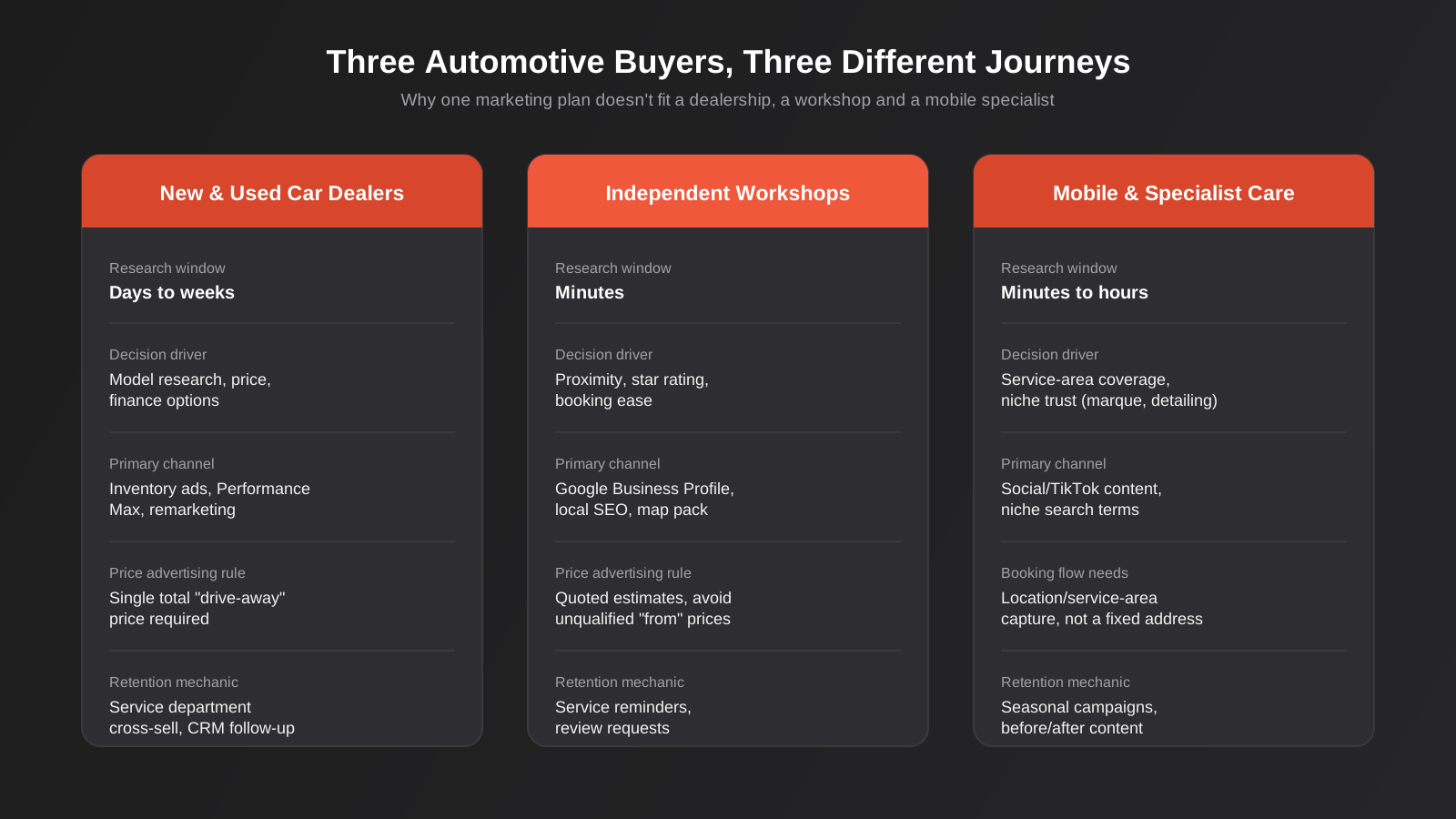
A new or used car purchase is a considered buy. The buyer is comparing models, reading reviews, checking finance rates and often visiting two or three dealers before deciding. That buying journey plays out over days to weeks, and it leans on inventory visibility, remarketing to people who’ve already looked at a specific vehicle, and a website that doesn’t make someone hunt for the drive-away price.
A workshop booking is the opposite. Something’s wrong with the car, or a service is due, and the decision gets made in minutes based on proximity, star rating and how easy it looks to book. Nobody’s reading model comparisons before choosing a mechanic. Mobile mechanics, detailers and niche specialists (a particular European marque, performance tuning, paint protection) sit somewhere in between — the research window is still short, but trust in the specific niche matters more than pure proximity, and the booking flow needs to capture a service area or location rather than assume a fixed shopfront address.
The diagram below lays out how differently those three groups behave, because it changes almost every marketing decision that follows — which channel gets the budget, what the website needs to do, and even how you’re allowed to advertise price.
Why “Near Me” Decides Service and Repair Business
For workshops specifically, the map pack usually shows before any website does. That’s not a guess — it’s how Google structures local service results, and it’s why a car care business with a mediocre website but a strong, well-reviewed Google Business Profile will consistently out-book a competitor with a beautiful site and a neglected profile. If you only fix one thing after reading this guide, fix that imbalance first.
Local SEO and Google Business Profile for Workshops and Dealers
We’ve written a general guide to setting up and optimising a Google Business Profile that covers the mechanics in depth — categories, attributes, posts, the Q&A section. What follows is what’s specifically different for automotive.
Getting the Profile Right for a Workshop
Primary category matters more here than in most industries, because Google treats “Auto Repair Shop”, “Mechanic” and “Car Service” as genuinely different intents, and a mismatched category quietly costs you relevance for the exact searches that would send you work. List every service you actually offer (logbook servicing, brake and clutch work, roadworthy certificates, air conditioning regassing) as services on the profile, not just in a sentence on the website — Google surfaces these directly in search results. Photos matter too: workshop exterior, the service bay, the team, and ideally a few before/after shots of work done. A profile with twelve photos and recent posts reads as active; one with three photos from 2019 reads as possibly closed, even if it isn’t.
Review Generation at the Point of Service
The single highest-leverage habit we see separate workshops that are booked out from ones that aren’t: asking for the review at the moment the customer picks up their car, not three days later by email when the memory of good service has already faded. A text message with a direct review link, sent within an hour of handover, consistently outperforms any automated email sequence sent the next day. If you’re running SMS or email automation for this already, it’s worth checking the timing before assuming the sequence itself is the problem.
Multi-Location Workshops and Dealer Groups
Dealer groups and multi-branch workshop chains run into a specific problem: each location needs to rank for its own suburb without the locations cannibalising each other in search results, and without the site structure creating duplicate-content issues across near-identical location pages. We’ve written a dedicated guide to multi-location SEO for Australian franchises that covers the site architecture and Google Business Profile setup for exactly this situation — it applies directly to a dealer group or workshop chain expanding past a single site.
Google Ads for Automotive: Search, Performance Max and Remarketing
Paid search earns its budget differently depending on which side of the automotive business you’re running.
High-Intent Search Campaigns for Service and Repair
For workshops, search campaigns should be built around the specific job, not the generic category. “Brake pad replacement [suburb]” and “logbook service [suburb]” convert at a different rate to a broad “car service” term, because the person searching the specific job is further along and closer to booking. Call extensions matter more here than almost any other local business type — a lot of service bookings still happen over the phone, especially for anything that sounds urgent, and a Google Ads campaign without call tracking is flying blind on half its actual conversions.
Vehicle Inventory and Performance Max for Dealerships
Dealerships selling vehicles are usually better served running a vehicle inventory feed through Performance Max, which puts specific stock in front of people actively searching for that model, rather than relying solely on generic search campaigns for “car dealership [suburb]”. Getting the feed accurate — make, model, trim, price, availability — matters more than campaign structure here, because a Performance Max campaign is only as good as the data it’s given.
Remarketing to People Who Looked at a Specific Vehicle
Someone who viewed a specific vehicle listing and left without enquiring is a warmer lead than almost anyone a cold campaign could reach. Remarketing with that exact vehicle (or close alternatives if it’s since sold) back to them is one of the more reliably efficient things a dealership can run, and it’s routinely under-used because it takes a bit more setup than a standard campaign.
Website and Booking Experience That Converts
A near-me search or a Google Ads click only pays off if what happens next doesn’t lose the customer.
Booking and Quote Flows Built for How People Actually Book
For a fixed workshop, that means a booking or quote-request form that works properly on a phone, asks for the minimum needed to triage the job (rego or vehicle details, the issue, preferred day), and doesn’t force a phone call to confirm something the form could have captured. For mobile mechanics, detailers and roadside services, the form needs to capture location or service area up front — a booking flow built assuming a fixed shopfront address will quietly turn away exactly the customers a mobile business depends on. This is a landing page and conversion problem as much as it’s a booking-software problem, and it’s worth treating the two together rather than bolting a third-party booking widget onto a page that was never designed around it.
Trust Signals Before Someone Hands Over Their Keys
Handing a car over to a stranger is a small act of trust, and a website that doesn’t acknowledge that loses bookings it should have won. Transparent indicative pricing (even a realistic range for common jobs), visible certifications and insurance, genuine photos of the premises and team, and reviews displayed on the page itself rather than only on Google all reduce the hesitation that causes someone to close the tab and call a competitor instead. None of this needs to be elaborate — it needs to be true and visible above the fold, not buried on an “About Us” page nobody reaches.
Finance and Trade-In Tools for Dealership Websites
For dealerships specifically, a simple repayment estimator or trade-in value form does more conversion work than another paragraph of brand copy. These don’t need to connect to a live finance API to be useful — even an indicative calculator that captures a lead while giving the buyer a genuinely useful number is worth building properly. They’re usually best built as a dedicated, fast-loading landing page rather than bolted onto an existing template, because a calculator buried three clicks into a generic page gets a fraction of the engagement of one that’s front and centre on the page a Google Ads campaign actually sends traffic to.
The Advertising Rule You Can’t Ignore: Price Advertising for Vehicles
This is the one piece of this guide that’s genuinely legal, not just tactical, and it catches dealers more often than almost any other compliance issue in Australian marketing.
The Single Total Price Rule
Under the Australian Consumer Law, if a car dealer advertises any component of a vehicle’s price — the cash price, say — they must also show a single, prominent total price that includes every fee and charge known at the time of advertising: on-road costs, dealer delivery, statutory charges, the lot. In practice this is the “drive-away” figure, and it’s meant to stop a vehicle looking cheaper in an ad than it actually is once the add-on costs land. The ACCC has taken Federal Court action against dealers over exactly this in the past, and it remains one of the more actively enforced pieces of advertising law in the sector. If your current ads, website or showroom signage show a price without a matching total drive-away figure sitting right next to it, that’s worth fixing before it’s someone else’s job to point out.
What This Means for Workshops Rather Than Dealers
Workshops aren’t bound by the exact same used-vehicle pricing rule, but the same underlying principle in the Australian Consumer Law applies: don’t advertise a price that misleads about what the job will actually cost. An unqualified “brake service from $99” that routinely turns into $350 once parts and labour are added is the kind of claim that invites a complaint, even if no regulator ever gets involved — customers remember being misled, and they leave the review that says so. Quoted estimates with a clear “subject to inspection” caveat protect both the business and the customer far better than a headline number designed purely to win the click.
State Licensing and Claims Worth Checking Before You Run With Them
Motor dealer and repairer licensing sits with the states rather than the Commonwealth, and the specifics — what a used car dealer must disclose, how a used vehicle statement or data sheet needs to be presented, cooling-off arrangements in some states — vary enough that it’s worth checking your own state regulator’s current requirements rather than assuming a rule that applies in one state carries over to another. The same caution applies to marketing claims like “roadworthy”, “accident-free” or “one owner”: these are statements of fact a buyer can hold you to, and in a dispute the business making the claim usually carries the burden of showing it was true at the time. None of this needs to slow marketing down, but it’s worth a conversation with whoever handles your dealership’s compliance before a new ad campaign repeats a claim nobody’s actually verified.
What Car Dealership Marketing Australia Actually Costs
Automotive quotes vary more than almost any other category we see, partly because “automotive marketing” covers everything from a one-person mobile mechanic to a multi-site dealer group, and partly because some agencies price a generic local-business package and simply relabel it for cars.
Realistic Ranges
For an independent workshop or small specialist, ongoing local SEO — Google Business Profile management, on-page work, citations, review strategy — typically runs somewhere between $800 and $2,500 a month depending on how competitive the local market is and how many services and locations are involved. Google Ads management for the same kind of business usually sits between $600 and $2,000 a month in fees, on top of whatever’s actually spent on ad clicks. Dealerships running inventory feeds, Performance Max and remarketing at scale pay more for management, simply because there’s more to build and monitor, but the fee should scale with genuine account complexity, not just with a bigger invoice for the same tier of work. A one-off booking form or finance calculator sits outside a monthly retainer entirely and is usually quoted as a fixed project cost once the scope is clear.
Realistic Timelines
Google Business Profile fixes tend to show movement fastest — sometimes within a few weeks for category and photo corrections, since the profile is already indexed and ranking, just not optimally. Broader local SEO, including the website’s own content and link profile, typically takes two to three months before the improvement is clearly visible in rankings and call volume, and keeps compounding from there. Google Ads can show results immediately, though the first few weeks are usually spent on the campaign learning what actually converts, which is why judging a new account on its first fortnight rarely tells you much. Anyone promising first-page rankings within days is either describing paid ads rather than SEO, or not being straight with you.
Turning One Service Into the Next: Retention Automation
A car needs attention again in months, not years, which makes automotive one of the better categories for automation to actually show up on the bottom line — if it’s built around the real cycle of a customer relationship rather than treated as a one-off acquisition channel.
The Loop That Actually Repeats
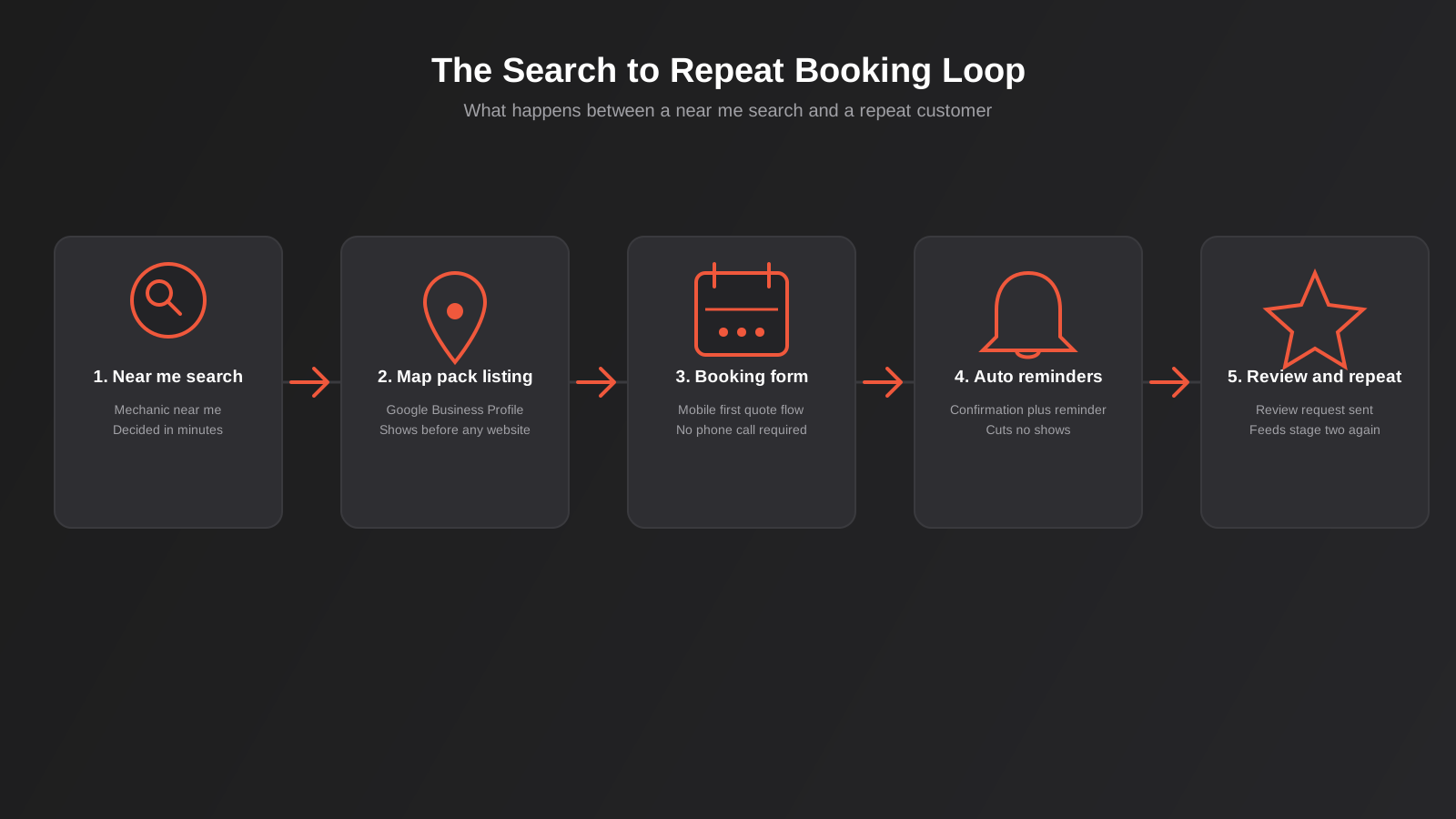
The diagram below shows the full loop, from the first near-me search through to the point where a happy customer’s next service reminder brings them straight back — without anyone needing to remember to call them.
What’s Worth Automating First
Three things, roughly in this order of return: booking confirmations and reminders (these alone noticeably cut no-shows, since most no-shows are forgetting, not changing their mind), service-interval reminders timed to the actual vehicle rather than a generic calendar cadence, and the review request sent right after handover rather than days later. A proper CRM and sales automation setup makes all three far less fragile than a collection of spreadsheet reminders someone has to remember to run — and it’s also what lets a dealership’s service department cross-sell back to the sales side without the two teams working off separate systems.
For a dealership specifically, that cross-sell link matters more than it sounds: a customer who bought a car eighteen months ago and is now overdue for a service is a warmer lead for an upgrade conversation than almost anyone a fresh campaign could reach, but only if the sales team actually sees that the service department just had them in for a brake job last month. Keeping those two records in one system, rather than one in the dealer management software and one in a separate booking tool nobody else can see, is a small structural fix that pays for itself fairly quickly once it’s in place.
Specialist and Niche Automotive Marketing
Not every automotive business is competing purely on proximity, and treating a specialist as a generic workshop undersells what actually makes them worth choosing.
Niche Positioning Beats Generic Automotive Copy
A European marque specialist, an EV-certified workshop, a classic car restorer or a pre-purchase inspection service is competing on expertise and trust in a specific niche, not on being the closest option. That means the keyword targeting should reflect the niche directly — “BMW specialist [suburb]” or “EV service centre [suburb]” rather than generic “mechanic [suburb]” terms — and the website copy needs to demonstrate specific expertise rather than reuse the same trust-signal language every other workshop uses. A generic tyre shop and a classic Porsche restorer shouldn’t read like the same business with the signage swapped, and search engines increasingly reward the one that actually reads like a specialist.
Where TikTok Actually Fits
Dealers and workshops often dismiss social media as irrelevant to a “near me” business, and for pure local search it mostly is — but for specialist and niche automotive businesses, it’s doing a different job entirely: building the kind of trust that proximity alone can’t. A European specialist, a detailing business, a performance workshop or a classic car restorer has an audience that genuinely enjoys watching the work — before/after detailing transformations, a tricky diagnostic explained simply, a restoration in progress. That’s exactly the kind of content that performs on platforms built around short, visually satisfying video, and it’s a channel most workshops haven’t touched yet, which also means less competition for attention than an already-crowded Meta feed. If this is a genuinely new channel for your business, our TikTok Ads guide covers how targeting and campaign structure work in an Australian context before you commit budget to it.
Common Mistakes We See
- Treating a workshop and a dealership as the same marketing problem, when the research window and decision driver for each are almost opposite.
- Letting the Google Business Profile go stale — old photos, unanswered reviews, wrong hours — while investing in a website redesign that barely anyone sees before the profile does.
- Asking for reviews by automated email days after service instead of by text message at handover, when the moment of genuine goodwill has already passed.
- Advertising a vehicle’s cash price without a matching total drive-away figure, which is both a compliance risk and, independent of that, a trust problem once a buyer discovers the real number.
- Building a booking form that assumes a fixed shopfront address for a mobile or roadside service, so the form itself turns away the exact customers the business needs.
- Running Google Ads on broad category terms (“car service”) instead of the specific jobs people actually search, and wondering why cost per lead looks high.
- Running a vehicle inventory feed through Performance Max with stale stock data — sold vehicles still showing as available, or missing pricing fields — which quietly tanks performance no amount of campaign tweaking will fix.
- Writing the same generic “trusted local mechanic” copy for a niche specialist business, when the entire reason a customer would drive past three closer workshops is the specific expertise on offer.
- Treating retention as an afterthought rather than the main event — automotive is one of the few categories where the next booking is almost guaranteed to happen eventually; the only question is whether it happens with you.
Frequently Asked Questions
Is Google Business Profile really more important than a workshop’s website?
For the initial decision, usually yes. Most “near me” car care searches show the map pack before any organic website result, so a strong, active, well-reviewed profile is often doing more work than the website in getting the booking in the first place. The website still matters once someone clicks through — that’s where trust signals and the booking flow live — but it’s rarely the first thing a prospective customer sees.
Do I need to show a drive-away price for used cars, or just new ones?
The single total price principle under the Australian Consumer Law applies to vehicle advertising generally, not only new cars. If you’re showing any component of the price — a cash price, a weekly repayment figure — the law requires a single, prominent total price including known fees and charges to sit alongside it. It’s worth checking current ACCC guidance or getting specific legal advice for your state before finalising ad or signage wording, since enforcement and the exact disclosure requirements can be updated over time.
How do I market a mobile mechanic or roadside service differently to a fixed workshop?
The biggest practical difference is the booking flow: it needs to capture a location or service area rather than assume a fixed address, since that’s the information that actually determines whether you can take the job. Local SEO still matters, but it’s structured around the suburbs you service rather than a single physical location, and Google Business Profile has specific settings for service-area businesses that are worth setting up correctly from the start rather than retrofitting later.
What’s the single highest-return marketing activity for an independent workshop on a limited budget?
Fixing and actively maintaining the Google Business Profile, then building a consistent review-generation habit at the point of handover. Both are largely free or low-cost, and both directly influence the map pack ranking that decides most local car care searches. Paid campaigns are worth adding once that foundation is solid — spending on ads to send traffic to a neglected profile or a thin review count is spending to compensate for a problem that’s cheaper to just fix. Once that’s genuinely solid, a small amount of Google Ads budget on the specific jobs you want more of tends to go further than it would have a few months earlier.
Should a dealership run Performance Max or standard Search campaigns?
Most dealerships benefit from running both, with different jobs. A vehicle inventory feed through Performance Max is generally stronger for putting specific stock in front of people already searching for that model. Standard search campaigns still earn their place for branded terms, finance and servicing searches, and any query where you want tighter control over the exact ad copy and landing page than Performance Max’s automated placements allow.
Can automation actually reduce no-shows for booked services?
Yes, and it’s one of the more measurable wins in this space. Most no-shows come down to someone forgetting, not changing their mind, so an automated confirmation immediately after booking plus a reminder closer to the appointment addresses the actual cause directly. It’s a small build compared to most automation projects, and workshops that implement it consistently report fewer wasted service bays and fewer last-minute gaps that nobody gets the chance to fill with a walk-in.
Where to Start
If you’re running a workshop, start with the Google Business Profile and review habit — it’s the cheapest lever and usually the one with the most slack in it. If you’re running a dealership, start with the price advertising compliance check and the inventory feed behind your Performance Max campaigns, since both quietly undermine everything else if they’re wrong. Either way, the retention layer — reminders, review requests, a CRM that actually gets used — is what turns an acquisition channel into a business that keeps growing without a proportional increase in ad spend.
We’d rather have an honest conversation about which of these is actually your bottleneck than sell you a package that doesn’t match where your business is right now. If you want a straight read on your current Google Business Profile, website and ad accounts, our SEO pricing page sets out exactly what’s included at each tier, with no lock-in contract either way.
Worth putting a number on it: our own local SEO starts from $550 a month — below the $800–$2,500 most Australian automotive businesses pay for genuinely hands-on local SEO work, rather than a templated package with your suburb name swapped in. If you’ve already got a written quote from another agency for comparable scope, send it through and we’ll do our best to beat it.
Keep reading
Related posts
Digital Marketing for Australian Manufacturers: Turning Visitors Into RFQs (2026)
How Australian manufacturers turn website visits into RFQs: capability pages, product SEO, LinkedIn Ads for procurement buyers, and quote automation.
Marketing for Recruitment Agencies in Australia: Winning Both Clients and Candidates
Recruitment agencies sell to two audiences at once. How SEO, LinkedIn Ads, job board strategy and compliance need to split between employers…
Cosmetic Clinic Advertising Rules in Australia: AHPRA, TGA and What You Can Legally Say (2026)
What AHPRA's 2025 guidelines and TGA rules actually restrict for cosmetic clinic marketing in Australia, and the compliant way to market injectables.
Got a project you'd like to talk through?
Tell us what you're working on — we'll come back with a plan.
