
Marketing for Recruitment Agencies in Australia: Winning Both Clients and Candidates
 Jignesh Vagadiya
22/10/2026
22 min read
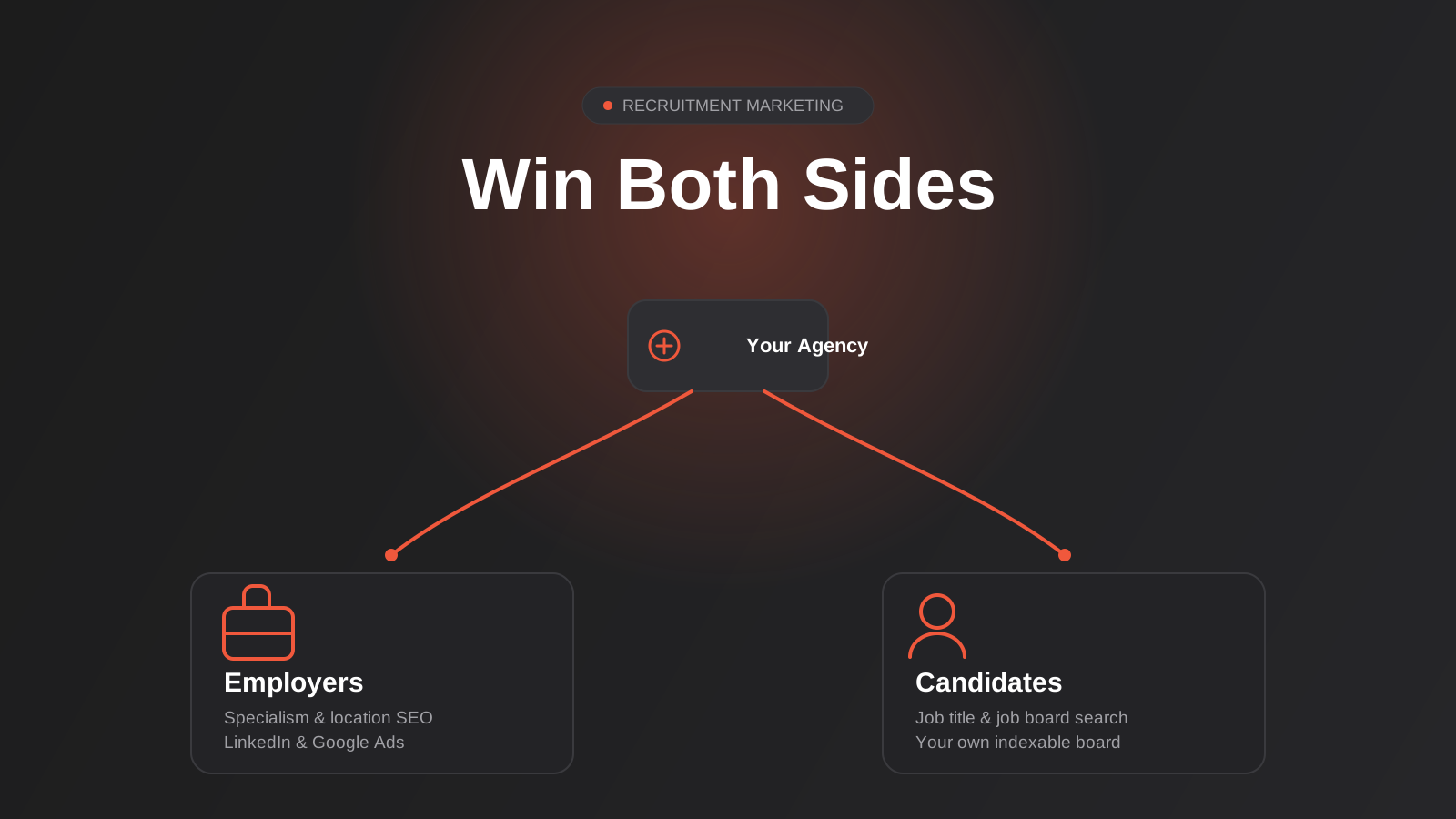
A recruitment agency’s website has to do something almost no other business website has to do: convince two completely different people, with opposite goals, to trust it in the same thirty seconds. A hiring manager lands on the site trying to work out whether this agency actually understands their industry well enough to send decent candidates. A job seeker lands on the same site five minutes later wanting to know if there’s a role worth applying for and whether the agency will bother replying. Most recruitment websites, and most recruitment marketing, are built as if only one of those people exists.
That gap shows up everywhere once you start looking for it. SEO strategies built around “recruitment agency Melbourne” and nothing else, which ignores every candidate-side search a job seeker actually types. LinkedIn campaigns running generic brand awareness instead of targeting the specific titles that sign hiring decisions. Job boards on the agency’s own site that Google can’t read, so every single candidate still has to come through SEEK or Indeed — at a cost per ad that adds up fast across dozens of open roles a year. None of this is a lack of effort. It’s a mismatch between how recruitment actually works as a business and how most digital marketing advice is written, which assumes one audience, one funnel, one conversion goal.
This guide to recruitment agency marketing in Australia is for agencies who want an approach that actually reflects the two-sided market they’re operating in — where to put SEO effort, how LinkedIn and Google Ads split between client-side and candidate-side goals, what it actually takes to reduce job board dependency, and the compliance issues specific to advertising jobs and holding candidate data. If you’ve read our broader guide to digital marketing for service businesses, this goes considerably narrower and deeper into the one thing that makes recruitment different from almost every other professional services category: you’re not selling to one market, you’re selling to two, and they don’t want the same thing.
Two Different Buyers, One Website
Every other professional services firm — an accounting practice, a law firm, a consultancy — sells to roughly one kind of buyer, even if that buyer has different segments within it. A recruitment agency sells to two buyers who barely overlap, who have almost nothing in common in what they’re looking for, and who both need to say yes for the business to actually make money. Win the client side without the candidate side and you’ve got open roles you can’t fill. Win candidates without clients and you’ve got a database with nowhere to place them. Marketing that treats this as one audience wastes budget convincing the wrong half of each message to a reader who was never going to act on it.
What a hiring manager is actually evaluating
A hiring manager comparing recruitment agencies is asking a fairly specific set of questions: does this agency actually work in my sector, or do they recruit “everything”? What’s their process, and how fast can they turn around a shortlist? What do their fees look like, and are they transparent about it before the first call? Can I see evidence — placements, client types, testimonials from people in roles similar to mine — that this isn’t their first attempt at my kind of hire? A generic “we recruit across all industries, get in touch” page answers none of this, which is exactly why specialist agencies consistently out-compete generalists even when the generalist has a bigger marketing budget. Specificity is the credibility signal in a market where anyone can call themselves a recruiter.
What a candidate is actually evaluating
A candidate is evaluating something almost entirely different: is there an actual role here worth my time, is it current (nothing kills trust faster than applying to a role that was filled three weeks ago), how easy is it to apply, and will anyone actually get back to me? Candidates have been burned by agencies before — ghosted after an initial call, sent to interviews for roles that didn’t match the brief, or simply ignored after submitting a CV into a black hole. A candidate-facing page needs to address that scepticism directly: a simple application path, visible proof that the agency treats people decently, and job listings that are genuinely live and genuinely current.
The practical consequence is structural, not cosmetic. The site needs an obvious, early split — “I’m hiring” and “I’m looking for work” — each leading to content, proof points and calls to action written for that specific reader, not a single homepage trying to be everything to everyone. Our recruitment agency website design and marketing page covers the structural side of this split in more detail; this guide focuses on how SEO, paid media and content need to follow the same split once the structure exists.
SEO for Recruitment Agencies: Two Keyword Universes
SEO for a recruitment agency isn’t one keyword strategy, it’s two, aimed at two readers with completely different search behaviour. Treating them as a single list — and most agencies do — means half the content on the site is invisible to one side of the market or the other.
Employer-side keywords: specialism and location
Hiring managers searching for a recruitment partner tend to combine a sector or role type with a location: “healthcare recruitment agency Melbourne”, “find a construction project manager Brisbane”, “IT recruitment agency Sydney”. These are lower-volume, high-intent searches — the person typing them is actively trying to fill a role, not browsing. The content that ranks for these terms is dedicated specialism pages: one page per sector or role type you genuinely recruit in, each with its own content about that market’s hiring challenges, salary expectations and your specific process for it, rather than one “industries we serve” page listing eight sectors in a bullet list. A generalist “we recruit across all industries” page is competing against every other generalist agency for an enormous, vague keyword with no real intent signal attached; a specific “logistics recruitment Perth” page is competing in a much smaller pool where showing up actually means something.
Candidate-side keywords: job titles and search intent
Candidates search completely differently — by job title, often with a location or remote-work qualifier: “marketing coordinator jobs Melbourne”, “senior accountant roles remote”, “warehouse jobs near me”. These searches are genuinely high-volume compared to the employer side, but they’re also the searches SEEK, Indeed, LinkedIn Jobs and Google for Jobs are all competing for with vastly more domain authority than a single agency’s site will ever have for the generic version of the term. The realistic play isn’t to out-rank SEEK for “jobs Melbourne” — it’s to make sure your own listed roles are individually indexable and specific enough (job title plus location plus a few distinguishing details) that they can rank for their own long-tail version of the search, and to make sure anyone who does land on your site from a branded or referral search finds a genuinely easy, current job board rather than a stale one.
Getting your own job board into Google for Jobs
Google for Jobs is the one piece of technical SEO that’s specific to recruitment and genuinely worth getting right, because it’s a direct line to candidate search traffic that bypasses the big job boards entirely. Each role needs to live on its own indexable page (not hidden behind a login or a third-party application portal that blocks crawling), marked up with JobPosting structured data. Google’s own documentation treats six properties as required — title, description, datePosted, validThrough, hiringOrganization and jobLocation — with others like baseSalary and employmentType recommended rather than mandatory. Two details trip up agencies more than anything else: the structured data has to match what’s visibly on the page (a mismatch is treated as a quality issue, not a minor technicality), and the role needs a genuine application path described on the page itself — Google won’t surface a posting that just sends candidates to log into an external portal with no visible way to apply.
The part that actually breaks this in practice isn’t the initial setup, it’s maintenance. A role that’s been filled but is still live on the site, still indexed, still showing up in Google for Jobs results, is a trust-destroying experience for a candidate and a quality signal problem for the agency. validThrough needs to reflect reality, and expired roles need to come down or be explicitly marked closed, not quietly ignored until someone notices the complaint.
Local SEO and the “recruitment agency near me” search
A decent slice of employer-side search still happens through Google’s local pack and Google Business Profile — a hiring manager typing “recruitment agency near me” or “[city] recruitment agency” expecting to see a map and a shortlist of local options. Optimising this is mostly unglamorous maintenance: accurate categories, a complete profile, genuine reviews from both clients and candidates (most agencies only ask clients, which misses half the available review volume), and posts or updates that keep the profile active rather than dormant. It’s a smaller lever than the specialism pages, but it’s a cheap one, and most agencies simply haven’t touched their profile since it was created.
Paid Media: Where the Budget Should Actually Go
Paid media for recruitment splits cleanly along the same line as SEO — some channels are genuinely built for reaching employers, others work better (or only) for candidates, and spreading budget evenly across both without a clear reason is how most agencies waste the spend that would otherwise generate real pipeline.
LinkedIn Ads for the employer side
LinkedIn is the strongest paid channel for the client side of a recruitment business, because it’s the only major ad platform that targets directly on job title, seniority and company size rather than inferred interests. For an agency selling into HR managers, operations directors or specific department heads, that precision is hard to replicate on any other platform. Sponsored Content paired with a Lead Gen Form — pre-filled from the viewer’s LinkedIn profile — tends to be the strongest starting format, since it removes the friction of a hiring manager typing out contact details on a mobile screen during a work break. We cover LinkedIn’s cost and targeting mechanics in more depth on our LinkedIn Ads page, but the recruitment-specific point worth emphasising is audience discipline: targeting “HR managers in Australia” broadly burns budget on people with no active hiring need right now, where targeting a narrower list — specific seniority, specific industry, ideally built around genuine signals of active or likely hiring — produces a far better cost per qualified enquiry even at a lower total reach.
Google Ads for high-intent hiring searches
Google Ads earns its place on the employer side for the same reason it works for most professional services: capturing someone who has already decided they need help and is actively searching for it. “Recruitment agency [sector] [city]” and similar high-intent terms are exactly the kind of bottom-of-funnel search Google Ads handles well, landing on a specialism page rather than a generic homepage. It’s a much weaker channel for the candidate side — running Google Ads against job-seeker search terms means competing directly with SEEK and Indeed’s own enormous ad budgets for traffic that mostly converts on their platforms anyway, which is rarely a good use of a recruitment agency’s budget relative to simply getting the agency’s own job board properly indexed.
Why most agencies should hold off on broad social spend
Meta and other broad social platforms can work for candidate-side awareness — particularly for high-volume, lower-skill roles where casting a wide net makes sense — but they’re a poor fit for the employer side, where the targeting signals (job title, company, seniority) that actually matter simply aren’t available with the same precision LinkedIn offers. The common mistake is spreading a modest budget thin across LinkedIn, Meta and Google simultaneously before any one channel has proven it can produce a qualified lead or application at a sane cost. Prove one channel on each side first, then diversify once there’s a baseline to compare new spend against.
The Job Board Problem: Reducing Reliance Without Cutting It Off
Third-party job boards are not the enemy — SEEK, Indeed and LinkedIn Jobs still carry enormous reach that a single agency’s own site can’t replicate, and for most agencies they’ll remain part of the mix indefinitely. The problem is exclusive reliance. A standard SEEK ad commonly runs to several hundred dollars, with pricing scaling by location, role seniority and add-on features like featured placement, and that cost repeats for every single role posted, with no residual value once the listing expires. An agency running dozens of roles a year is paying that fee dozens of times over, for traffic it never owns and can’t retarget once the ad comes down.
What “owning the pipeline” actually means
Owning more of the candidate pipeline doesn’t mean abandoning job boards — it means building parallel sources that don’t disappear the moment a listing expires: an indexable job board on your own site that accumulates search authority over time, a growing database of candidates who’ve registered interest even when nothing currently matches their profile, and specialism content that keeps bringing in relevant candidate traffic between active roles. None of this replaces SEEK overnight. What it does is reduce the number of roles where SEEK is the only source of applicants, and over a year or two it noticeably shifts cost-per-hire in a direction most agencies never measure because they’re not tracking the two pipelines separately in the first place.
Nurturing a candidate database between roles
The candidates who apply to a role you’ve already filled, or register interest with nothing currently open, are a genuine asset if they’re nurtured — and a wasted cost (you paid to acquire that application) if they’re left in a database no one ever emails again. A simple nurture sequence covering job alerts matched to their registered preferences, occasional market or salary updates relevant to their sector, and a light-touch “still looking?” check-in keeps a warm database actually warm, so that when a matching role does open, you’re reaching out to people who already know the agency rather than starting cold. This is squarely automation territory — application acknowledgements, alert emails and periodic nurture touches are exactly the kind of repetitive, rules-based work that shouldn’t be consuming a consultant’s time by hand rather than a system that handles it automatically.

Specialisation Is the Marketing Strategy, Not a Decoration
It’s worth stating plainly because it changes almost every decision above: in a market this crowded, specialisation isn’t a positioning nicety layered on top of the marketing — it is the marketing strategy. A generalist agency’s SEO competes against every other generalist for the broadest, least intent-rich searches in the category. A generalist’s LinkedIn campaign has to speak to every industry at once, which in practice means speaking to none of them well. A generalist’s content has nothing specific enough to say to outrank a specialist’s genuinely detailed sector guide. None of the channel-level advice above works particularly well bolted onto a “we recruit everything” positioning, because every channel rewards specificity — search engines rank it, LinkedIn’s targeting is built for it, and hiring managers trust it more than a broad claim to cover every sector equally well. If the agency genuinely does recruit across several distinct sectors, the fix isn’t to blend them into one message — it’s dedicated pages, dedicated content and, where budget allows, dedicated campaigns for each one, so that within each sector the agency still reads as a specialist rather than a generalist wearing several hats.
Content That Actually Works for Recruitment Marketing
Content for a recruitment agency has an unusually clear job to do on both sides of the market, which makes it easier to plan than content for most professional services firms. On the employer side, salary guides and hiring-market updates for your specific sectors are genuinely useful, genuinely linkable content — a hiring manager trying to budget a new role or benchmark an offer against market rate has a real reason to search for exactly this, and a credible, data-backed guide earns trust in a way a generic “why use a recruiter” blog post never will. On the candidate side, practical content — interview preparation for specific role types, what a realistic career path looks like in a given sector, how to read a job ad in your industry — builds the same kind of trust from the other direction, and it’s the kind of content candidates actually search for and share.
The content mistake specific to recruitment is writing generic “5 tips for your next interview” posts that could apply to literally any agency in any sector. The content that actually earns search visibility and candidate or client trust is specific to your specialisms — a salary guide for mid-level software engineers in Melbourne tells a genuinely different, useful story than a generic “software engineer salaries” post scraped together from public averages, and it signals the kind of specialist knowledge a generalist competitor simply doesn’t have to draw on.
Compliance: Job Ads, Discrimination Law and Candidate Data
Recruitment marketing carries a couple of compliance obligations that don’t apply to most other professional services content, and they’re worth building into process rather than treating as an afterthought once a campaign is already live.
Job advertisements have to be accurate — the role, salary range (where stated) and requirements described in the ad and on the landing page need to reflect the actual role, not an aspirational or inflated version written to attract more applications. They also can’t discriminate on the protected attributes covered by Australian anti-discrimination law — age, sex, race, disability and several others — which rules out ad copy and targeting that, even unintentionally, excludes candidates on those grounds. This matters for paid media specifically: audience targeting that filters by age brackets or other protected characteristics on platforms that allow it can create genuine legal exposure, not just an optics problem.
Candidate data is personal information under the Privacy Act, and a recruitment agency typically holds more of it, in more sensitive form, than most small businesses — CVs, salary history, references, sometimes health or visa information. Application forms, CRM storage and any marketing automation that touches candidate records need to be built with the Australian Privacy Principles in mind: clear disclosure of what’s collected and why, sensible retention limits rather than keeping every application indefinitely, and genuine security around who inside the agency can access what. None of this is a substitute for your own legal advice on your specific obligations, but it does need to be a design input for the website and systems from the start, not a compliance patch applied after the fact.
Measuring What Matters: Two Funnels, Two Sets of Numbers
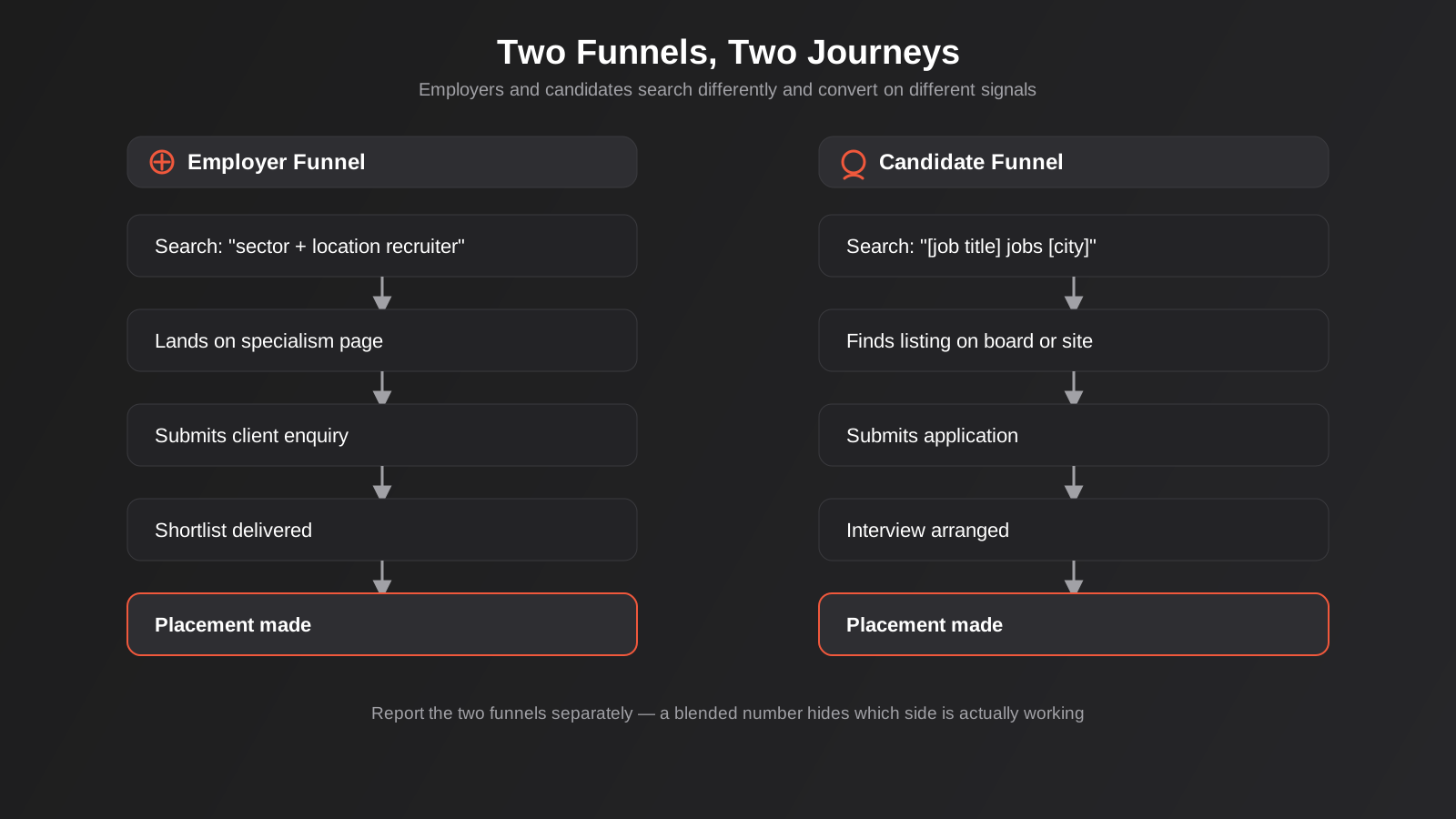
The single most common measurement mistake in recruitment marketing is blending client and candidate metrics into one dashboard, which produces a number that looks reassuring and tells you almost nothing useful. “Website conversions up 20% this month” could mean client enquiries doubled while candidate applications fell off a cliff, or the reverse — and those two scenarios call for completely different responses. Tracking needs to separate the two funnels from the point of first contact: client enquiries and candidate applications tagged and reported separately, by channel, so you can actually see which source is producing which side of the business.
Once that separation exists, the next useful step is tracking all the way to placement, not just to lead or application — a channel that produces lots of candidate applications that rarely convert to actual placements is a weaker channel than the raw application count suggests, and the same logic applies to client enquiries that don’t turn into instructed roles. This is where the connection between marketing and your CRM or applicant-tracking system matters: if marketing-sourced leads and applicants aren’t tagged at the point of entry, there’s no way to close the loop later and work out which channel is actually earning its budget.
Common Recruitment Agency Marketing Mistakes in Australia
- Running one generic message at both audiences. A homepage and SEO strategy built for “recruitment agency Melbourne” with no separate consideration of candidate search behaviour leaves half the available traffic on the table.
- Letting the job board go stale. Filled or expired roles left live on the site damage candidate trust and, if marked up with JobPosting data, can create quality issues with Google for Jobs.
- Targeting LinkedIn too broadly. A generic “HR professionals Australia” audience burns budget on people with no active hiring need, where a narrower audience built around genuine hiring signals produces a better cost per qualified lead.
- Treating all specialisms as one undifferentiated service. A single “industries we serve” page competing for the broadest, lowest-intent keyword in the category, instead of dedicated pages that let each specialism rank and read as genuine expertise.
- Letting the candidate database go cold. Paying to acquire an application once and then never speaking to that candidate again until the next time a matching role happens to open.
- Blending client and candidate metrics. A single “conversions” number that hides whether the client side or the candidate side is actually the one driving (or dragging on) overall performance.
- Writing generic content instead of sector-specific content. Interview tips and hiring advice that could apply to any agency in any sector rarely outperforms a genuinely specific salary guide or market update for your actual specialisms.
Frequently Asked Questions
Should a recruitment agency’s website have separate pages for employers and candidates?
Yes, and ideally the split happens early — on or very near the homepage — because the two audiences want almost entirely different content and calls to action. A site that tries to speak to both with one generic message tends to under-serve both, where a clear “I’m hiring” / “I’m looking for work” split lets each page genuinely focus on what that reader is evaluating.
Is SEO or LinkedIn Ads the better starting point for a recruitment agency?
It depends which side of the market is weaker right now. If client-side pipeline is the bottleneck, LinkedIn Ads can produce leads faster than SEO while specialism pages build authority in the background. If the bottleneck is candidates, getting your own job board properly indexed and readable by Google for Jobs is usually the higher-leverage move, since it’s a one-off technical investment rather than ongoing spend per role.
How do I get my job listings to show up in Google’s job search results?
Each role needs its own indexable page with JobPosting structured data covering the required fields — title, description, date posted, closing date, hiring organisation and location — and a genuine, visible way to apply on the page itself. Keep listings current: an expired role still showing as live is a common cause of roles quietly disappearing from Google’s job search results after an initial period of visibility.
Can a recruitment agency really reduce reliance on SEEK and Indeed?
Reduce, realistically, rather than eliminate. Job boards carry reach a single agency site won’t fully replicate, but an indexable owned job board, a nurtured candidate database and specialism content that attracts candidate traffic between active roles all chip away at how many roles rely on a paid board as the only source of applicants. It’s a gradual shift measured over a year or more, not a single project with a defined end date.
What should a recruitment agency avoid in job ad copy and targeting?
Ad copy and paid targeting both need to steer clear of Australia’s anti-discrimination law — no filtering or language tied to age, sex, race, disability or other protected attributes, even where a platform technically allows that kind of targeting. Job ads also need to accurately reflect the actual role and conditions rather than an inflated version written purely to attract more applications.
How should a recruitment agency measure whether its marketing is working?
Track client enquiries and candidate applications as two separate funnels, tagged by channel, rather than one blended “conversions” number. Where possible, follow both through to the actual outcome — placements for the client side, successful hires for the candidate side — since a channel producing lots of early-funnel activity that rarely converts further down is weaker than the raw volume suggests.
Where to Start
If you’re not sure where the weaker side of your market actually is right now, that’s usually the honest starting point rather than a guess about which channel sounds more exciting. An agency that’s drowning in candidate applications but short on instructed roles needs a completely different first move — LinkedIn Ads and specialism-page SEO aimed squarely at hiring managers — than one that’s winning client work but struggling to fill it, where the job board, candidate database and Google for Jobs setup matter more. Either way, the fix is rarely “more marketing in general”; it’s the specific lever on the specific side that’s actually constrained. Our SEO pricing page sets out current package tiers if search visibility on either side turns out to be the gap.
Worth putting a number on it: our own SEO packages start from $550 a month — below the $700–$1,500 a month most Australian small businesses pay for an entry-level SEO engagement, as we set out in our broader SEO pricing guide. If you’ve already got a written quote from another agency for comparable scope, send it through and we’ll do our best to beat it.
Tell us which side of your market feels thinner right now, which sectors you actually specialise in, and what system your consultants work in day to day. That’s enough for us to come back with specific, honest recommendations rather than a generic marketing pitch — and if the answer is “you don’t need us for this yet,” we’ll say that too.
Keep reading
Related posts

Digital Marketing for Car Dealerships and Workshops in Australia (2026)
Digital marketing for Australian car dealerships and workshops: local SEO, Google Ads, booking flows, and the price-advertising rule every dealer must follow.
Digital Marketing for Australian Manufacturers: Turning Visitors Into RFQs (2026)
How Australian manufacturers turn website visits into RFQs: capability pages, product SEO, LinkedIn Ads for procurement buyers, and quote automation.
Cosmetic Clinic Advertising Rules in Australia: AHPRA, TGA and What You Can Legally Say (2026)
What AHPRA's 2025 guidelines and TGA rules actually restrict for cosmetic clinic marketing in Australia, and the compliant way to market injectables.
Got a project you'd like to talk through?
Tell us what you're working on — we'll come back with a plan.
