
Influencer Marketing for Australian Businesses: Costs, AANA Rules and UGC Rights (2026)
 Jignesh Vagadiya
07/10/2026
21 min read
Somewhere in the last two years, every business we talk to started getting pitched by influencers, UGC agencies, or a cousin’s friend with 40,000 TikTok followers who “wants to work together.” The pitch always sounds the same: send product, get content, watch sales follow. Sometimes it works. More often, the brand ends up with a folder of nice-looking videos, no idea whether any of it moved revenue, and — if they’re unlucky — a letter from Ad Standards about a post nobody disclosed properly.
We get asked about influencer marketing constantly now, usually by businesses that already run Meta Ads or organic social and want to know if creator partnerships are worth adding on top. The honest answer is that influencer marketing isn’t really a marketing channel in the way Google Ads or email is. It’s a content supply and licensing problem wearing a marketing hat, and most of the mistakes we see happen because businesses treat it like the former when it behaves like the latter.
This influencer marketing Australia guide covers what creator partnerships actually cost right now, how the Australian Association of National Advertisers (AANA) disclosure rules work and where businesses get caught out, and the content licensing mechanics — UGC rights, whitelisting, Spark Ads — that decide whether a campaign is a one-off post or an asset you can keep using. If you want the broader platform and content strategy picture first, our social media marketing strategy guide covers choosing platforms and building content pillars; this one is specifically about working with other people’s audiences rather than building your own.
What influencer marketing actually buys you
Strip away the hype and influencer marketing does three distinct jobs, and businesses usually want one of them without realising the other two come bundled in whether they ask for them or not.
The first is reach into an audience you don’t have access to any other way — a creator’s followers trust that creator more than they trust your ad. The second is content. A single influencer brief can produce a dozen usable video and photo assets at a fraction of a studio shoot’s cost, which is often the real reason savvy ecommerce brands run these programs at all. The third is social proof: a product shown being used by a real person, in a real setting, does something a product photo on white background can’t.
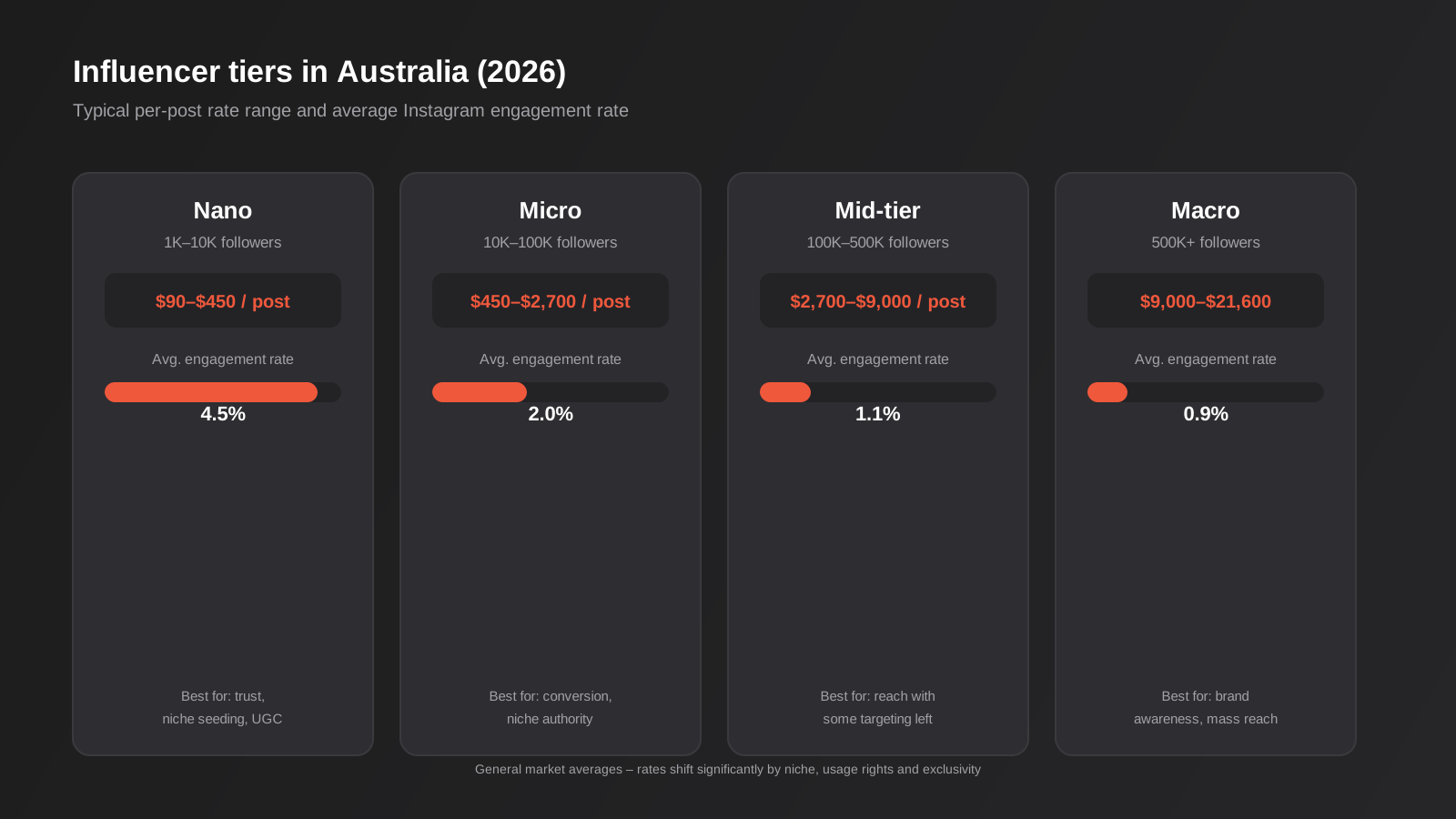
One widely cited industry figure puts the earned media value of influencer marketing at somewhere around $11 for every dollar spent, though that number moves a lot depending on niche, creator quality and what you count as “value.” Treat it as a sense of scale rather than a number you can plug into a forecast. What we’d say with more confidence, because it shows up consistently across the Australian creator market: nano-influencers (roughly 1,000–10,000 followers) post average Instagram engagement rates around 4.5%, micro-influencers (10,000–100,000) sit closer to 2%, and macro accounts with 500,000-plus followers often average under 1%. Reach and engagement move in opposite directions as follower count climbs, and which one matters depends entirely on what you’re trying to achieve.
Reach vs. trust: picking the right trade-off
If the goal is brand awareness — getting a new product in front of as many eyeballs as possible — a handful of macro or mid-tier creators does that job efficiently, even with a lower engagement rate, because the raw numbers are large. If the goal is conversion — actual sales, bookings, sign-ups — the data consistently favours micro and nano creators, because their audiences are smaller but far more responsive, and the recommendation reads as an opinion from a known person rather than an ad.
Most Australian small and mid-sized businesses get better results running five to ten micro-influencer partnerships than one macro deal at the same total spend. It’s more work to manage, but the content performs better and you end up with a wider spread of usable assets.
Which businesses actually benefit from creator partnerships
Not every business should be doing this, and it’s worth being honest about where it fits before spending anything.
Ecommerce and DTC brands are the clearest fit. The content pipeline alone justifies the spend for a lot of stores — a handful of micro creators can produce more usable, authentic-feeling product footage in a week than a studio shoot delivers in a month, and sales are trackable through discount codes and tracked links in a way that cleanly ties the spend back to revenue. It’s also the category where whitelisting earns its cost most reliably, because that content slots directly into the catalog and retargeting campaigns already running.
Local and hospitality businesses — cafes, gyms, salons, local retailers — can get genuine value from hyper-local nano creators, often at gifting-only cost. A local food creator with 3,000 followers in the right suburb drives foot traffic in a way a boosted Facebook post rarely does, because the audience is already geographically and demographically matched. The catch is scale: this model works brilliantly for one location and gets complicated fast across multiple sites, where the disclosure and briefing overhead starts to outweigh the low per-post cost.
Consumer-facing service businesses — beauty clinics, allied health, real estate, financial advice — sit in a harder middle ground. Creator content showing a genuine client experience can work well, but anything touching a regulated profession runs into the same advertising restrictions that apply to the business itself, which means claims need the same legal scrutiny as content you’d write in-house, not less just because someone else is saying it.
Pure B2B software and professional services generally aren’t a good fit for consumer-platform creators at all — there’s no meaningful audience overlap between a TikTok creator’s followers and a buyer evaluating ERP software. The B2B equivalent is industry commentators and practitioners with a LinkedIn following, which works on trust and specificity rather than reach, and behaves more like a trusted referral than a traditional influencer deal.
What influencer marketing costs in Australia right now
Rates in Australia are set by individual creators, not a published rate card, so the numbers below are market ranges, not fixed prices. They also shift meaningfully by industry — tech and luxury creators typically command two to three times what food or fitness creators in the same follower bracket charge, because the perceived purchase value is higher.
- Nano (1,000–10,000 followers): roughly $90–$450 per post, often negotiable down to product-only for the right fit.
- Micro (10,000–100,000 followers): roughly $450–$2,700 per post.
- Mid-tier (100,000–500,000 followers): roughly $2,700–$9,000 per post.
- Macro (500,000+ followers): roughly $9,000–$21,600 per post, climbing well beyond that for genuine celebrities.
Three things move those numbers more than follower count alone. Usage rights push the price up significantly — a creator charging $800 for an organic post might ask for another 25–50% on top to let you run that same content as a paid ad through your own accounts, and more again if they want to keep their own handle attached via whitelisting (more on that below). Exclusivity, where a creator agrees not to work with a competitor for a set period, adds a premium too. And format matters: a 30-second TikTok or Reel with usage rights costs noticeably more than a single static photo with a caption.
For businesses just starting out, gifting (sending product in exchange for an honest post, no cash) is a legitimate entry point, particularly with nano creators, but it’s not free marketing. Under Australian disclosure rules, a gifted product in exchange for a post is still a form of payment, and it still has to be disclosed as one — which is the part most businesses miss.
The legal side most businesses get wrong: AANA disclosure and ACCC enforcement
This is the section that actually matters more than the pricing table, because it’s where businesses lose money and reputation, not just budget efficiency. Influencer marketing in Australia operates under the AANA Code of Ethics, with the industry’s own AiMCO Code of Practice sitting alongside it, and the Australian Competition and Consumer Commission (ACCC) enforcing misleading and deceptive conduct provisions of the Australian Consumer Law on top of both.
The core rule is simple to state and surprisingly easy to get wrong in practice: if a creator has received payment, free product, a discount, or any other value-in-kind benefit in exchange for posting about your brand, that relationship has to be disclosed clearly and upfront, in a way an ordinary viewer would notice without having to look for it. A hashtag like #ad or #sponsored placed prominently near the start of a caption generally satisfies this. A #ad buried at the end of a long caption, after a “see more” cut-off, or hidden among twenty unrelated hashtags, generally does not — and Ad Standards has upheld complaints on exactly this basis.
In March 2026, the AANA Community Panel upheld a complaint against a food and beverage brand over a TikTok post where a paid collaboration wasn’t clearly disclosed — a reminder that enforcement in this space isn’t theoretical or limited to huge global brands. Roy Morgan’s ongoing tracking for Ad Standards has also found that a meaningful share of Australian influencer content still fails to disclose adequately, despite years of the AANA pushing on this. It’s not a solved problem, and it’s not going away as a compliance risk.
Why the brand is on the hook, not just the creator
The detail that catches businesses out: under the AANA framework, the advertiser is responsible for ensuring disclosure happens properly — not just the creator. If you brief a creator and they post without disclosing, or bury the disclosure where nobody will see it, that’s your compliance problem as much as theirs. “We told them to add #ad” is not a defence if the final post doesn’t make the commercial relationship clear.
That means disclosure needs to be a contract term, not a verbal request, and ideally something you check before the post goes live rather than after. It also means using the platform’s own disclosure tools — Instagram and Facebook’s “Paid partnership with” label, TikTok’s branded content toggle — rather than relying purely on hashtags, since these tools are what the platforms themselves point to as acceptable disclosure and they’re harder for a creator to accidentally omit or bury.
In practice, that means building two small habits into any paid or gifted arrangement: a pre-publish check where you (or whoever manages the relationship) actually look at the post before or immediately after it goes live, not three weeks later during a monthly report, and a dated screenshot or saved copy of what was published. Creators edit and delete posts; platforms change labelling tools; a saved record of what actually went live, and when, is the difference between a quick fix and a drawn-out dispute if a complaint does land.
Where the ACCC fits in alongside the AANA
The AANA and Ad Standards operate as industry self-regulation — real, with real consequences for repeat or serious breaches, but separate from government enforcement. The ACCC’s remit is broader: misleading or deceptive conduct under the Australian Consumer Law, which covers undisclosed sponsorships but also extends to false claims made in influencer content itself — health claims, environmental or “sustainable” claims, and exaggerated product performance claims. The ACCC has specifically flagged influencer-related misleading conduct and greenwashing claims as compliance priorities, and the penalties under the Australian Consumer Law are not small: potentially up to $500,000 for an individual and significantly more for a company, scaled to the conduct.
If your product sits in a regulated category — supplements, cosmetics, financial products, health services — this matters even more. A creator making a therapeutic claim about your supplement that you’d never be allowed to make yourself in a Google ad is still your liability if you briefed, paid, or gifted them to post it.
UGC rights and whitelisting: where most contracts fall apart
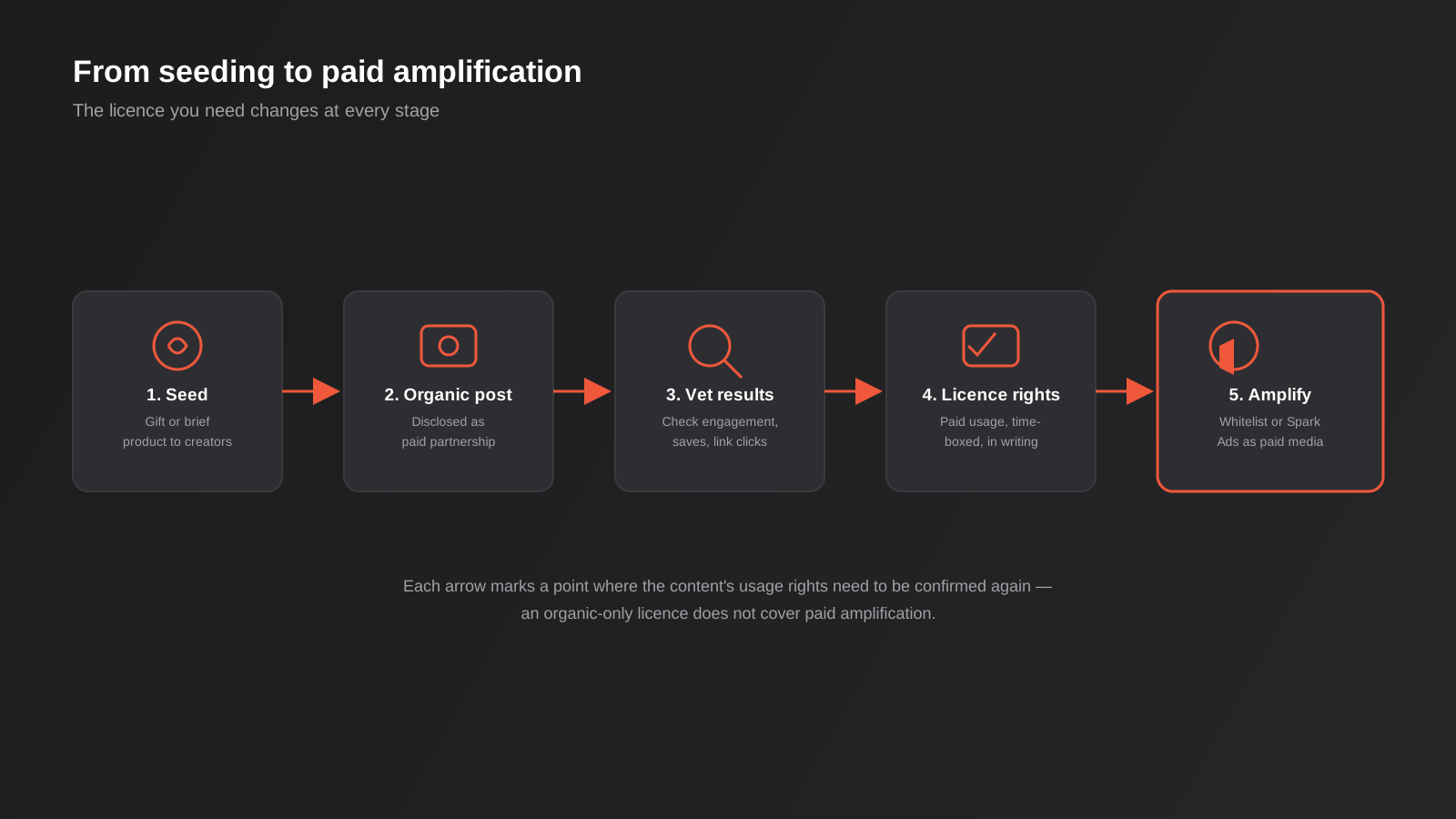
This is the part of influencer marketing that looks like a formality until it isn’t. There’s a meaningful legal difference between a creator posting content organically on their own account, and you using that same content anywhere else — in your own paid ads, on your website, in an email campaign, on retail signage. Organic post rights do not automatically include any of that. If your agreement only covers “the creator will post,” you have no legal right to repurpose the content anywhere, no matter how good it looks.
There are two distinct licensing arrangements that get lumped together under “UGC” and shouldn’t be:
Content licensing (UGC for your own channels)
This is a creator producing content and granting you a licence to use it — on your own social accounts, your website, in email, sometimes in your own paid ads run from your own ad account. This is the simpler and usually cheaper arrangement, and it’s what most “UGC creator” marketplaces are built around, often producing content from people who aren’t influencers at all and never post it organically themselves. You’re essentially commissioning raw footage.
Whitelisting and Spark Ads (paid amplification through their handle)
Whitelisting (Meta) and Spark Ads (TikTok) let you run paid advertising through the creator’s own account, with their permission, rather than reposting the content as “your” ad. This performs well specifically because the ad carries the creator’s identity and social proof rather than the brand’s — viewers see it as content from an account they already follow or trust, not a brand placement. It’s also the more complex arrangement: it requires the creator to grant ad-account-level access (a Business Manager partner permission or a TikTok Spark Ads code), it typically costs more than a standard usage licence, and it needs very explicit terms because you’re now running media spend through someone else’s account and reputation.
For ecommerce brands already running catalog and retargeting campaigns — the kind of setup we cover in our Facebook Ads for ecommerce stores guide — whitelisted creator content is often the highest-performing creative in the account, specifically because it doesn’t look or feel like a catalog ad.
Whichever arrangement you use, the contract should specify, in plain terms: which platforms and placements the licence covers (organic social, paid ads, website, email, print, retail), whether it’s exclusive or the creator can license the same content elsewhere, how long the licence runs (30, 60, 90 or 365 days are common, with rights expiring automatically unless renewed in writing), and whether you can edit the content or must run it as delivered. “They said we could use it” is not a licence. Get it in writing before the content goes live, not after you’ve already started running it as an ad.
Building a program without an agency retainer
You don’t need a dedicated influencer agency to run this well, particularly starting out. Most Australian SMBs run one of three models, often blending them as the program matures.
Gifting and seeding
Send product to a curated list of relevant creators with no guarantee of a post, just a genuine hope they’ll like it enough to share. Cheap and low-commitment, but unpredictable, and — as above — still requires disclosure if a post does happen, because free product is still payment under the rules.
Paid, briefed partnerships
A clear brief, a negotiated fee, agreed deliverables and a usage licence. More predictable, and the only model where you can reasonably hold a creator to deadlines, specific messaging, or compliance requirements.
Affiliate and commission-based
Creators earn a percentage of sales through a unique code or tracked link rather than (or alongside) a flat fee. This aligns incentives well for ecommerce and reduces upfront risk, but it only works if your margins support it and your platform can actually attribute sales to the right creator — which is where a lot of affiliate programs quietly fail.
Whatever the model, a usable brief covers: the key message and any must-include or must-avoid claims (particularly for regulated categories), a short reference to your actual brand and visual identity guidelines so creator content doesn’t clash with everything else you publish, the disclosure requirement stated explicitly rather than assumed, the exact usage rights you’re licensing and for how long, the deadline and approval process, and how you’ll track performance — a unique discount code or UTM-tagged link beats “we’ll check engagement” every time, because it ties the content back to an actual business outcome rather than a vanity metric.
Finding relevant creators doesn’t require an expensive platform subscription at small scale — manually searching relevant hashtags and checking who already engages with your brand organically works fine for the first five to ten partnerships. Influencer marketplaces and creator databases become worth paying for once you’re running enough partnerships that manual vetting becomes the bottleneck, not before.
Measuring performance beyond vanity metrics
Likes, views and comments feel like measurement, but they don’t reliably predict sales, and judging a campaign on them alone is how businesses end up convinced influencer marketing “doesn’t work” when the real problem is that nothing was actually tracked.
The fix is simple but gets skipped constantly: give every creator their own discount code or a UTM-tagged link, even on a small campaign. This does two things at once — it gives you a clean, attributable sales number per creator rather than a guess, and it gives the creator’s audience a reason to act now rather than just feel briefly good about the brand. Compare the resulting cost per sale against what you’re already paying through other channels, rather than judging influencer spend in isolation. If a creator partnership is landing a sale for less than your blended paid social cost per acquisition, that’s a result worth scaling; if it’s landing well above it with no offsetting content value, that’s a signal to adjust the brief, the creator, or the model, not necessarily to abandon the channel.
Timeframe matters more than it gets credit for. A single organic post typically does most of its work in the first 48–72 hours, but whitelisted or Spark Ads content can keep converting for as long as the ad runs, which might be weeks or months after the original post. Judging a campaign purely on first-week numbers undercounts the return from any content you’ve licensed for paid use, and overstates the case for one-off organic-only posts.
Platform-native insights (reach, saves, profile visits, link clicks) are still useful as a secondary signal — a post with strong saves and shares but modest immediate sales may be building consideration you’ll see convert later, particularly for higher-priced products with a longer decision cycle. Just don’t let that secondary signal replace an actual tracked conversion number as the thing you report against spend.
Common mistakes
- Treating gifting as free advertising. Free product in exchange for a post is still payment under the AANA rules, and still needs disclosure — “no money changed hands” isn’t a defence.
- Skipping the usage rights conversation until after the content performs well. By then the creator knows the content is valuable and the price to license it for paid use goes up, or they simply decline.
- Chasing follower count over fit and engagement. A macro creator with a disengaged, broad audience routinely underperforms a niche micro creator whose followers are the exact people who’d buy the product.
- No written brief on claims. A creator improvising a health, performance or sustainability claim you’d never be allowed to make yourself is still your liability, especially in regulated categories.
- Relying on hashtags alone for disclosure. A #ad buried after a “see more” cut-off or lost among twenty unrelated tags doesn’t meet the “clear and upfront” standard, and Ad Standards has upheld complaints on exactly this pattern.
- No tracking mechanism. Without a unique code or tracked link, you’re left guessing at ROI from vanity metrics like likes and views, which don’t reliably correlate with sales.
- Assuming an organic licence covers paid use. Running a creator’s organic post as a paid ad without a separate whitelisting or usage agreement is both a contract breach and, depending on the platform, can get flagged or pulled.
- Judging the campaign in the first 48 hours and nothing after. Whitelisted content keeps earning for as long as the ad runs; a campaign that looks flat in week one can still be the best-performing creative in the account by week six.
Frequently Asked Questions
Do micro-influencers need to disclose free products the same way as paid partnerships?
Yes. Under the AANA Code, any material benefit from a brand — cash payment, free product, a discount, or a value-in-kind service — triggers the same disclosure requirement. Follower count doesn’t change the rule; a nano-influencer gifted a $40 product has the same disclosure obligation as a macro creator paid $15,000.
What actually happens if a post isn’t disclosed properly?
Ad Standards can uphold a complaint against the advertiser (not just the creator), which typically results in a public ruling and a requirement to remove or amend the content. For conduct that also breaches the Australian Consumer Law — misleading claims, not just non-disclosure — the ACCC can pursue penalties that scale well into the hundreds of thousands of dollars for a business. Reputational damage from a public ruling, particularly if media picks it up, is often the bigger cost.
Can I repost a customer’s organic content without a formal contract?
Technically a customer’s content is their copyright, and reposting it — even with credit — without permission is a breach, regardless of whether they were paid. In practice, a clear comment or DM asking permission and getting an explicit “yes, go ahead” is enough for low-stakes organic reposting. It is not enough for paid advertising use; for that, get written permission that specifically covers paid use, even if it’s just a quick message confirming scope and duration.
How long should a content usage licence run?
Common terms in Australian creator agreements are 30, 60, 90 or 365 days, with rights expiring automatically at the end of the period unless both parties agree to renew in writing. Shorter terms are cheaper but mean you’ll need to renegotiate for high-performing content; longer or perpetual licences cost more upfront but remove that friction. Match the term to how long the content is likely to stay relevant — a seasonal campaign rarely needs a 12-month licence.
Is influencer marketing worth it for B2B businesses?
It works differently, not necessarily worse. B2B “influencers” are usually industry commentators, consultants or practitioners with a following on LinkedIn rather than consumer-platform creators, and the value is closer to credible third-party endorsement than mass reach. It suits considered-purchase categories — software, professional services, equipment — where a respected voice in the space saying “I use this” carries real weight. It’s a poor fit for low-consideration B2B products where the audience doesn’t follow anyone in the category at all, and the same AANA disclosure obligations apply regardless of platform — a sponsored LinkedIn post needs the same clear, upfront disclosure as a sponsored Instagram Reel.
How much should a small business budget for a first campaign?
A sensible test budget is five to eight micro or nano creators at $200–$800 each, including a basic content usage licence, which lands a first campaign somewhere between $1,500 and $5,000 depending on niche and whether you’re paying cash or product. That’s enough to see real performance variance across creators and get a usable content library, without committing to a mid-tier or macro deal before you know what resonates with your audience.
Where to start
If you’re weighing up influencer marketing against the rest of your social spend, the honest starting point is usually a small, well-briefed test with four or five creators in the micro or nano range, with disclosure and usage rights nailed down in writing before anything goes live — not a single big-name deal. It tells you more about what actually resonates with your audience, for less money and less compliance risk, than one expensive placement ever will.
If you’d rather talk through how creator content fits alongside your existing social media marketing and paid social activity — including how to brief for disclosure compliance and structure usage rights properly from the start — we’re happy to have that conversation. It’s worth getting the contract terms right once, rather than renegotiating after the content’s already live.
Either way, start smaller than feels comfortable, track every creator with a code or link from day one, and treat the disclosure and usage-rights paperwork as part of the campaign, not an afterthought bolted on once something’s already working.
Keep reading
Related posts
Digital Marketing for Car Dealerships and Workshops in Australia (2026)
Digital marketing for Australian car dealerships and workshops: local SEO, Google Ads, booking flows, and the price-advertising rule every dealer must follow.
Digital Marketing for Australian Manufacturers: Turning Visitors Into RFQs (2026)
How Australian manufacturers turn website visits into RFQs: capability pages, product SEO, LinkedIn Ads for procurement buyers, and quote automation.
Marketing for Recruitment Agencies in Australia: Winning Both Clients and Candidates
Recruitment agencies sell to two audiences at once. How SEO, LinkedIn Ads, job board strategy and compliance need to split between employers…
Got a project you'd like to talk through?
Tell us what you're working on — we'll come back with a plan.
