
Digital Marketing for Gyms, Studios and Personal Trainers in Australia (2026)
 Jignesh Vagadiya
15/10/2026
22 min read

Walk into most gym or studio marketing conversations and the advice sounds identical to what you’d give a plumber or a hairdresser: get on Google, run some ads, post on Instagram. None of that is wrong exactly, but it skips past the thing that actually makes fitness businesses different — you’re not selling a single transaction, you’re selling a recurring relationship, and the entire economics of the business depend on how long someone sticks around after the sale closes. A trial that converts but churns in six weeks can be worse for the business than a trial that never converts at all, because you’ve spent the acquisition cost and the retention cost and still ended up with nothing.
We’ve worked across this exact mix — gyms, boutique studios and personal trainers — through our fitness and wellness industry work, and the pattern that shows up again and again is a business that’s genuinely good at getting trials through the door and genuinely unprepared for what happens in the first fortnight after. The marketing plan stops at “book a trial” as if that’s the finish line, when it’s really just the start of the part that determines whether any of the spend was worth it.
This guide covers gym and fitness studio marketing in Australia specifically — gyms, boutique studios and personal trainers: how the buyer and the sales cycle differ across those three business types, where local search and Google Business Profile actually earn their keep, how Google Ads, Meta and TikTok compare for fitness specifically, what a trial-offer funnel needs to look like, and the state-based membership contract rules that quietly shape what you can and can’t say in an ad or on a landing page.
Gym, Boutique Studio or Personal Trainer: Three Different Businesses Wearing the Same Label
“Fitness marketing” gets talked about as one category, but a 24-hour access gym, a boutique Pilates or boxing studio running a class timetable, and a solo personal trainer building a client book are three different sales motions with three different cost structures behind them. Treating them the same wastes budget in predictable ways.
The Access Gym: Volume, Convenience and Low-Touch Sign-Up
A large-format or 24-hour gym competes mostly on convenience, price and equipment range. The buying decision is fast and relatively low-commitment — someone compares two or three gyms within a reasonable drive or walk, checks opening hours and price, and signs up, often without ever speaking to a staff member if the sign-up flow is self-serve. Marketing here leans heavily on local visibility (map pack presence, a fast-loading site with clear pricing) and low-friction trial offers, because the sales process itself barely exists until after someone’s already a member.
The Boutique Studio: Community, Class Experience and a Higher-Trust Decision
A boxing, Pilates, reformer or CrossFit-style studio sells something closer to an experience and a community than a facility. The price per session is usually higher than an access gym, and the decision leans more on trust — does the instructor seem good, does the vibe of the class suit me, will I feel comfortable walking in as a beginner. This is where content that shows the actual class experience (not stock photography of someone mid-burpee) does real work, and where a genuinely warm first-visit experience matters more to conversion than almost any ad creative.
The Personal Trainer: A Trust Sale, One Person at a Time
Independent PTs and small training businesses are selling the most personal version of this — often literally one-on-one time with the person doing the marketing. The sales cycle resembles a professional services decision more than a retail one: a potential client wants to see results from past clients, get a sense of personality and training style, and often have a short consultation before committing. Volume matters far less here than trust signals and a credible, specific before-and-after story (ethically sourced and honestly framed, which we’ll come back to under compliance).
Plenty of businesses sit across more than one of these — a studio that also sells PT add-ons, a gym with an in-house training team selling personal sessions separately. If that’s you, the practical fix is the same one we’d give any business straddling two buyer types: run the group fitness/membership offer and the PT offer as separate landing pages and separate ad campaigns, even if it’s the same brand and the same front desk. A single generic “join us” page tends to under-serve both.
Local Search and Google Business Profile: Where Most First Contact Still Happens
For gyms and studios specifically, “gym near me” and “[suburb] gym” style searches still drive a large share of first contact, and the map pack above the fold on mobile is where that decision mostly gets made before anyone reaches your website. Industry commentary on gym digital marketing (Glofox’s analysis of ABC Fitness’s membership data among them) has consistently pointed to Google Business Profile completeness and recency — not just existence — as one of the clearer differentiators between gyms that hold map pack positions and gyms that quietly slip down the list over a year.
What a Profile Actually Needs to Earn Its Position
A profile set up once at launch and left alone signals an inactive business to Google in exactly the way an inactive Instagram account signals it to a prospective member. The listings that hold position tend to have genuinely recent photos (not a single hero shot from the opening week three years ago), class timetables and services kept current, a booking or trial link that actually goes somewhere useful, and categories that reflect what you actually offer — a reformer Pilates studio categorised generically as “gym” is leaving relevant searches on the table. We’ve written a full, step-by-step walkthrough of this in our Google Business Profile guide, which covers the setup and maintenance mechanics in more depth than fits here; this section is specifically about what changes for a membership-based fitness business.
Reviews: Why Timing Matters More Than Volume
Review requests sent generically (a blanket email blast to the whole member list once a quarter) get a fraction of the response rate of a request sent at the right moment — straight after someone finishes a class they clearly enjoyed, or at the end of a trial that converted to a sign-up. The emotional high point of “that was a great session” is a genuinely different moment to ask in than “please consider reviewing us” landing in an inbox three weeks later with no context. A simple automated trigger — a text message or app notification sent an hour or two after a booked class, timed to land after the endorphins rather than during the admin of booking the next one — consistently outperforms a manual, inconsistent ask from front-desk staff who are busy doing six other things.
Short-Form Video Is Increasingly Part of Local Discovery
Fitness content is one of the categories where Instagram Reels and TikTok clips now regularly surface inside Google search results themselves, not just inside the platforms they were posted to — a thirty-second clip of a class in progress can appear alongside your map listing for a local search. That’s a reasonable argument for treating short-form video as part of your local search presence, not a separate “social media” line item with its own budget and its own goals. We go deeper on the specific mechanics of running paid short-form campaigns in our TikTok Ads service page, which is worth a look if organic reach on its own isn’t moving fast enough.
Paid Acquisition: Google, Meta and TikTok Compared for Fitness
The three paid channels that matter most for gyms and studios behave quite differently, and the mistake we see most often is running one undifferentiated budget across all three with the same creative and the same offer.
Google Ads: Expensive but High-Intent
Google Search captures people who have already decided they want a gym, studio or trainer and are actively comparing options — which makes it reliably the highest-intent channel and also usually the most expensive per lead. Industry benchmarking circulated by Australian PPC agencies has put average cost per lead for gym-related Google Search terms somewhere in the mid-twenties to high-thirties dollar range, with a wide spread either side depending on how competitive the local market is and how tightly the account is structured; treat any specific figure you read as a planning reference rather than a guarantee, and judge your own account against trial-to-member conversion, not cost per lead in isolation. A $30 lead that converts to a twelve-month membership is a far better result than a $15 lead that cancels inside the cooling-off period.
Meta: Cheaper Reach, Better for Warming People Up
Meta (Facebook and Instagram) generally produces a lower cost per lead than Google Search for fitness businesses, because it’s reaching people earlier in their decision — someone scrolling who sees a well-shot class video and thinks “I should actually do that” rather than someone who’s already typed “gym near me” into a search bar. The trade-off is lead quality variance: Meta leads skew toward people who are interested but not yet decided, which is exactly where a strong trial offer and fast follow-up matter most. Retargeting website visitors and video viewers on Meta before they ever search on Google is also one of the more reliable ways to bring your Google cost per lead down, since some share of those searches will be people you’ve already warmed up.
TikTok: Where Fitness Content Genuinely Performs
Fitness is one of the categories where organic and paid short-form video content consistently performs well, because the format rewards exactly what a good class or training session already produces — movement, energy, a clear before-and-after arc within thirty seconds. For boutique studios and PTs especially, a modest paid boost behind content that’s already getting organic traction tends to outperform producing bespoke “ad-style” creative from scratch. The same caution applies here as with any paid social spend aimed at a membership product: pair it with a landing page built for the specific offer, not a link to your homepage.
The Trial-Offer Funnel Is Where Most of the Budget Actually Gets Decided
Whichever channel brings someone in, what happens on the page they land on and in the hours after determines whether that click was worth paying for. A dedicated trial-offer landing page — built around one offer, one class type or membership tier, a short and specific form, and a visible next step — converts meaningfully better than sending paid traffic to a general homepage that’s trying to explain the entire business to someone who just wants to know “can I try this, and what does it cost.” Building that as a proper, fast-loading page rather than a generic contact form is exactly the kind of work our landing page development team does for exactly this reason.
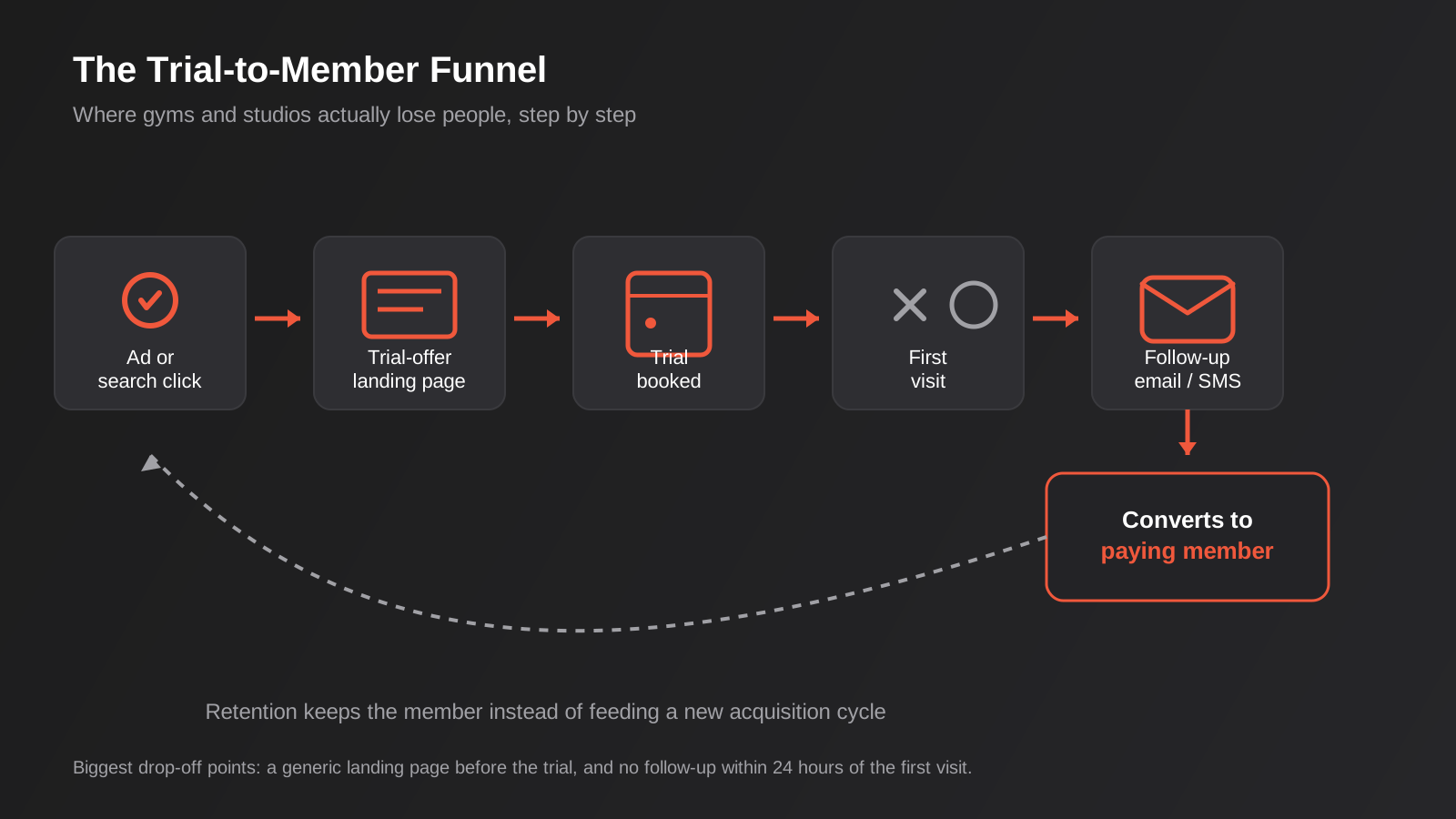
The follow-up gap is the part that gets ignored most often. A trial booked through a form and then never followed up until the person shows up (or doesn’t) wastes a huge share of the acquisition spend that got them there in the first place. A short automated sequence — a confirmation immediately, a reminder the day before, a check-in the day after if they didn’t show, and a specific next-step message the day after they did — recovers a meaningful chunk of trials that would otherwise just evaporate. None of this needs to be complicated or expensive to build; it needs to exist and run reliably every single time, which is the actual bar most businesses are missing, not sophistication.
Content and Social Media: What’s Actually Worth Posting
Fitness is one of the few industries where organic content genuinely performs without a big production budget, because the raw material — people training, visible progress, a class in full swing — is inherently watchable and you’re already creating it every day you’re open. The businesses that get the most out of social media usually aren’t posting more than everyone else; they’re posting a more deliberate mix.
A workable set of content pillars for a gym or studio:
- Real class and training footage — actual sessions, not staged shots, showing the energy and the people who already train with you.
- Instructor and trainer personality — the person leading a class is a meaningful part of why people choose a studio over a gym; let that personality show rather than hiding behind a branded logo post.
- Education and form content — short, genuinely useful clips (how to set up a deadlift, why a certain stretch helps a certain movement) that build credibility beyond “come join us.”
- Member wins and testimonials — specific, honestly framed, and ideally with the member’s actual words rather than a generic quote written for them.
- Behind-the-scenes and community — the parts that show this is a place people belong to, not just a service they pay for.
We’ve covered the broader framework for building a sustainable content and platform strategy — which platforms to prioritise, how much to post, and how to avoid burning out a small team trying to do all of it — in general terms elsewhere. The fitness-specific point worth adding is that transformation and results content needs to be handled carefully: the Australian Consumer Law’s provisions on misleading or deceptive conduct apply to fitness marketing the same as any other industry, which means results claims need to be genuinely representative, not the single most dramatic outlier dressed up as a typical result.
Retention Is a Marketing Channel, Not Just an Operations Problem
Acquisition gets almost all the marketing budget conversation and almost none of the attention goes to the fact that keeping an existing member is nearly always cheaper than acquiring a new one, and a membership business’s unit economics live or die on average membership length far more than on cost per lead. Industry reporting on membership trends (ABC Fitness’s periodic Wellness Watch analysis is one commonly cited source) has repeatedly pointed to engagement and community-focused experiences correlating with lower cancellation rates, even in periods where new-member growth has slowed industry-wide. Treat any such figures as directional industry commentary rather than an audited Australian statistic, but the underlying logic holds regardless of the exact numbers: a member who feels like they belong somewhere cancels less often than one who feels like a line item.
Lifecycle Email and SMS, Applied to Membership
The same welcome-flow, segmentation and lifecycle thinking that works for ecommerce applies directly to membership retention, just with different triggers. A new member’s first fortnight is the highest-risk window for early cancellation, so a short onboarding sequence — what to expect in week one, how to book classes, an invitation to a specific upcoming session — does real work here. Attendance-based triggers matter even more: a member who hasn’t checked in for two or three weeks is showing you the clearest possible cancellation signal available, well before they actually cancel, and a genuine, non-automated-sounding check-in at that point saves far more memberships than any win-back offer sent after they’ve already cancelled. We go into the mechanics of building these flows properly — welcome sequences, behavioural triggers, segmentation — in our email marketing automation guide; the membership version of it is simply “attendance” standing in for “cart” as the key behavioural signal.
Community as a Retention Mechanism, Not Just a Vibe Word
Challenges, socials, milestone recognition (a member hitting their hundredth class, a PT client hitting a strength goal) and simply making sure instructors know members’ names are unglamorous retention tactics compared to a slick ad campaign, but they move the number that actually determines profitability — how long someone stays. None of this is purely a marketing function, which is part of why retention gets under-invested in: it sits at the boundary between marketing, front-desk operations and coaching, and nobody’s budget line clearly owns it. Whoever owns member experience day to day should be treated as part of the marketing team’s success metrics, not a separate department whose job ends where marketing’s begins.
Membership Contracts, the ACL and What Your Ads and Landing Pages Can’t Skip
Fitness marketing intersects with consumer law in ways that general small-business marketing advice usually ignores, and getting this wrong isn’t just a legal risk — it directly affects how your trial-offer landing pages and sign-up flow need to be built.
Cooling-Off Periods Vary by State
There’s no single uniform national cooling-off period for gym and fitness memberships in Australia — the rules sit partly under the Australian Consumer Law and partly under state-based fair trading regimes, and they differ by jurisdiction. Queensland, for example, requires a 48-hour cooling-off period on fitness membership agreements, during which a member can cancel in writing and the business must refund fees within 14 days, though it can still charge for services already used and a reasonable administration fee. Other states have their own variations, and some guidance you’ll find online (including some that quotes a flat 14-day period) doesn’t match the state-specific rules, so this is worth checking against your own state’s current fair trading guidance rather than relying on a generic blog post — including this one.
Unfair Contract Terms Carry Real Penalties Now
Since reforms that took effect in late 2023, the Australian Consumer Law’s unfair contract term provisions carry significant civil penalties, and standard-form gym and studio membership agreements are exactly the kind of contract these provisions target — one-sided cancellation rights, excessive or disproportionate exit fees, and terms that let a business vary the agreement unilaterally are the kinds of clauses that have drawn scrutiny. This matters for marketing specifically because a landing page or ad that implies a deal is simpler, cheaper or easier to exit than the actual contract terms allow can turn an advertising claim into a misleading conduct problem on top of a contract-fairness one. AUSactive, the national fitness industry body (formerly Fitness Australia), was engaging with proposed federal reforms targeting so-called “subscription trap” practices as recently as early 2026, which is a reasonable signal that scrutiny of membership cancellation terms isn’t going away.
What This Means for Your Landing Pages
Practically, this argues for being upfront about cancellation terms and cooling-off rights on the trial-offer and sign-up pages themselves, not buried in a PDF contract someone signs on a tablet at the front desk after they’ve already mentally committed. It’s a better conversion decision as well as a compliance one — a prospective member who can see clearly how to cancel if it’s not right for them is more likely to commit to trying in the first place than one who suspects there’s a catch they haven’t been told about yet.
Building a Realistic Budget by Business Stage
Channel mix should follow what stage the business is actually at, not a generic percentage copied from an unrelated industry. A brand-new studio with no local reputation yet needs to spend more on building awareness and trial volume than an established gym that’s mostly managing a steady-state member base and needs to protect its position more than expand it.
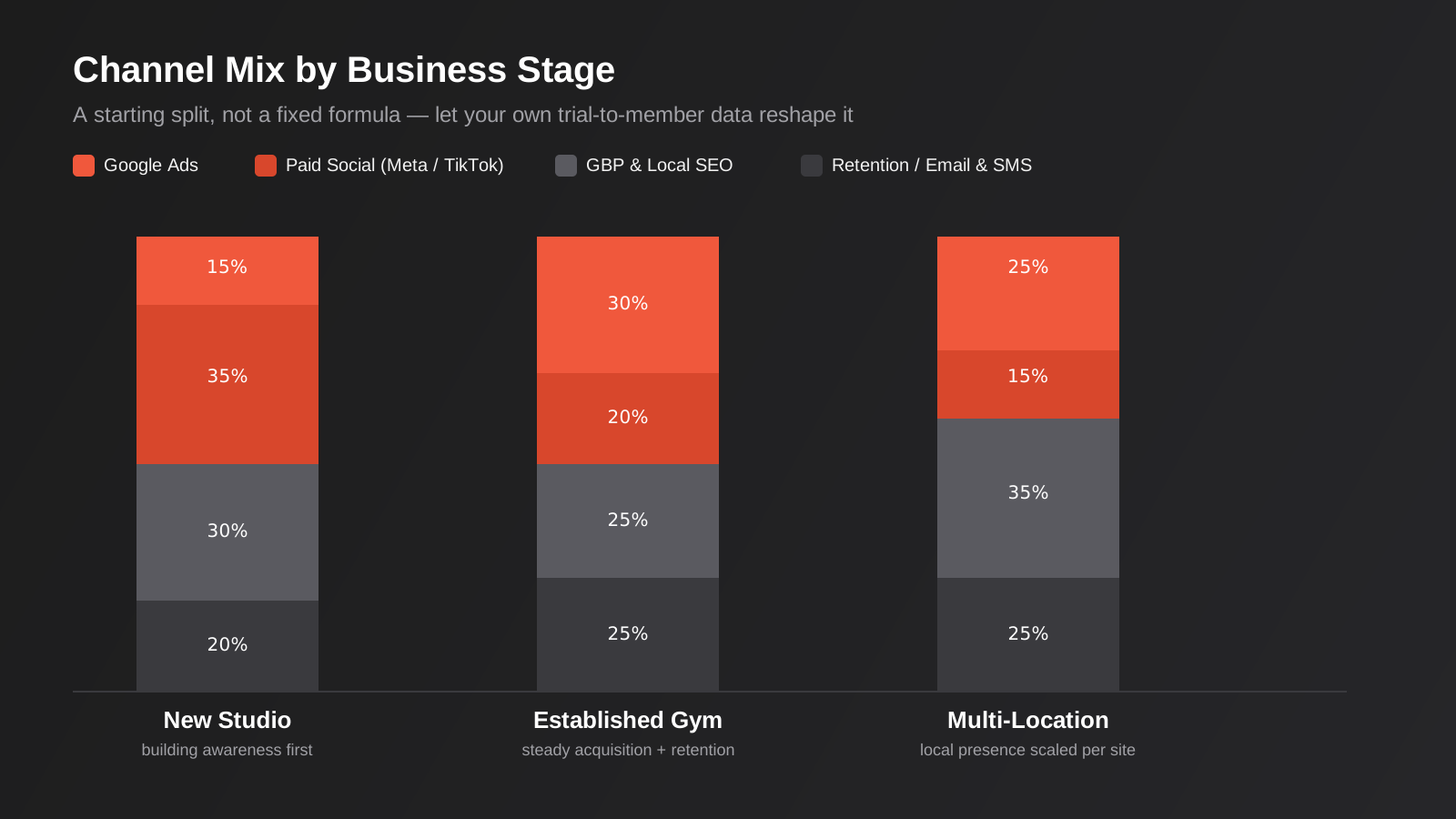
A new studio typically needs a heavier lean toward paid social and content, because it hasn’t yet built the review volume and local search history that make Google Ads and Google Business Profile efficient on their own. An established gym can usually shift more weight toward Google Ads (capturing people already comparing options) and a meaningful, consistent retention budget, because the harder job of building initial local trust is largely done. A multi-location or franchise operation needs a heavier Google Business Profile and local SEO weighting per site — each location is effectively its own local business competing in its own map pack, and treating the group as one undifferentiated brand campaign tends to under-serve every individual site.
Whatever the split, the number that should be reviewed monthly isn’t cost per lead on its own — it’s cost per lead against trial-to-member conversion rate and, ideally, average membership length by acquisition channel. A channel that produces cheap leads who cancel within the cooling-off window is quietly more expensive than a pricier channel that produces members who stay a year.
Common Mistakes We See Constantly
- Sending paid traffic to the homepage instead of a dedicated trial-offer landing page, forcing someone who just wants to know “can I try this and what’s it cost” to dig for the answer.
- Letting the Google Business Profile go stale after launch — outdated photos, an old class timetable, categories that don’t reflect what’s actually on offer.
- No follow-up sequence after a trial is booked, relying on the person simply showing up without a reminder, a confirmation or a check-in if they don’t.
- Running one undifferentiated campaign across group fitness and PT offers, which compromises messaging and landing pages for both.
- Treating reviews as a quarterly email blast instead of a trigger sent at the actual emotional high point — right after a great class or a successful trial.
- Advertising a deal as simpler to cancel than the actual contract allows, which risks both a consumer law problem and a trust problem the moment someone tries to leave.
- Measuring cost per lead without measuring trial-to-member conversion or average membership length, which makes it impossible to tell a genuinely efficient channel from one that just looks cheap.
- Spending on acquisition every month while retention gets no dedicated budget or owner, despite retention being the cheaper lever almost every time.
Frequently Asked Questions
Is Google Ads or Meta better for a gym or studio?
They tend to do different jobs rather than compete directly. Google Ads reaches people who’ve already decided they want a gym or studio and are comparing options, so it’s usually higher-intent and more expensive per lead. Meta (and TikTok) generally produce cheaper leads by reaching people earlier, before they’ve started actively searching, which works well for warming up an audience and lowering your Google cost per lead over time through retargeting. Most established gyms and studios run both, weighted differently depending on business stage.
How much should a gym or studio budget for digital marketing?
It depends heavily on membership price point, local competition and what stage the business is at, but the more useful planning question is what stage you’re at rather than a flat percentage of revenue. A new studio generally needs more weighted toward paid social, content and trial offers to build initial awareness, while an established gym can shift more budget toward Google Ads and a dedicated, ongoing retention budget once local trust and review volume are already in place.
Do I really need a separate landing page for a trial offer?
Yes, in most cases it’s one of the higher-impact, lower-cost fixes available. A homepage is trying to explain the whole business to every kind of visitor; a trial-offer landing page only has to answer one question for one kind of visitor — what’s the offer, what does it cost, and how do I book it — which consistently converts paid traffic better than a generic page built for a different job.
What’s the cooling-off period for gym memberships in Australia?
There’s no single national period — it varies by state under a mix of Australian Consumer Law and state fair trading rules. Queensland, for instance, sets a 48-hour cooling-off period with a 14-day refund turnaround, minus any reasonable usage or admin fee. Check your own state’s current fair trading guidance before setting contract terms or writing cancellation claims into ads and landing pages, since the specific periods and conditions differ and can change.
Should personal trainers market themselves differently to gyms and studios?
Generally yes. A PT’s sales cycle looks more like a professional services decision — trust in one specific person, evidence of real results, often a short consultation before committing — than the lower-touch, higher-volume decision behind joining a gym. Volume-focused tactics like broad paid reach matter less than specific, honestly framed proof of results and a genuine personal brand.
Why do trial sign-ups not show up for their first visit?
Most commonly, no confirmation or reminder was sent between booking and the session itself, so the trial loses priority against everything else in someone’s week. A short automated sequence — immediate confirmation, a reminder the day before, and a genuine check-in if they don’t show — recovers a meaningful share of trials that would otherwise just quietly disappear, and it’s a far cheaper fix than generating a replacement lead from scratch.
Where to Start
If you’re working out where to focus first, start by being honest about which of the three business shapes you actually are — low-touch access gym, community-driven studio, or trust-based PT practice — because that decision shapes almost everything downstream: what your Google Business Profile needs to emphasise, which paid channel deserves the bigger share of budget, and what your trial-offer landing page should actually say. From there, an honest audit of what’s already running — profile health, whether trial follow-up exists at all, and whether cost per lead is being measured against conversion and retention rather than in isolation — usually surfaces the two or three fixes that matter more than anything new you could add on top.
We work with gyms, studios and personal trainers across Australia on exactly this mix of local search, paid acquisition and the retention side most marketing plans leave out. If you’d like a second opinion on what’s currently running and where the real gaps are, get in touch and we’ll have a look — no pressure, just a genuine conversation about what would actually move the needle for your business.
Keep reading
Related posts

Digital Marketing for Car Dealerships and Workshops in Australia (2026)
Digital marketing for Australian car dealerships and workshops: local SEO, Google Ads, booking flows, and the price-advertising rule every dealer must follow.
Digital Marketing for Australian Manufacturers: Turning Visitors Into RFQs (2026)
How Australian manufacturers turn website visits into RFQs: capability pages, product SEO, LinkedIn Ads for procurement buyers, and quote automation.
Marketing for Recruitment Agencies in Australia: Winning Both Clients and Candidates
Recruitment agencies sell to two audiences at once. How SEO, LinkedIn Ads, job board strategy and compliance need to split between employers…
Got a project you'd like to talk through?
Tell us what you're working on — we'll come back with a plan.
