
Cosmetic Clinic Advertising Rules in Australia: AHPRA, TGA and What You Can Legally Say (2026)
 Jignesh Vagadiya
20/10/2026
21 min read
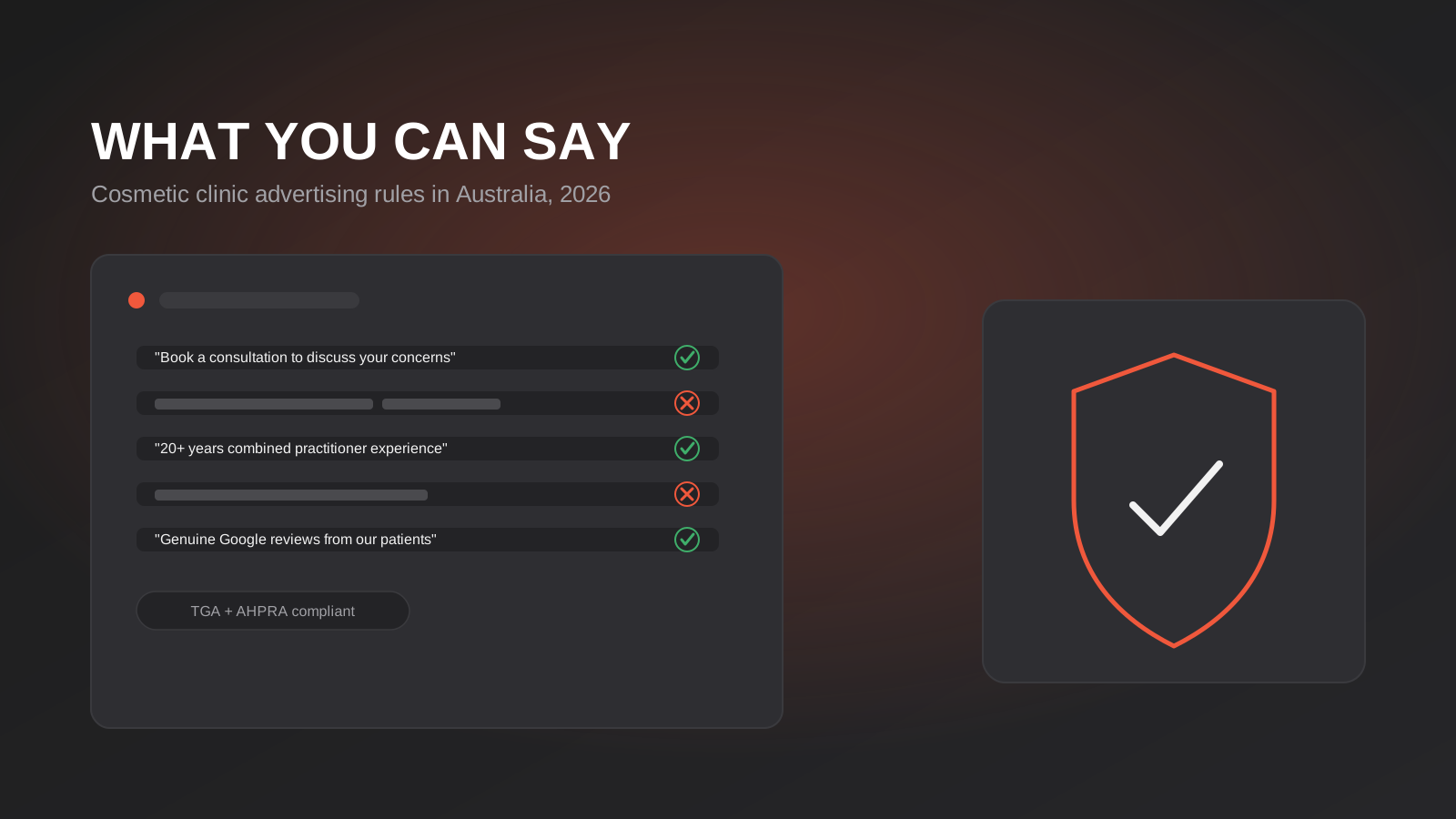
A skin clinic in Brisbane ran a well-produced Instagram campaign for its anti-wrinkle treatments in early 2026. Good creative, decent targeting, a landing page that converted. Meta pulled it within days, not for the imagery but for the wording — the ad named the treatment in a way that pointed straight at a prescription-only medicine. The clinic wasn’t trying to break the rules. Nobody had told them where the line actually sits.
That story is unremarkable because it happens constantly. An Operation Redress audit of 100 Australian cosmetic clinic websites found prohibited terms on 98 of them. Not a handful of bad actors — nearly the entire sample. Most of that non-compliance isn’t deliberate. It’s clinics copying language every competitor uses, built by web developers and marketers who never read the Therapeutic Goods Advertising Code, operating in a category where the rules changed meaningfully as recently as September 2025.
We work with skin and cosmetic clinics on marketing and website design, and this is the question that comes up in almost every first conversation: what can we actually say? This guide sets out the cosmetic clinic advertising rules in Australia properly — what the Therapeutic Goods Administration (TGA) controls, what AHPRA controls, what changed in 2025, and the marketing model that works inside both sets of rules instead of quietly ignoring them.
The two-regulator problem behind cosmetic clinic advertising rules
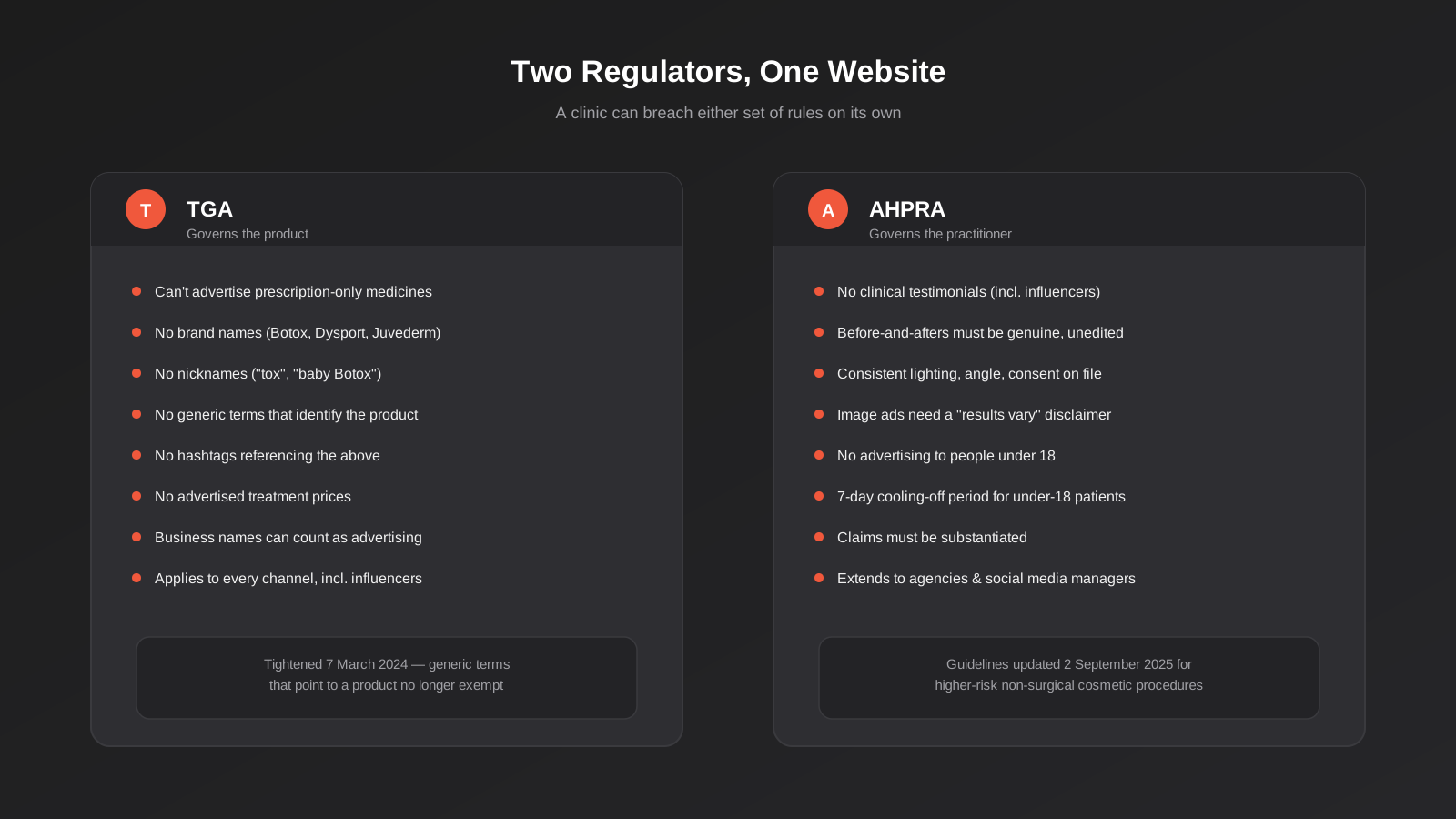
Cosmetic clinic marketing in Australia sits under two separate regulatory regimes that overlap but aren’t the same thing, and conflating them is where most confusion starts. One governs the product. The other governs the practitioner. A clinic can be compliant with one and still be in breach of the other.
What the TGA controls
Botulinum toxin (the active ingredient in anti-wrinkle injectables) and most dermal filler products are Schedule 4 prescription-only medicines. Under the Therapeutic Goods Act and the Therapeutic Goods Advertising Code, prescription-only medicines cannot be advertised to the public, full stop. That’s not a cosmetic-industry-specific rule — it’s the same principle that stops a pharmaceutical company running a TV ad for a blood pressure medication. Cosmetic clinics just happen to be the industry where it collides hardest with normal marketing instinct, because naming the exact treatment someone is searching for is usually step one of digital marketing.
The TGA tightened its guidance on 7 March 2024, and the update closed a loophole clinics had been using for years. Terms like “anti-wrinkle injections” and “dermal fillers” had previously been treated as acceptable generic language. The updated guidance makes clear that generic terms are still unlawful where they clearly point a consumer toward a specific prescription-only product — which, in practice, most of them do. A clinic that writes “book your anti-wrinkle treatment today” is almost certainly still in breach, because there’s no real ambiguity about what’s being sold.
The ban reaches further than most clinics expect. It covers brand names (Botox, Dysport, Juvederm), the informal nicknames patients and staff use (“tox”, “baby Botox”, “lip filler”), hashtags that reference any of the above, and advertised prices for the treatment itself. Even a clinic’s business name can be treated as unlawful advertising if it clearly references a prescription-only product — a name like “[Suburb] Botox Clinic” tells the TGA (correctly) exactly what’s being promoted. The Code applies to every channel: website copy, social media posts, paid ads, email, SMS, printed signage and influencer content posted by someone the clinic paid or gifted treatment to.
What AHPRA controls
Separately, every registered health practitioner in Australia — doctors, nurses, nurse practitioners administering these treatments — is bound by AHPRA’s advertising guidelines under the Health Practitioner Regulation National Law. These rules exist regardless of what’s being advertised; they govern how a practitioner can present their service generally, including claims, testimonials and imagery. For most industries this is a background compliance issue. For cosmetic procedures specifically, AHPRA has progressively tightened the guidelines because this category carries a documented history of misleading advertising, unrealistic before-and-after imagery and pressure-selling.
So a clinic answers to two different bodies with two different remits, and a marketing decision can trip either one independently. Naming a treatment breaches TGA rules regardless of how you present it. Running a testimonial about clinical outcomes breaches AHPRA’s guidelines even if you never mention a product name. Treating these as one combined “cosmetic compliance” problem, rather than two separate sets of rules that both need satisfying, is the most common structural mistake we see in clinic marketing.
What changed on 2 September 2025
AHPRA’s updated guidelines for advertising higher-risk non-surgical cosmetic procedures — injectables, dermal fillers and similar treatments — took effect on 2 September 2025, and they apply not just to practitioners but to the marketing agencies, social media managers and influencers working with them. If your clinic’s social media is run by an external agency or a freelancer, that person is now operating under the same restrictions the practice itself faces. “We didn’t know our agency was posting that” isn’t a defence that holds up well.
The testimonial ban
Testimonials about clinical aspects of cosmetic care are now explicitly prohibited under AHPRA’s guidelines, and the prohibition extends to influencer content — a paid or gifted post from an influencer describing their results counts as a testimonial for these purposes. This catches a lot of clinics off guard because testimonials are such standard currency in beauty and wellness marketing generally. The distinction that matters: a patient saying “the team made me feel comfortable and the clinic was spotless” is a service review. A patient saying “my lines are so much softer, I love my results” is a clinical testimonial, and it’s now off the table.
Before-and-after imagery
Before-and-after photos remain permitted but under tighter conditions. Images must be genuine and unedited — no retouching, no selective lighting that exaggerates the before shot or flatters the after shot, no angle changes between the two photos that create a misleading impression of the result. Where an image-based ad is used, a disclaimer that results vary between individuals is now required. Given that before-and-after photography is usually the single most persuasive asset a cosmetic clinic has, it’s worth treating the photography protocol — consistent lighting, consistent camera position, consistent distance, documented consent — as a standing operating procedure, not something improvised per patient.
Minors and the cooling-off period
Advertising non-surgical cosmetic procedures to people under 18 is now banned outright. For patients under 18 who do proceed (within whatever separate clinical and parental consent requirements apply), a mandatory seven-day cooling-off period now sits between the first consultation and the procedure itself. This has direct marketing implications beyond the obvious one: any paid social targeting that could reasonably reach a under-18 audience needs its targeting parameters checked, and any booking funnel needs to handle the cooling-off period without quietly pressuring a young patient to skip it.
What you still can’t say, even though it’s tempting
Knowing the rules exist is one thing. Knowing exactly where the line sits in your own copy is the harder part, because the unlawful phrasing is often one word away from something perfectly fine. A few patterns worth checking against your current website right now:
- Brand names and their shorthand — “Botox”, “Dysport”, “Juvederm”, “tox”, “baby Botox” — anywhere in copy, image alt text, page titles or metadata.
- Generic treatment terms used in a way that clearly identifies the product, such as “anti-wrinkle injections” paired with a price or a specific results claim.
- Hashtags referencing any of the above, including on reposted or boosted influencer content.
- Published prices for the injectable treatment itself (skincare, consultations and non-prescription services can be priced openly).
- A business name or domain that functions as advertising for a specific product.
- Clinical testimonials in any format — written, video, or an influencer describing their own results.
None of this is compliance advice specific to your clinic, and your own legal or compliance adviser should review your actual copy — we’re a marketing and web development agency, not a law firm. But we won’t build a site around brand names you aren’t permitted to publish, because rebuilding it after a TGA warning letter costs more than building it correctly the first time.
Auditing your own site in an afternoon
You don’t need a developer to do a first pass. Pull up every page on your site — including ones you haven’t touched in a year, like an old blog post or a seasonal promotion page nobody deleted — and search the page source, not just the visible text, for brand names and their shorthand. Browser “find on page” (Ctrl+F or Cmd+F) catches visible copy; viewing page source or using your CMS’s search function catches alt text, meta descriptions and page titles, which are exactly where legacy breaches tend to hide because nobody reviews them once they’re set.
Check your Google Business Profile posts and Q&A section separately — it’s a live advertising surface that’s easy to forget sits under the same rules as your website. Check any PDF price lists or downloadable brochures too; a PDF uploaded three years ago doesn’t update itself when your website copy does, and it’s just as much “advertising to the public” as a web page. Finally, pull your last twelve months of social posts and skim for testimonials, named treatments and before-and-after pairs that weren’t shot under consistent conditions. This isn’t a legal audit, but it will surface the obvious issues fast, and it’s the same exercise we run before taking on a new clinic client.
If you find something, the fix usually isn’t a full rebuild — it’s rewording the specific pages and purging the specific posts, then changing the editorial process so new content doesn’t repeat the mistake. The bigger risk is not knowing it’s there at all.
It’s worth adding one more layer here, because clinics sometimes assume the rules are a single national standard and stop checking once they’ve covered the TGA and AHPRA. State and territory health departments can apply additional requirements on top — Queensland Health, for example, updated its own guidance on cosmetic procedures in April 2025, sitting alongside the national rules rather than replacing them. If you operate across state lines, or you’re planning to, it’s worth checking whether your home state’s guidance has been updated recently rather than assuming national compliance covers everything.
The compliant marketing model: sell the consultation, not the treatment
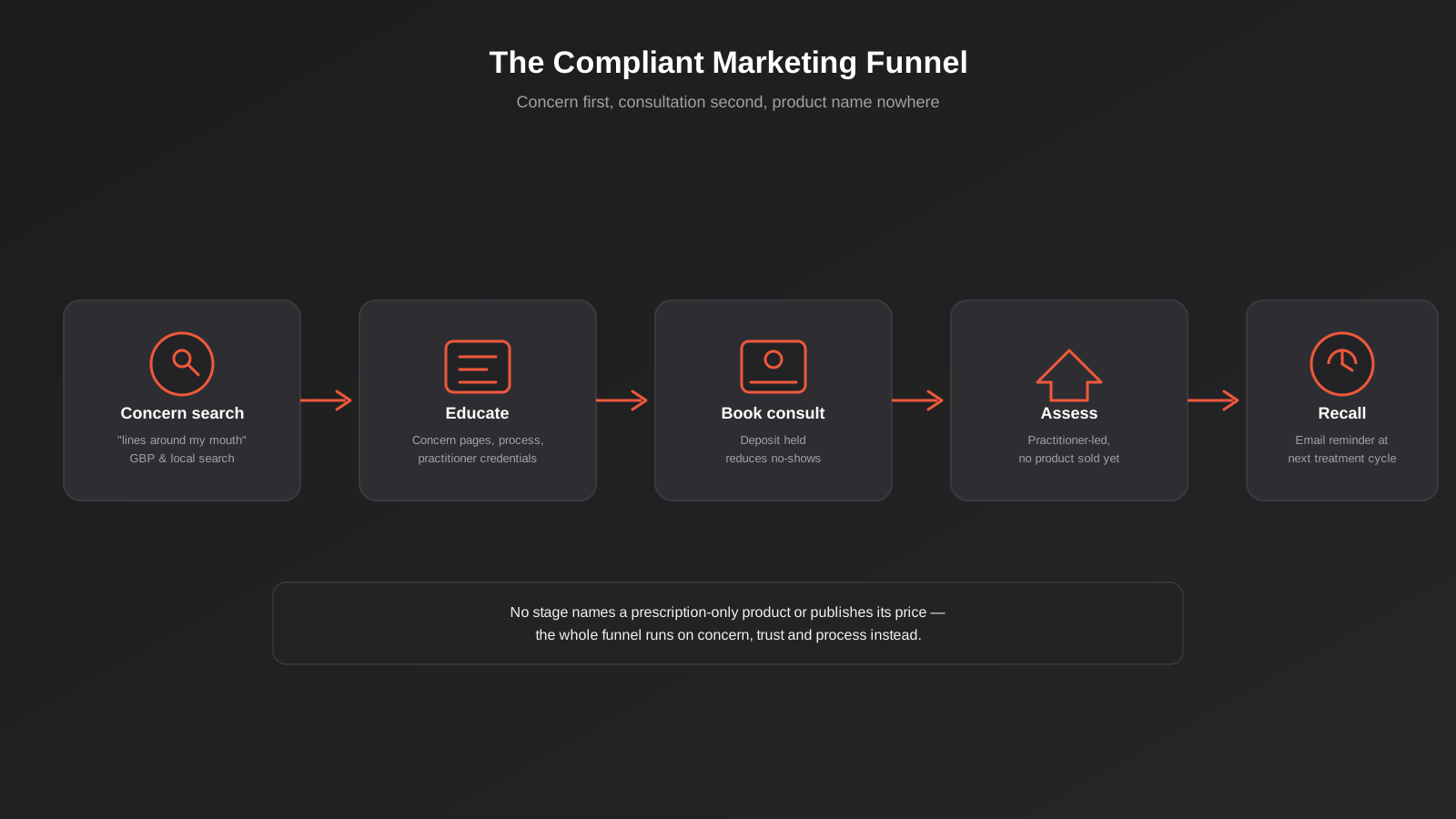
Here’s the part most clinics miss, and it’s genuinely good news rather than a workaround. You can’t advertise the product. You can advertise almost everything around it — the concern someone’s trying to address, the assessment process, the practitioner’s qualifications, the clinic environment, the booking experience. That’s not a loophole; it’s a legitimate and, done properly, more effective funnel than naming a treatment ever was.
People searching for cosmetic treatment information are mostly searching by concern, not by product name: “lines around my mouth getting worse”, “why does my face look tired”, “options for sagging jawline”. Someone who doesn’t know injectables are even an option for their concern is a far more valuable lead than someone who’s already decided on a specific product and is shopping purely on price. Content and ad creative built around the concern reaches that first group. Content built around a named treatment only ever reaches the second.
Concern-based content and SEO
Structurally, this means building content and page architecture around concerns and outcomes rather than product pages. A page about “softening fine lines around the eyes” that explains the range of approaches, what a consultation involves, and what results genuinely look like will outrank and out-convert a page that just lists a treatment name and a price — partly because it’s not competing in the same crowded, policy-flagged keyword space every other clinic is chasing, and partly because it answers the actual question the searcher came with.
This is also where local SEO and Google Business Profile carry disproportionate weight for clinics, because “cosmetic clinic near me” and suburb-level searches sit outside any advertising restriction — they’re not advertising a specific product, they’re helping someone find a business. A strong, regularly updated Google Business Profile with genuine service reviews (not clinical testimonials) is one of the few assets in this category that’s both highly effective and entirely unrestricted.
Reviews versus testimonials — the line that actually matters
This distinction is worth labouring because it trips up so many clinics. A Google Business Profile review about wait times, staff friendliness, the cleanliness of the clinic or how the booking process went is a service review, and it sits outside AHPRA’s testimonial restriction. A review describing clinical results — “my skin looks ten years younger” — strays into exactly the territory the September 2025 guidelines close off, regardless of which platform it’s posted on. Clinics can’t fully control what a patient chooses to write in a public review, but they can control what they solicit, what they repost, and what they feature on their own website and social channels. The safe practice is to only actively request and promote reviews about the experience, not the clinical outcome.
Qualifications and process as trust signals
With testimonials restricted and product names off-limits, the trust signals that remain are practitioner qualifications, years of experience, professional memberships, and a transparent description of what actually happens in a consultation. This content is entirely unrestricted and, for a category where patients are inherently nervous about who’s holding the needle, genuinely persuasive on its own terms. A page that walks through the assessment process — what’s discussed, what’s measured, what the practitioner is qualified to do and not do — does real conversion work that a treatment price list never could, because it answers the trust question rather than the price question.
Channel by channel: what actually works
SEO and local search
Organic search is the channel least affected by the advertising restrictions, because ranking for concern-based and local terms doesn’t require naming a product at all. The practical build order is a concern-and-condition page structure (not a treatment-name page structure), a genuinely optimised Google Business Profile, and suburb-level content if you operate across more than one location. If your clinic also runs broader SEO alongside this, the concern-based structure should sit underneath that strategy rather than bolted on separately — the keyword research and content planning are the same discipline, just applied to a more constrained vocabulary.
Paid social: the law, then the platform’s own rules on top
Paid social for cosmetic clinics has to clear two separate hurdles. The first is the legal restrictions already covered. The second is each platform’s own advertising policy, which is frequently stricter than the law requires and applies regardless of jurisdiction. Meta in particular routinely rejects before-and-after imagery, body-focused creative and certain health claims even when the underlying copy is fully compliant with Australian law — the Brisbane clinic example that opened this guide is a common pattern, not an edge case. Creative for this category needs to be built anticipating both sets of rules from the first draft, because redesigning an ad after a rejection wastes the exact window (a seasonal promotion, a new practitioner launch) the campaign was built around.
Email and retention for treatment cycles
Most cosmetic treatments have a natural re-booking interval — three to four months for many injectable categories, longer for others — and email is the channel best suited to working that cycle, because it’s a direct relationship with an existing patient rather than a cold audience. The compliance posture is slightly different here too: communicating with existing patients about their own ongoing care sits closer to clinical communication than public advertising, though the same TGA restrictions on naming prescription products still apply to any promotional content. A reminder that it’s “time to book your next appointment” with a clear booking link does the job without naming anything.
Website and the booking funnel
The website is where all of this has to come together structurally, not just in the copy. A consultation-first booking flow, deposit collection to reduce the no-show rate (cosmetic consultations run a meaningfully higher no-show rate than general healthcare appointments), and a clean separation between concern pages, practitioner pages and the booking step all matter more here than in most industries, because the site can’t lean on the product-focused landing pages that work for almost everything else. Good conversion-focused design — clear hierarchy, minimal friction between “I have a concern” and “I’ve booked a consultation” — carries more of the commercial weight when you can’t simply put a treatment name and a price in a hero banner.
It’s also worth building the retail side of the business properly rather than treating it as an afterthought. Skincare and cosmeceutical products aren’t subject to the same prescription-advertising restrictions, carry healthy margins, and are a recurring purchase for existing patients who are already primed to buy what was recommended in a consultation. A proper ecommerce setup with repeat ordering and client-only product access captures revenue that a lot of clinics currently hand to third-party retailers simply because their own site doesn’t make it easy to reorder.
Enforcement: what actually happens if you get it wrong
The practical risk picture is worth understanding honestly, because it shapes how urgently clinics should treat this. The TGA reported removing over 2,000 unlawful cosmetic advertisements in a single year, almost entirely through warning letters and voluntary takedown requests rather than prosecution — no provider was referred for prosecution in 2024 despite the scale of non-compliance the Operation Redress audit uncovered. That doesn’t mean the risk is theoretical. A warning letter still means pulling live ad campaigns and rebuilding website copy on short notice, often during a period when the clinic can least afford the disruption, and it sits on file if the same breach recurs. AHPRA’s parallel track carries separate consequences for the registered practitioner personally, since advertising breaches sit alongside the practitioner’s broader professional conduct obligations under the National Law — a different and generally more serious exposure than a TGA takedown notice.
Platform-level enforcement, by contrast, is immediate and happens constantly regardless of whether the TGA ever gets involved. An ad gets flagged, the campaign stops serving, and the ad spend scheduled against it is simply gone. For most clinics, the platform’s own enforcement is the risk they’ll actually experience day to day; the regulatory risk is the one that does lasting damage if it ever lands.
There’s also a complaints pathway that operates independently of any proactive audit. Competitors, former patients and consumer advocacy groups can and do report suspected breaches directly to the TGA, and a reported ad tends to move through the system faster than one the TGA finds itself through routine monitoring. In a category as commercially competitive as cosmetic clinics, assuming a competitor won’t eventually notice and report a brand name on your site is optimistic. The practical implication is that the audit covered above isn’t a one-off task to tick off — it’s worth repeating whenever a new staff member takes over social media, a new practitioner joins and brings their own content habits, or you run a seasonal campaign under time pressure and skip the usual review.
Common mistakes
- Naming the specific brand or using the common nickname anywhere in website copy, alt text or page titles, assuming “everyone calls it that” makes it safe.
- Treating generic terms like “anti-wrinkle injections” as automatically compliant after the March 2024 update tightened exactly this loophole.
- Featuring clinical testimonials — including reposted influencer content — collected before the September 2025 guidelines took effect, without auditing what’s still live.
- Editing or inconsistently lighting before-and-after photos, which now breaches the guidelines even when the underlying result is genuine.
- Letting an external social media manager or agency post without briefing them on the restrictions, given they now carry the same compliance exposure as the practice.
- Building paid ad creative around a treatment price, then being surprised when the platform rejects it before the legal issue even comes into play.
- Ignoring Google Business Profile because it feels like a minor channel, when it’s one of the few places social proof can be built without restriction.
- Selling skincare and retail through a generic product gallery instead of a proper store, leaving recurring revenue on the table.
Frequently Asked Questions
Can we name injectable brands anywhere on our website?
No. Botulinum toxin and dermal filler products are prescription-only medicines under Australian therapeutic goods law, and advertising them to the public — including by brand name, nickname or a generic term that clearly identifies the product — is prohibited. This applies to every page on your site, not just obvious treatment pages, and it covers alt text and metadata as well as visible copy.
Does the testimonial ban cover Google reviews too?
It covers what you solicit and promote, more than what a patient independently writes. A Google Business Profile review about the service experience — staff, cleanliness, booking ease — sits outside AHPRA’s restriction on clinical testimonials. A review describing a clinical outcome strays into the territory the September 2025 guidelines close off, regardless of the platform. The safer practice is to only actively request and feature reviews about the experience, not the result.
Will removing brand names from our site hurt our search rankings?
Less than most clinics fear. Concern-based and outcome-based searches represent genuine, substantial search volume in their own right, and they’re far less contested than branded treatment terms every competitor is also chasing (often unlawfully). The traffic composition shifts toward people earlier in their decision process, which tends to convert at least as well once they reach a consultation-first site.
Can we still run before-and-after photos in ads?
Yes, with conditions. Images need to be genuine and unedited, taken under consistent lighting, angle and distance, with appropriate patient consent on file, and image-based ads now need a disclaimer that results vary. Separately, expect social platforms to reject some compliant before-and-after creative anyway under their own advertising policies, which are often stricter than the law requires.
Does the AHPRA testimonial ban apply to our marketing agency, not just us?
Yes. The September 2025 guidelines explicitly extend to agencies, social media managers and influencers working with the practice, not just the registered practitioner. If an external party runs your social accounts, they need to be briefed on these restrictions directly — the practice carries the exposure either way.
What’s the actual risk if we get this wrong?
Most TGA enforcement to date has been warning letters and takedown requests rather than prosecution, but that still means pulling live campaigns and rewriting website copy on short notice. Platform-level rejection of individual ads happens far more often and far faster than any regulatory action. AHPRA breaches carry separate, generally more serious exposure for the registered practitioner personally under their professional conduct obligations.
Where to start
If you’re reading this because something about your current site feels uncertain, the first useful step is a straight audit — not a redesign, just an honest look at what’s actually live. Check your own copy, image alt text and metadata against the patterns above, and if you’ve got an external agency or social media manager, send them this guide so you’re both working from the same understanding of where the line sits. For the website side specifically, our skin and cosmetic clinic marketing and website design page goes into how we structure concern-led content, booking funnels and skincare retail for clinics working inside these exact rules, and we’ll tell you honestly if anything on your current site looks exposed.
Worth putting a number on it: our own SEO starts from $550 a month — well under the $1,200–$3,000 most Australian small businesses pay for comparable monthly SEO, and a fraction of the $3,000–$8,000 agencies typically charge for competitive, regulated categories like healthcare and cosmetic clinics. If you’ve already got a written quote from another agency for comparable scope, send it through and we’ll do our best to beat it.
If you’d rather talk it through first, that’s a better starting point than a brief. Tell us what your current site looks like and what’s worrying you about it, and we’ll give you a straight answer on what needs to change and what doesn’t — whether that’s a content restructure, a proper booking funnel, or just a second opinion on a page you’re not sure about. For broader context on how healthcare marketing works under AHPRA generally, our guide to healthcare SEO and AHPRA compliance covers the practitioner advertising rules that apply across medical and dental practices; this guide exists because cosmetic clinics carry an extra layer — the TGA’s restrictions on prescription-only injectables — that general healthcare marketing doesn’t have to deal with.
Keep reading
Related posts

Digital Marketing for Car Dealerships and Workshops in Australia (2026)
Digital marketing for Australian car dealerships and workshops: local SEO, Google Ads, booking flows, and the price-advertising rule every dealer must follow.
Digital Marketing for Australian Manufacturers: Turning Visitors Into RFQs (2026)
How Australian manufacturers turn website visits into RFQs: capability pages, product SEO, LinkedIn Ads for procurement buyers, and quote automation.
Marketing for Recruitment Agencies in Australia: Winning Both Clients and Candidates
Recruitment agencies sell to two audiences at once. How SEO, LinkedIn Ads, job board strategy and compliance need to split between employers…
Got a project you'd like to talk through?
Tell us what you're working on — we'll come back with a plan.
