
Best Accounting Software for Australian Small Business (2026): 6 Compared
 Jignesh Vagadiya
15/10/2026
21 min read
Ask ten Australian small business owners which accounting software they use and you’ll get Xero from about seven of them, MYOB from two, and one person who’s still running a desktop version of something nobody’s updated since 2019. That’s not because Xero is the only option worth having — it’s because nobody tells small business owners there’s anything else to compare it against. The conversation starts and ends with “Xero or MYOB” before anyone’s actually worked out what the business needs.
We set up accounting system integrations for Australian businesses often enough — syncing Xero to Shopify, wiring up payment gateways, connecting inventory and payroll — that we end up with a reasonably honest view of what each platform does well and where it quietly causes problems six months after the sales call. This isn’t a ranked “best to worst” list. It’s six platforms we see genuinely used by real Australian businesses, with a straight account of what each one costs, who it suits, and where it falls over.
Our criteria: current published Australian pricing where a vendor actually publishes one, how well each platform handles GST, BAS and Single Touch Payroll (because an accounting tool that doesn’t handle Australian tax reporting cleanly isn’t really a contender here), what happens once you need more than one user or add inventory, and an honest drawback for each. If a section below reads like it was written by the vendor’s marketing team, we haven’t done the job properly.
What Accounting Software Costs for an Australian Small Business
Published pricing in this category moves more than most SaaS categories, partly because vendors run near-constant introductory discounts that make the “real” ongoing price hard to pin down from a glance at a pricing page. As a rough planning range for 2026: expect somewhere between $15 and $40 a month for a basic single-user plan covering invoicing and bank reconciliation, $60 to $110 a month once you need multiple users, inventory or more advanced reporting, and payroll almost always costs extra on top — either bundled with a per-employee fee or sold as a separate add-on, depending on the vendor. Treat every dollar figure in this piece as a reference point to sanity-check against, not a quote, because every vendor below changes pricing and promotional terms more often than this article will be updated.
What actually drives the price within that range is less about the software and more about what you’re asking it to do. A sole trader invoicing a dozen clients a month needs almost none of what a 15-person business with inventory, multiple bank accounts and award-based payroll needs, and the platforms below are priced accordingly — the gap between the cheapest and most expensive plan on the same platform is often four or five times the entry price. If you’re also planning to connect your accounting platform to Shopify, a POS system or a CRM, it’s worth costing that integration work separately; our automation pricing guide covers what that kind of systems work typically runs, because it’s rarely included in the accounting subscription itself.
There are also a few costs that rarely show up on a vendor’s pricing page but turn up in the actual bill. Some Australian banks charge a fee for direct bank feeds into third-party accounting software — it’s not universal and varies by bank and account type, so check with your own bank rather than assume it’s free. Multi-entity structures (a trust and a company, or two related businesses) usually need a separate subscription for each entity on every platform here, which doubles the monthly cost in a way that’s easy to miss when you’re only costing out the business you’re focused on today. And if you’re migrating from an existing platform, several vendors charge nothing for the migration itself but the bookkeeping hours to clean up and reconcile historical data properly are a real, separate cost worth budgeting for before you commit to switching.
Xero
Xero is the default most Australian bookkeepers and accountants recommend first, and there’s a reasonable reason for that beyond habit: it has by far the largest app marketplace of anything on this list, with well over a thousand third-party integrations covering everything from point-of-sale to inventory management to industry-specific job costing tools. If your business runs on a stack of five or six different SaaS products, there’s a good chance Xero already has a clean, maintained connector for most of them.
Payroll is the other genuine differentiator. Xero includes payroll on every plan tier, including its entry-level plan, where most competitors either leave payroll out entirely or charge a separate per-employee fee on top of the subscription. For a business that’s about to hire its first employee, that one detail can make Xero noticeably cheaper in practice than a platform with a lower sticker price and a payroll add-on. Bank reconciliation is also genuinely good — the matching algorithm handles recurring transactions well, and most Australian banks feed cleanly into it.
Where it falls short: inventory is thin unless you add a third-party app on top, which is itself an extra monthly cost and another system to keep synced. Xero has also raised its Australian prices twice in recent years, and reviewers who’ve used it for several years consistently note that it’s drifted from “the cheap newcomer” to one of the pricier options on this list, particularly once you’re on the Comprehensive or Ultimate tiers. For a product-based business with real inventory needs, that combination — weaker native inventory, higher price — is worth weighing against MYOB before you default to Xero out of habit.
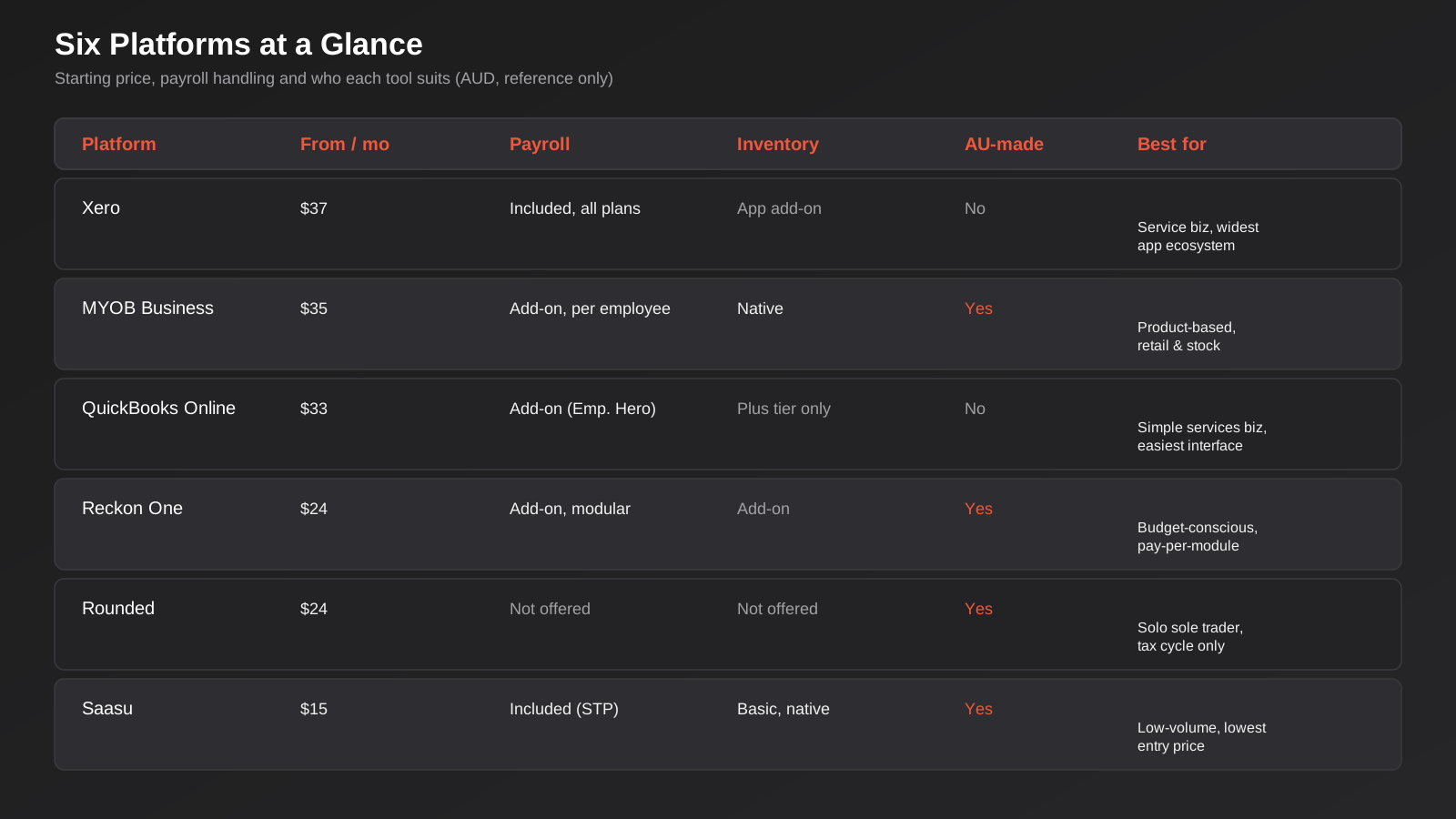
Pricing (reference only, confirm current figures at xero.com/au before committing): Ignite sits around $37 a month, Grow around $78, Comprehensive around $107, and Ultimate 10 around $143, with higher Ultimate tiers for more employees on payroll. All tiers include GST and payroll; multi-currency and more advanced reporting are reserved for the higher tiers.
Xero suits a service-based or multi-system business that values the largest possible app ecosystem and wants payroll included from day one, and is willing to pay a premium for that breadth over a cheaper, narrower competitor.
MYOB Business
MYOB is the platform we see most often in product-based Australian businesses — retailers, light manufacturers, wholesalers — because its native inventory management is genuinely more capable than Xero’s out of the box. Stock tracking, purchase orders, and multi-location inventory are built into the core product rather than bolted on through a third-party app, which matters once a business is managing real physical stock rather than just invoicing for services.
It’s also an Australian company with a long history in local payroll and compliance — MYOB has been handling Australian tax tables, Single Touch Payroll and award interpretation for small business for decades, and that depth shows in how well it handles the compliance side without needing a bolt-on. For a business whose main pain point is getting GST, BAS and payroll right rather than connecting to twenty SaaS tools, that’s a real advantage over Xero’s broader-but-shallower approach.
The honest drawback: payroll isn’t bundled the way it is with Xero. MYOB charges a separate per-employee fee on top of the plan price once you add staff, which changes the real monthly cost meaningfully compared to the headline subscription figure, and it’s easy to underestimate that when comparing plans side by side. User review scores for MYOB also sit consistently below Xero’s across independent review sites, with common complaints around interface responsiveness and customer support wait times rather than core accounting functionality. It’s a capable product that doesn’t always feel as polished day to day as its main competitor.
Pricing (reference only, confirm current figures at myob.com/au before committing): Business Lite runs around $35 a month, Business Pro around $70 a month, with AccountRight Plus (aimed at businesses with more complex inventory and multi-currency needs) running closer to $135 a month. Payroll is billed separately per employee on top of any plan.
MYOB suits a product-based or inventory-heavy Australian business that wants strong native stock management and deep local compliance history, and is comfortable paying payroll as a separate line item rather than bundled into the subscription.
QuickBooks Online
QuickBooks Online is the platform most Australian buyers already know from word of mouth overseas — it’s the dominant accounting platform in the US, and Intuit has brought that same product into the Australian market with local GST and BAS handling. The interface is generally considered the most approachable of the three mainstream platforms for someone with no bookkeeping background, with a simpler visual layout than Xero or MYOB and a gentler learning curve for basic invoicing and expense tracking.
Where it does well: straightforward invoicing, expense categorisation, and a mobile app that’s genuinely usable for photographing receipts and reconciling on the go. For a simple services business — a consultant, a tradie doing their own books, a small agency — the entry-level Simple Start tier covers the basics without much setup overhead, and the step up between tiers is more gradual and predictable than some competitors.
The drawback worth knowing before you commit: QuickBooks’ Australian ecosystem is noticeably thinner than Xero’s or MYOB’s. Fewer Australian bookkeepers and BAS agents use it as their default platform, which can make it harder to find local support when something goes wrong, and fewer Australian-specific third-party apps (industry job management tools, local POS systems) build a QuickBooks integration first compared to Xero. Payroll also isn’t native — it runs through a QuickBooks Payroll add-on powered by Employment Hero, which is a perfectly workable combination but is, again, an extra cost and an extra system to manage rather than one unified product.
Pricing (reference only, confirm current figures at quickbooks.intuit.com/au before committing): Simple Start sits around $33 a month, Essentials around $60, Plus around $84, with an Advanced tier above that for larger teams needing more users and reporting depth. Introductory discounts of up to 70% for the first several months are common and will make the first few invoices look considerably cheaper than the ongoing rate.
QuickBooks Online suits a simple services business that wants the most approachable interface of the three big platforms and doesn’t need a deep bench of local bookkeepers or Australian-specific integrations to fall back on.
Reckon One
Reckon is the quiet Australian-owned option that most small business owners have heard of without necessarily knowing it’s still an active, modern product — it’s the company that used to distribute QuickBooks in Australia and New Zealand before building its own cloud platform, Reckon One, after that licensing arrangement ended. The pitch is modular pricing: rather than buying a fixed tier with features you don’t need, you pick and pay for individual modules (invoicing, payroll, time tracking, cashbook) and build a plan around what your business actually does.
That modularity is genuinely the strongest reason to consider it. A sole trader who only needs invoicing and GST tracking can get in for a noticeably lower monthly cost than the equivalent Xero or MYOB tier, because they’re not paying for payroll or inventory modules they’ll never touch. It’s also an Australian company with Australian-based support, which matters more than it sounds like it should once you’re stuck on a BAS deadline and need an answer the same day.
The honest trade-off is ecosystem size. Reckon’s app marketplace and third-party integration library is a fraction of Xero’s, which matters a lot if your business runs on several other SaaS tools that need to sync cleanly with your books. The interface also reads as functional rather than modern — it does the job without the visual polish of its competitors, and some long-time users describe the migration from the older desktop Reckon products as rougher than it should have been. For a business that’s already outgrown “simple invoicing” and needs broad connectivity, Reckon starts to feel limiting faster than Xero or MYOB do.
Pricing (reference only, confirm current figures at reckon.com/au before committing): the entry Accounting Plus module starts around $24 a month, with payroll available as an add-on from around $16 a month for up to four employees. Because pricing is modular, the real cost depends entirely on which modules you add, which makes it one of the few platforms here where the final price can genuinely undercut Xero or MYOB for a simple setup.
Reckon One suits a cost-conscious Australian small business with straightforward needs that wants to pay only for the modules it actually uses, and values Australian-based support over the biggest possible integration marketplace.
Rounded
Rounded is a genuinely different category of product to the other five on this list, and it’s worth including precisely because most “best accounting software” round-ups ignore it entirely. It’s built from the ground up for one specific person: the Australian sole trader managing their own tax obligations without an accountant doing the heavy lifting, and everything about the product reflects that narrow focus.
Where it earns its place is the Australian sole trader tax cycle specifically. Rounded tracks PAYG instalments, estimates what you’ll owe at tax time as you earn, handles logbook-style vehicle expense claims, and presents GST and BAS obligations in language built for someone without a bookkeeping background — rather than a general ledger that happens to support Australian tax codes, bolted on top of a product designed for a different market. For a freelancer, contractor or very small operator, that specificity genuinely reduces the mental overhead of staying compliant.
The drawback is right there in the positioning: Rounded is not built for teams. There’s no meaningful multi-user access, no payroll module, and no real inventory management, because none of that is what it’s for. The moment a sole trader hires their first employee or takes on a business partner, they’ve outgrown Rounded and need to migrate to one of the fuller platforms above — which is a real cost in time and disruption, even if the monthly subscription saving got them there faster in the meantime.
Pricing (reference only, confirm current figures at rounded.com.au before committing): the Starter plan runs around $24 a month, positioned specifically against Xero’s entry-level Ignite plan as the cheaper, more sole-trader-focused alternative.
Rounded suits a genuine one-person operation — freelancer, contractor, consultant — that wants Australian tax compliance handled simply, and has no near-term plan to add staff or manage inventory.
Saasu
Saasu is the other Australian-made platform on this list, and one of the longest-running — it predates Xero as a cloud accounting product and has quietly kept a loyal base of Australian small businesses who’ve never felt a reason to switch. Like Reckon, it covers the core Australian compliance set properly: GST, BAS, Single Touch Payroll and SuperStream are all built in rather than retrofitted, and its entry pricing undercuts every other platform on this list.
Its real strength is for a small, straightforward business that wants local compliance handled without paying for Xero’s broader (and pricier) ecosystem it’ll never use. Inventory and budgeting tools exist and are reasonably capable for a business that size, and because the entry tier caps transaction volume rather than user count, it can work out cheaper than competitors for a low-volume business with more than one person needing access.
The honest drawback is integration reliability and community size. Saasu’s app marketplace is smaller than Xero’s or MYOB’s, independent reviewers have flagged inconsistent bank feed connections as a recurring complaint, and because its user base is smaller, there’s simply less community knowledge, fewer bookkeepers who specialise in it, and fewer answered forum threads when something doesn’t behave as expected. User satisfaction scores on independent review sites sit lower than the other five platforms here, which is worth weighing against the attractive entry price.
Pricing (reference only, confirm current figures at saasu.com before committing): entry plans start from around $15 a month for a capped number of transactions annually, stepping up through mid and larger business tiers as transaction volume and feature needs grow.
Saasu suits a small, transaction-light Australian business that wants core local compliance handled at the lowest entry price on this list, and is comfortable with a smaller support and integration ecosystem in exchange for that saving.
How to Choose
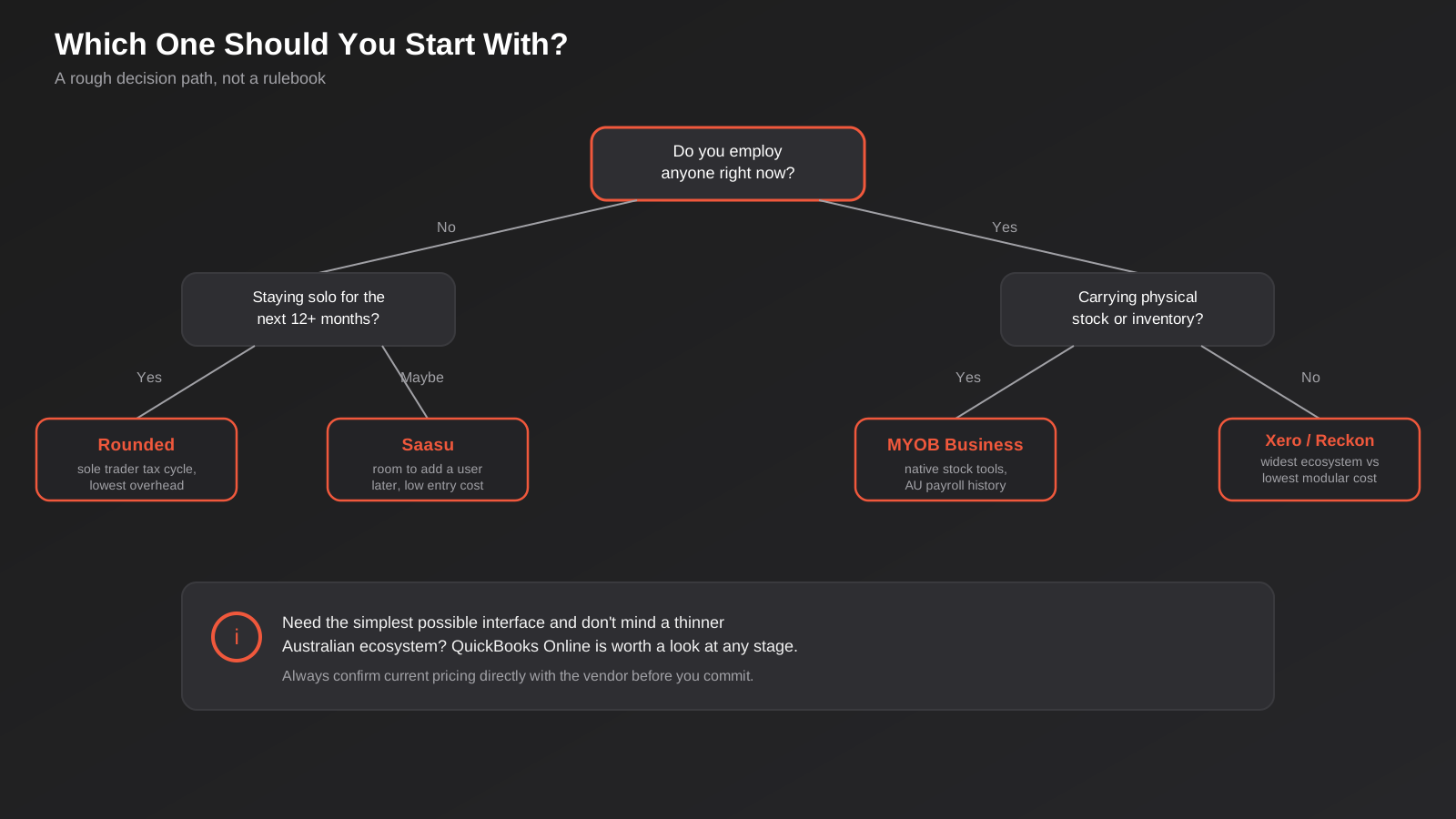
Start with whether you employ anyone, because that single question eliminates half this list immediately. If you’re a genuine sole trader with no plans to hire, Rounded or Saasu’s entry tier will cost less and do everything you actually need. The moment payroll enters the picture, you’re choosing between Xero (payroll bundled into every plan), MYOB or Reckon (payroll as a clearly priced add-on), or QuickBooks (payroll via a third-party add-on) — and the real monthly cost comparison only makes sense once you price in that add-on properly rather than comparing base subscription prices.
Second, be honest about whether you’re product-based or service-based. A business carrying real physical stock should weight MYOB’s native inventory tools more heavily than Xero’s app-marketplace breadth, because adding a third-party inventory app to Xero is itself an extra subscription and another integration point that can break. A service business with no stock to track gets little benefit from that distinction and can prioritise ecosystem size or interface simplicity instead.
If your business operates through a trust, a company and a related sole trader entity — common enough in Australian small business structures, particularly in trades, hospitality and professional services — check how each platform handles multiple entities before you commit to one. Some accountants prefer keeping related entities on the same platform purely for their own workflow efficiency even if it means paying for a second subscription, because reconciling inter-entity loans and distributions is considerably easier when both sets of books live in the same software and reporting format.
Third, factor in what your accounting platform needs to talk to. If you’re running Shopify or WooCommerce, check which of these platforms has a proven, well-maintained connector for your specific stack before assuming they’re interchangeable — Xero’s Shopify integration is the most mature of the group, which is a genuine reason it’s the default recommendation for online retailers even where MYOB’s inventory tools would otherwise suit the business better. We’ve written specifically about connecting Xero to Shopify if that’s the exact combination you’re weighing up.
Fourth, think past the next twelve months, not just the next invoice. A business that’s clearly heading toward multiple warehouses, a proper ERP system or complex multi-entity reporting will eventually outgrow all six of these platforms in their current form, and that’s a different conversation entirely — our guide to ERP integration covers what that transition actually looks like once accounting software alone stops being enough to run the business on.
Finally, talk to your bookkeeper or accountant before you sign up for anything, not after. Most Australian bookkeeping and BAS agent practices specialise in one or two platforms, and choosing one they don’t use well means you’re either paying more for their time while they work around unfamiliar software, or you’re stuck finding a new accountant at the same time you’re migrating systems. That conversation is free and will save you more than any pricing comparison in this article.
Common Mistakes
- Comparing headline subscription prices without pricing in payroll, which is bundled on some platforms and a meaningful separate cost on others.
- Choosing a platform based on its biggest competitor’s reputation rather than what your specific business — product-based, service-based, sole trader, team — actually needs.
- Signing up during an introductory discount period without checking what the ongoing price becomes once the promotion ends, then being surprised six months in.
- Picking the cheapest option for a business that’s about to hire staff or carry inventory, then paying twice to migrate once it’s outgrown within a year.
- Ignoring which platform your bookkeeper or accountant actually uses day to day, and paying more in professional fees as a result of that mismatch.
- Assuming every platform’s Shopify, WooCommerce or POS integration is equally mature, rather than checking the specific connector’s track record before committing.
Frequently Asked Questions
Which accounting software is cheapest for an Australian small business?
For a genuine sole trader with no staff, Saasu’s entry tier and Rounded’s Starter plan are the cheapest options on this list, both priced well below Xero or MYOB’s entry plans. For a business that needs payroll, Reckon One’s modular pricing often works out cheapest because you only pay for the modules you actually use, rather than a fixed tier that includes features you don’t need.
Is Xero or MYOB better for a small business in Australia?
Xero generally suits service-based businesses that want the broadest app ecosystem and payroll bundled into every plan. MYOB generally suits product-based businesses with real inventory to manage, and has a longer track record in Australian payroll compliance specifically, though payroll is a separate cost on top of the subscription. Neither is universally “better” — it depends on whether you’re selling stock or services.
Do I need an accountant if I use Xero, MYOB or QuickBooks?
The software handles the mechanics — invoicing, reconciliation, GST calculation, payroll processing — but it doesn’t replace the judgement an accountant or registered BAS agent brings to tax planning, structuring and lodgement review. Most Australian small businesses run one of these platforms alongside a bookkeeper or accountant rather than instead of one, and your accountant’s familiarity with a given platform is a genuinely useful factor in choosing between them.
Can I switch accounting software once I’ve started using one?
Yes, but it’s genuinely disruptive rather than a quick export-import job. Migrating historical transaction data, reconciling opening balances, re-connecting bank feeds and re-training staff all take real time, and most businesses that switch do so around the start of a new financial year to keep the transition clean. It’s worth getting the choice right the first time rather than treating any platform as a short-term test.
Does accounting software handle GST and BAS automatically?
All six platforms here calculate GST on transactions and can generate a BAS-ready report, but “automatic” still means someone needs to categorise transactions correctly, reconcile the bank feed regularly and review the report before lodging. None of them lodge your BAS directly with the ATO without that human review step, and errors in categorisation are the most common reason a BAS figure comes out wrong.
What’s the difference between Rounded and the bigger platforms like Xero?
Rounded is deliberately narrow: it’s built for one person managing their own sole trader tax obligations, with no payroll, multi-user access or inventory management. Xero, MYOB, QuickBooks and Reckon are all built to scale with a growing business that may add staff, stock or multiple users over time. If you’re confident you’ll stay a sole operator, Rounded’s focus is a genuine advantage; if hiring is even a possibility in the next year or two, a fuller platform avoids a forced migration later.
Is my financial data safe in cloud accounting software?
All six platforms here encrypt data in transit and at rest and run regular backups on their end, which is generally more reliable than a single desktop file on an office computer with no offsite backup. That said, “cloud” doesn’t mean “no responsibility on your end” — use a strong, unique password with two-factor authentication enabled on every accounting login, and be deliberate about who on your team has admin access versus read-only or data-entry access.
Where to Start
If you’re choosing accounting software for the first time, start with the two questions that actually narrow the list fastest: do you employ anyone, and are you carrying physical stock? Those two answers alone will rule out at least three of the six platforms above before you’ve looked at a single pricing page. From there, the gap between the remaining options usually comes down to ecosystem breadth versus cost, and that trade-off is genuinely a judgement call based on what else your business runs on.
If you’re already on one of these platforms and it’s connected to Shopify, WooCommerce, a POS system or payroll, and something in that chain is breaking, duplicating records or costing more time than it should, that’s usually an integration problem rather than a reason to switch accounting software entirely. We help Australian businesses connect, troubleshoot and properly sync their accounting platform with the rest of their systems — see how we approach accounts payable automation for the kind of invoice processing work that sits on top of whichever platform you choose, or get in touch if you want a second opinion on the setup you’re already running. If you’re also comparing CRM platforms as part of the same systems decision, our CRM comparison for Australian small business covers that side of the stack.
Keep reading
Related posts
Changing Live Automations Safely: Staging, Version Control and Rollback for Zapier, Make and n8n (2026)
How to draft, test, release and roll back changes to live Zapier, Make and n8n automations without breaking invoices, orders or customer…
Peppol E-Invoicing for Australian Businesses: Automating Accounts Payable From Structured Invoices (2026)
Peppol e-invoicing in Australia: what is and isn't mandatory, how to pick an access point, and how to automate accounts payable once…
Clean Your Data Before You Automate: A Practical Guide to CRM Data Cleanup for Australian Businesses (2026)
Connecting systems on messy data copies the mess everywhere. Here's how to clean, match and merge records before you automate or integrate.
Got a project you'd like to talk through?
Tell us what you're working on — we'll come back with a plan.
