
AI Data Residency for Australian Businesses: Where Does Your Data Actually Go? (2026)
 Jignesh Vagadiya
10/10/2026
22 min read
A manufacturing client asked us a question last month that we didn’t have an immediate answer to: when their staff pasted a customer’s order details into Copilot to draft a follow-up email, where did that data actually go? Not in the vague sense of “the cloud”—they meant it literally. Which server, in which country, retained for how long, and under whose jurisdiction. We had to go and find out, because nobody at the vendor level had made it easy to answer.
That’s become a fairly common conversation for us. Most Australian businesses adopted AI tools the way they adopt most software—sign up, connect it to something useful, start using it—without pausing on where the actual processing happens. For a spell-checker or a scheduling tool, that’s a reasonable shortcut. For a tool that’s reading customer records, draft contracts, or support tickets full of personal information, it’s a question worth answering before the fact rather than after a client or an auditor asks it first.
This isn’t the AI governance conversation about staff using unapproved tools, and it isn’t the one about locking down what an AI agent is allowed to do inside your systems—we’ve written about both of those separately. This one is narrower and, in our experience, less well understood: it’s about AI data residency in Australia specifically—once you’ve decided an AI tool is approved and scoped correctly, where does the data it touches physically go, and what does Australian law actually require you to do about it?
It matters more in 2026 than it did two years ago, for a simple reason: AI features are now showing up inside tools businesses already trust, often without a clear flag that a new vendor, a new region, or a new set of terms just entered the picture. A CRM that quietly adds an AI summarisation feature, a helpdesk platform that bolts on an AI reply suggestion, an accounting tool that offers to draft client correspondence—each one can introduce a new data flow to a new jurisdiction without your business ever signing a new contract specifically for it.
Data Residency, Data Sovereignty and Data Localisation Aren’t the Same Thing
These three terms get used interchangeably in vendor marketing, which causes more confusion than it solves. They describe different things, and the difference matters when you’re trying to work out what a provider is actually promising you.
Data residency is the simplest of the three: it just means where your data is physically stored, typically which country or cloud region. A vendor saying their data residency is “Australia East” is telling you where the servers sit, full stop.
Data sovereignty goes further. It asks which country’s laws govern that data, regardless of where it’s stored. This is the one that trips people up, because data stored in an Australian data centre owned by a US company can still be subject to US law if that company is required to hand it over under US legislation. Residency tells you where the data sits; sovereignty tells you who can compel access to it.
Data localisation is a legal requirement, not a technical arrangement—it’s when a law or regulation mandates that certain data must stay within a country’s borders, full stop, no exceptions. Australia doesn’t have a broad data localisation law for general business data. It has sector-specific rules (health records in some states, certain government and defence data, some financial services obligations) and a privacy framework that regulates how data crosses borders without banning the crossing outright.
That last point surprises a lot of business owners. Australia’s Privacy Commissioner has been explicit that data sovereignty — in the sense of requiring Australian data to physically stay in Australia — isn’t actually baked into the Privacy Act. The Act protects the data wherever it goes. It just makes you accountable for what happens to it once it leaves.
What Australian Privacy Law Actually Requires
If you handle personal information—and almost every business does, through customers, staff records, or both—Australian Privacy Principle 8 (APP 8) is the rule that governs what happens when that information crosses a border, including when it’s processed by an AI model hosted overseas.
APP 8’s “reasonable steps” test
APP 8 doesn’t prohibit sending personal information overseas. It requires you to take reasonable steps to ensure the overseas recipient doesn’t breach the Australian Privacy Principles with that data, and in most cases, it makes you accountable for what that recipient does with it, as if you’d done it yourself. The OAIC’s APP 8 guidelines set out what “reasonable steps” means in practice and the specific exceptions that apply. In practice, “reasonable steps” usually means a contract with the vendor that binds them to equivalent privacy standards, some visibility into how they actually handle the data, and a documented basis for believing the arrangement holds up—not just a tick-box in a signup flow.
This is where most businesses fall short with AI tools specifically, not because they’re being careless, but because the accountability trail for an AI vendor is harder to establish than it is for, say, a payroll platform. A payroll vendor’s data processing agreement tells you clearly what they store, for how long, and where. Plenty of AI tools—particularly consumer-grade chatbot subscriptions bought on a company card rather than negotiated through procurement—don’t come with anything close to that clarity, and the free or entry-level tiers of major platforms often reserve broader rights to use your inputs than the enterprise tiers do.
Automated decision-making disclosure
The 2024 round of Privacy Act amendments introduced a new transparency obligation that’s being phased in through 2026: where a business uses personal information to make, or materially inform, a decision that significantly affects someone—credit decisions, eligibility assessments, pricing that varies by customer—your privacy policy needs to say so, in terms a person can actually understand. If you’re layering an AI model over a decision that used to be made by a person, this is the provision that catches up with you. It doesn’t ban the practice; it requires you to be upfront that it’s happening and roughly how.
The cross-border exception, and why it barely helps yet
The same amendments created a shortcut: if the overseas recipient is in a country the Australian government has formally recognised as having a comparable privacy framework, or is covered by a binding scheme, you can skip the reasonable-steps analysis entirely. It’s a sensible idea that solves a real problem—except the list of recognised countries is still being built out, so for most AI vendors in 2026, this exception doesn’t yet apply, and you’re still working through the standard reasonable-steps test. Don’t assume a shortcut exists until you’ve actually checked whether the specific country your vendor processes data in is on the list.
AI Data Residency in Australia: Where Your Data Actually Goes
Here’s the part that’s easy to miss even once you understand the legal framework: your application stack and your AI model don’t have to live in the same place, and very often they don’t.
The model layer gap
A business can do everything right on paper—host their CRM in an Australian data centre, store customer records in an Australian database, run their website on Australian infrastructure—and still send personal information overseas the moment they bolt an AI feature onto that stack, because the large language model doing the actual reasoning is very often hosted elsewhere, or routed through infrastructure that isn’t guaranteed to stay in-region even when the provider has an Australian presence.
This is the gap we see most often in practice: a business is confident their data is onshore because their database is, without realising the AI layer sitting on top of it—whether that’s a chatbot, a drafting assistant, or an AI feature built into a SaaS tool they already use—may be calling out to a model hosted somewhere else entirely, sometimes without that being disclosed anywhere obvious in the product.
Four places data actually leaks
When we audit an AI integration for data flow, we’re generally looking at the same four points, because this is where personal information actually moves beyond your control, rather than staying inside systems you directly manage.
- Prompts. Whatever a staff member types into an AI tool, or whatever your system sends to a model as part of an automated workflow, leaves your infrastructure the moment it’s submitted. If that prompt contains a customer’s name, order history, or medical note, that’s personal information crossing whatever border the model sits behind.
- Embeddings. If you’ve built a retrieval system—an internal assistant that searches your documents, for instance—your content gets converted into numerical representations and stored, often with a different vendor again, in a separate database from the one holding your original documents. It’s less obviously “your data” in that form, but it can still be reconstructed close enough to the original to matter under privacy law.
- Logs. Most AI vendors retain some form of interaction log, for debugging, abuse monitoring, or model improvement, depending on the tier and contract you’re on. Consumer and free tiers are far more likely to retain prompts for training than enterprise agreements, which usually let you opt out—but that opt-out needs to be deliberately configured, not assumed.
- Outputs. What the model generates back to you can itself be personal information, particularly with drafting tools that produce a document referencing a real customer. Where that output is cached, logged, or used to fine-tune a future model matters just as much as where the original prompt went.
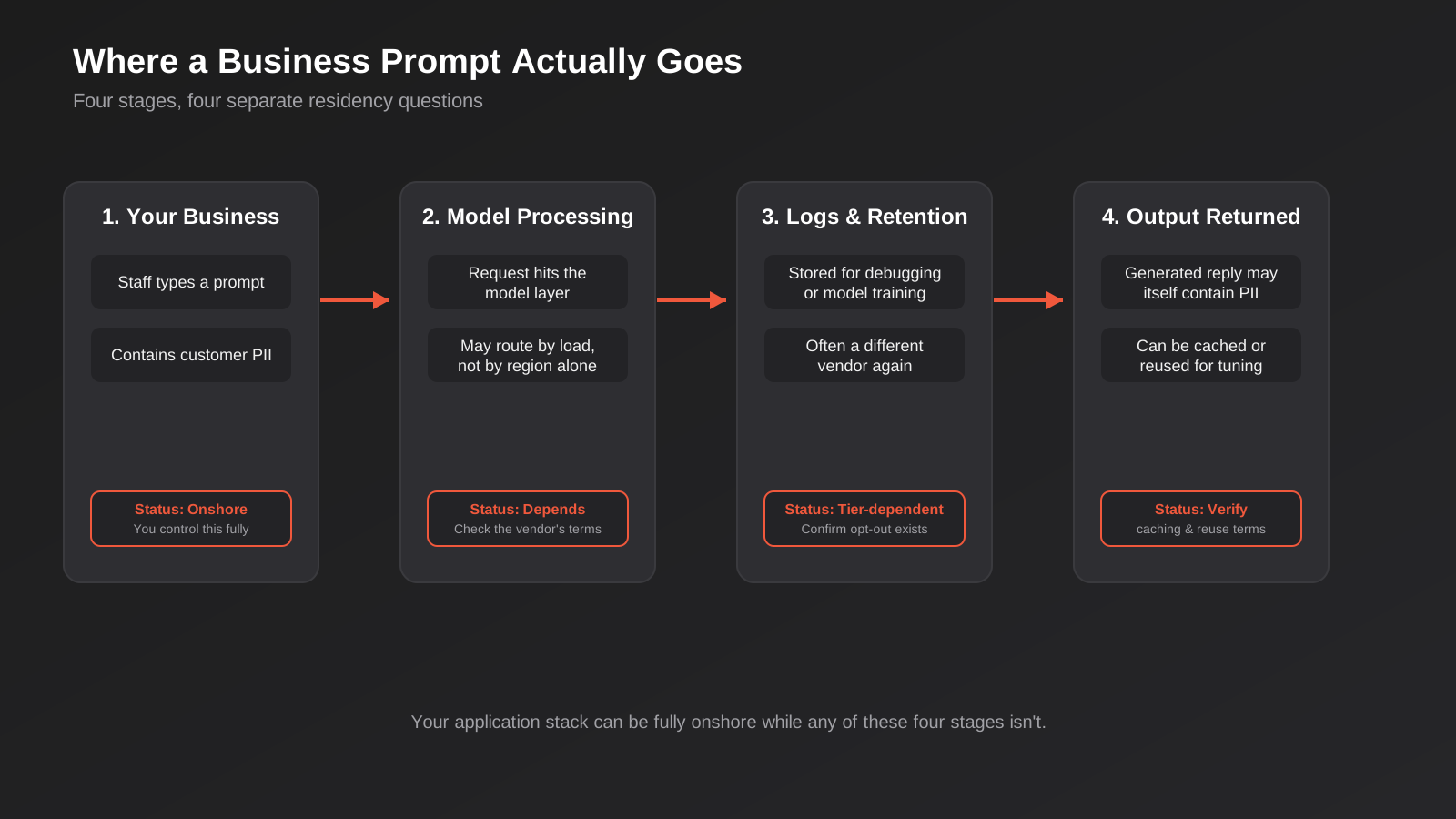
The practical takeaway isn’t that any of this is automatically a problem. It’s that “where does our data go” needs to be answered at each of these four points, for each AI tool connected to personal information, rather than assumed to be the same answer as your main application stack.
What’s Actually Onshore in 2026: Azure, AWS and Google
If your business is building or buying AI functionality on one of the major cloud platforms, here’s roughly where things stand in 2026—though regional availability changes often enough that this is a starting point for your own check, not a substitute for one.
Azure OpenAI (Australia East)
Microsoft offers Azure OpenAI deployments in the Australia East region out of Sydney, and most of the popular model families are available with in-region processing. The gap worth knowing about is that new frontier models tend to land in Australian regions some months after their global release, which means the models actually available onshore can lag behind what you’d get calling the provider’s API directly from the US. If your use case depends on having the newest model available, check whether it’s actually deployed in-region yet, rather than assuming Australia East covers everything Azure offers globally.
AWS Bedrock (Sydney and Melbourne)
AWS runs Bedrock out of both Sydney and Melbourne, and several model families are available through Australian cross-region inference, which keeps processing inside those two regions. Where this gets murkier is when a newer model is made available to Australian customers through what AWS calls global cross-region inference—the request is accepted from an Australian endpoint, but Bedrock is free to route the actual processing to whichever supported region has capacity, which may not be Australia at all. If data residency is a requirement rather than a preference, this distinction is worth confirming model by model, not assumed from the region name on the console.
Google Vertex AI
Google’s position is broadly similar to the other two: regional processing is available for a subset of models through Australian Google Cloud regions, with the newest capabilities typically arriving in-region after their initial global launch. The same rule applies here as with Azure and AWS—check the specific model and region pairing you intend to use, because the platform’s general availability in Australia doesn’t mean every individual model is guaranteed to process there.
The CLOUD Act Agreement wrinkle
There’s a layer above all three of the above that’s easy to miss: the Australia–US CLOUD Act Agreement, which came into force in early 2026, allows US law enforcement to compel data from US-incorporated cloud providers under a streamlined process, even when that data is sitting in an Australian region. This doesn’t mean your data is routinely being accessed—it means the legal protection you might assume comes from “it’s stored in Australia” is weaker than it looks if the provider is a US company, because US jurisdiction can reach into that Australian region under specific legal processes. For most everyday business use this is a background risk rather than a live concern, but it’s a relevant fact for businesses in regulated sectors or handling genuinely sensitive data, and it’s the kind of detail that gets skipped in vendor sales conversations.
A Practical Vendor Questionnaire Before You Adopt an AI Tool
You don’t need a legal team to run this properly, but you do need to actually ask the questions rather than accept a vendor’s marketing page as the answer. Before connecting an AI tool to anything involving customer or staff personal information, we’d want clear answers to the following:
- Which country or region does the model actually process requests in, for the specific plan and model you’re on—not the vendor’s general global footprint?
- Is that processing location guaranteed contractually, or is it “typically” or “usually” the case, with routing elsewhere permitted under load or for newer models?
- Are your prompts and outputs used to train or improve the vendor’s models, and is that configurable or opt-out, or is it fixed by your plan tier?
- What’s the retention period for logs, and can you request deletion?
- Does the vendor’s data processing agreement name the specific sub-processors involved, including any model provider they’re reselling access to, rather than just naming themselves?
- If the vendor is a US entity, or uses US-based infrastructure, have you factored in CLOUD Act exposure for anything genuinely sensitive?
- Is there an enterprise or business tier with materially different data handling terms than the consumer tier your staff might otherwise sign up for on a personal card?
That last point is worth emphasising on its own. A huge amount of AI data exposure we see isn’t from a deliberate architectural decision—it’s from a staff member signing up for a free or personal-tier AI tool because it was faster than waiting for IT to approve something, and that free tier having materially weaker data handling terms than the paid business tier of the exact same product. This overlaps with what we’ve written about managing shadow AI use, but the data residency angle is the specific reason it matters here: the tier someone signs up for on their own initiative often comes with a different, less favourable answer to every question on this list.
What to do when a vendor won’t answer clearly
Not every vendor will have a crisp answer ready, particularly smaller SaaS platforms that have bolted AI features onto an existing product by calling out to a third-party model provider behind the scenes. That’s not automatically a dealbreaker, but it changes what you’re relying on: instead of a direct contractual guarantee from the company processing your data, you’re relying on a chain of agreements between your vendor and whichever model provider they’re reselling, and you may not get to see those terms at all. In that situation, push for the name of the underlying model provider specifically—most platforms will tell you if asked directly even when it isn’t advertised—and treat the absence of a clear answer as a reason to limit what you send through that tool rather than assuming the best. A vendor that genuinely can’t tell you where processing happens usually hasn’t thought about it either, which tells you something about how carefully the rest of their data handling has been built.
It’s also worth building this question into procurement before a tool is adopted, not after. Once an AI feature is embedded in a platform your team relies on daily, the leverage to demand better terms—or to walk away if the vendor can’t provide them—drops considerably. Asking the data residency questions during the trial or sales process, while you’re still a prospect rather than a locked-in customer, tends to get clearer answers than asking the same questions a year into the contract.
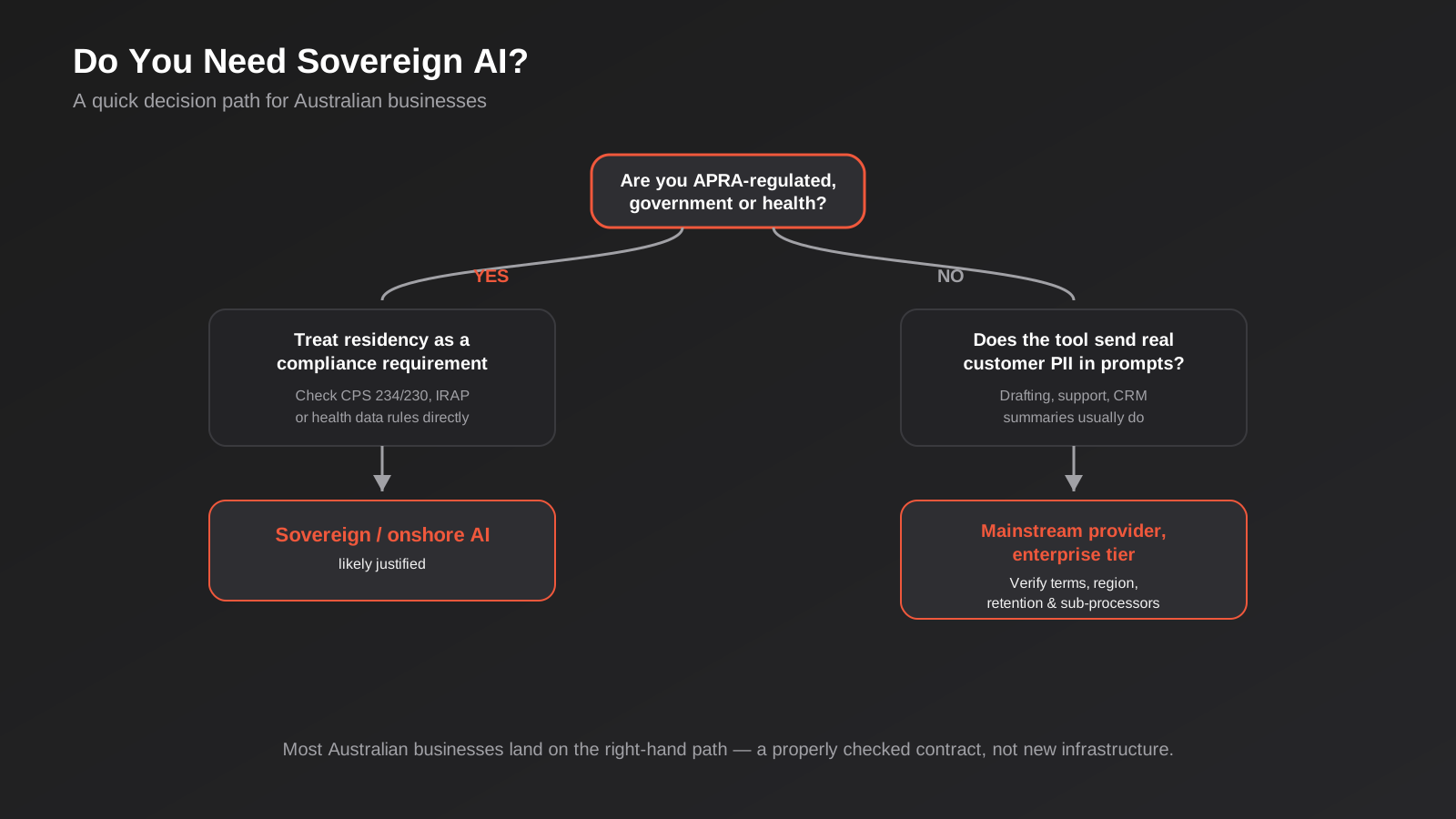
Do You Actually Need Sovereign AI?
“Sovereign AI”—AI infrastructure built, owned, and operated entirely within Australia, sometimes running open-source models on local hardware rather than calling an overseas-owned platform at all—gets marketed hard, and for a specific set of businesses it’s genuinely the right call. For most, it’s a more expensive answer to a question that a well-negotiated contract with a mainstream provider already resolves.
Regulated sectors: APRA, government, health
If you’re an APRA-regulated entity, CPS 234 and CPS 230 extend your own security and operational resilience obligations to your material service providers, which now explicitly includes AI vendors doing anything consequential with your data or decisions. Government agencies and contractors often work against frameworks like IRAP that assess whether infrastructure meets specific Australian government security requirements, independent of where a vendor claims the servers sit. Health data carries its own state-based rules on top of the Privacy Act. If you’re in any of these categories, the calculus is genuinely different, and “check the vendor’s contract carefully” is no longer sufficient on its own—you need infrastructure that can actually demonstrate compliance with the specific framework your sector answers to.
Within these sectors, the sovereign AI conversation also tends to move faster than the general market, because the compliance deadline isn’t optional and the cost of getting it wrong isn’t limited to reputational damage—it can mean a regulator finding, a failed audit, or a contract clause that was never satisfied. If this applies to your business, it’s worth treating data residency as a procurement requirement with sign-off from whoever owns your compliance obligations, rather than a technical preference the development team resolves on its own.
Everyday SMB use cases
For the large majority of Australian businesses using AI to draft content, summarise documents, support customer service, or run internal workflows, the realistic answer is that a mainstream provider on an enterprise or business-tier plan, with the right contractual terms and a clear understanding of where processing happens, meets your obligations without needing dedicated sovereign infrastructure. The cost and complexity of running your own onshore model deployment is real, and for most businesses it buys protection against a risk—foreign government compelled access to routine business correspondence—that isn’t actually the risk they’re most exposed to. The more common risk is a vague contract, an unconfigured retention setting, or a staff member on a free-tier tool, all of which a sovereign deployment doesn’t automatically fix either if it’s configured just as loosely.
Building This Into How You Already Use AI
Data residency isn’t a one-off project you complete and file away—it’s a question that needs answering again every time you add a new AI tool, upgrade a plan, or let a model provider swap out which underlying model handles your requests. A few places it connects directly to decisions you’re probably already making:
If you’re building an internal assistant over your own company documents, the RAG architecture that makes it useful also determines where your embeddings and retrieved content live, often in a separate vendor from the model doing the generation—worth checking both, not just one. If you’re giving an AI agent the ability to act inside your systems, we’ve covered the access-control side of that in AI agent security, but the data residency question sits alongside it: an agent with tightly scoped permissions can still be sending personal information to a model hosted somewhere you haven’t checked. And if you’re commissioning a custom AI integration that connects a model to your CRM, finance system, or support desk, data residency is a design decision that should be made at build time—which model, which region, which retention settings—rather than discovered after the integration has been live for a year.
The same goes if you’re working with an AI agent that reaches into business systems through an MCP server: the protocol itself is agnostic about where the model sits, so that choice is still yours to make deliberately when the integration is scoped, rather than inherited by default from whichever model the platform happened to ship with.
Common Mistakes We See
- Assuming “our data is hosted in Australia” covers AI tools too. Your database being onshore says nothing about where the AI model layered on top of it processes requests.
- Taking a vendor’s marketing page as the data processing agreement. “Built for Australian businesses” on a landing page isn’t a contractual residency guarantee—check the actual terms.
- Not distinguishing between consumer and enterprise tiers of the same AI product. The free version your staff signed up for personally often has materially weaker data handling terms than the business tier.
- Treating data residency as solved once, rather than re-checked per tool. Every new AI feature, plug-in, or model upgrade can quietly change where processing happens.
- Buying sovereign AI infrastructure to solve a contract problem. If the actual gap is a vague vendor agreement or an unconfigured retention setting, dedicated onshore infrastructure doesn’t fix that by itself.
- Ignoring the embeddings and logs layer. Businesses often check where the model provider sits and stop there, missing that a separate vector database or logging pipeline can be hosted somewhere else entirely.
- Not updating the privacy policy when AI starts informing real decisions. If AI output materially affects pricing, eligibility, or credit decisions, that needs disclosing, not just handling well internally.
Frequently Asked Questions
Is it illegal to send Australian customer data to an AI model hosted overseas?
No. Australian privacy law doesn’t ban sending personal information overseas; APP 8 requires you to take reasonable steps to ensure the overseas recipient handles it consistently with the Australian Privacy Principles, and generally holds you accountable for what happens to it. Plenty of mainstream AI tools can be used lawfully with the right contractual terms in place—the obligation is due diligence, not avoidance.
Does using ChatGPT, Copilot or Gemini automatically breach the Privacy Act?
Not automatically, but it depends heavily on which tier you’re using and what you’re feeding into it. Enterprise and business plans from these providers typically come with clearer data handling terms, no training on your inputs by default, and configurable retention. Free or personal-tier access, especially when staff sign up independently, often carries weaker guarantees and is the more common source of real exposure.
What’s the actual difference between data residency and data sovereignty?
Residency is about where data is physically stored. Sovereignty is about whose laws govern it, regardless of location. Data stored in an Australian data centre owned by a US company can still be reachable under US law in specific circumstances, which is why checking only the storage region doesn’t tell you the full picture.
Do we need to tell customers we’re using AI to process their data?
If AI is materially informing a decision that significantly affects them—pricing, eligibility, credit, that kind of thing—transparency obligations introduced under the 2024 Privacy Act amendments require disclosure in your privacy policy. For AI used to draft a reply or summarise a document with no decision attached, the bar is lower, but it’s still worth being upfront about in general terms as good practice.
Is sovereign or on-premise AI worth the cost for a small or mid-sized business?
For most businesses outside regulated sectors like finance, government and health, no—a mainstream provider on a properly contracted enterprise plan, with verified data handling terms, covers the realistic risk at a fraction of the cost. Sovereign infrastructure earns its cost when a specific regulatory framework requires it, not as a general-purpose precaution.
How do we find out where an AI tool we already use actually processes data?
Start with the vendor’s data processing agreement or enterprise terms, not their marketing page, and look specifically for named regions, sub-processors, and retention periods. If that documentation doesn’t exist or doesn’t answer the question clearly, that’s itself useful information—ask your account manager directly, and treat a vague answer as a reason to look harder before connecting it to anything sensitive.
Where to Start
Getting on top of AI data residency in Australia doesn’t require a big-bang project. If you haven’t actually mapped which AI tools your business uses touch personal information, and where each of them sends it, that’s the honest starting point—not a sovereign AI migration, not a blanket ban on a tool everyone’s found useful. Most businesses we talk to find the gap is narrower than they feared once they’ve actually checked: a couple of free-tier sign-ups worth moving to a proper business plan, a retention setting worth switching off, one vendor whose terms are vague enough to be worth a direct question.
If you’re building a custom AI integration, an internal assistant, or an MCP-based connection into your business systems and want the data residency questions answered properly at design time rather than discovered later, that’s a conversation we’re set up to have. Reach out and we’ll walk through what you’re actually running today and where it genuinely needs attention.
Keep reading
Related posts
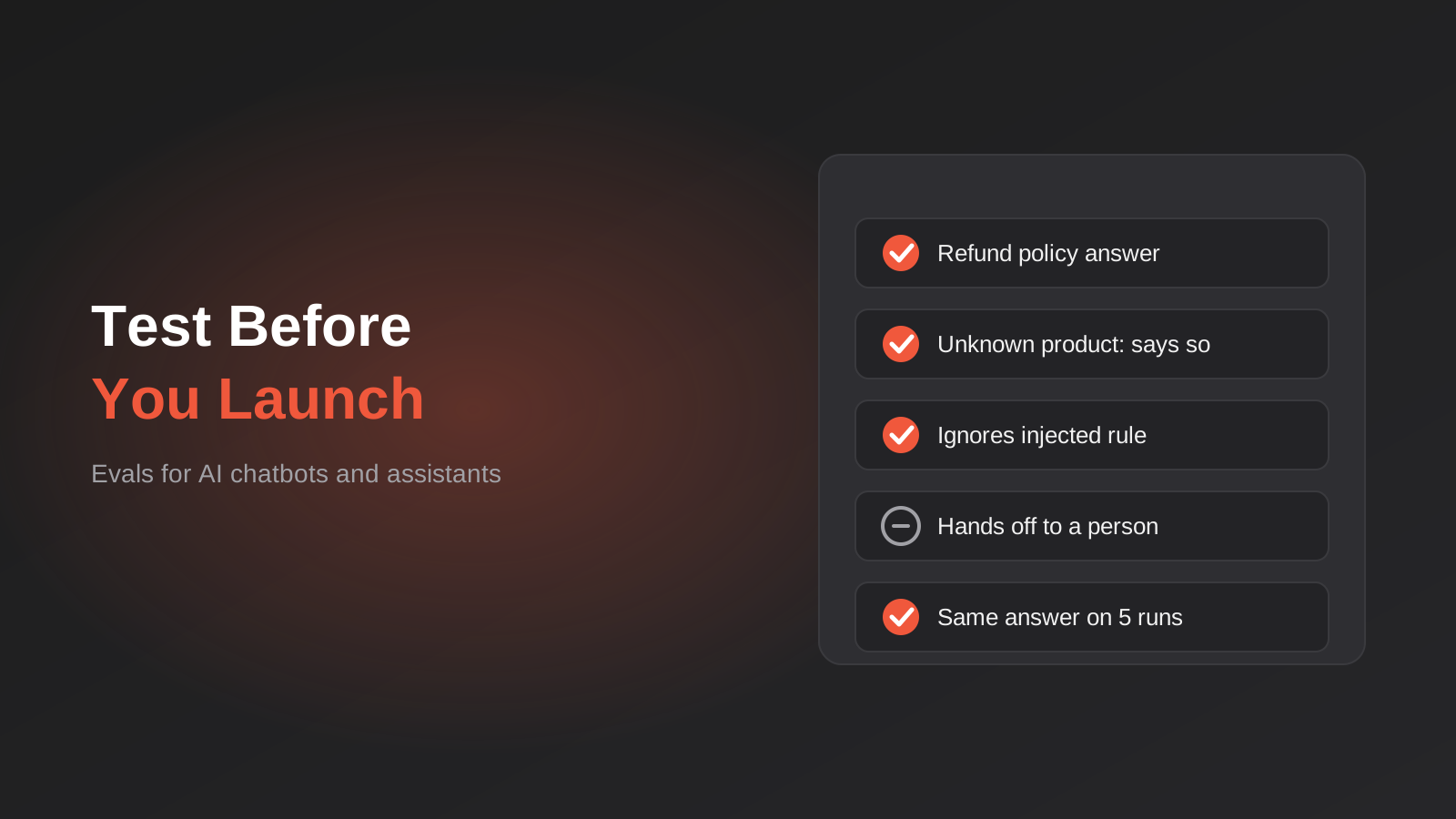
How to Test an AI Chatbot Before Launch: Evals, Test Sets and Release Gates for Australian Businesses (2026)
How to test an AI chatbot before launch: build a test set from real questions, score answers properly, set release gates, and…
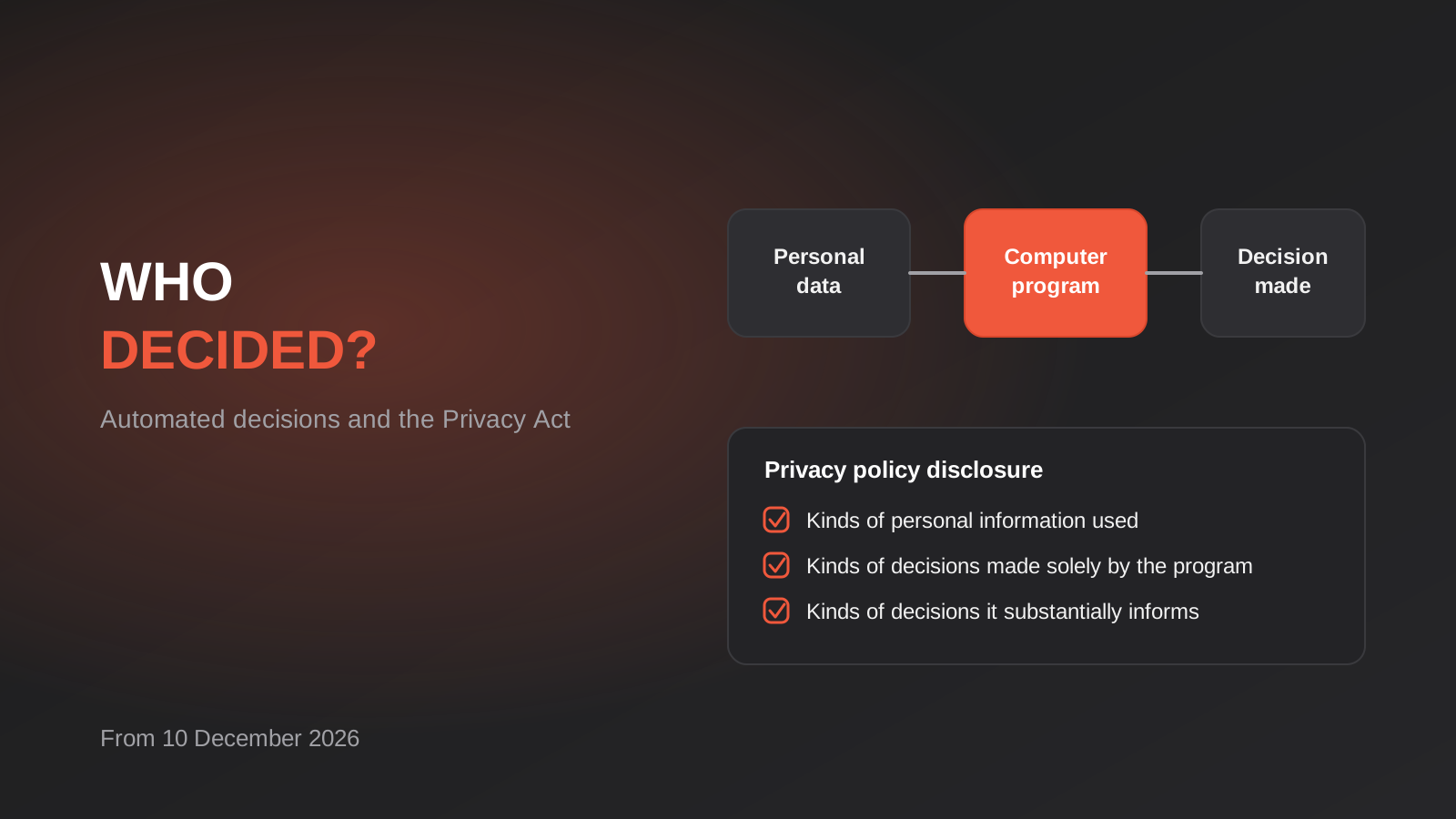
Automated Decision-Making and the Privacy Act: What Your Automations Must Disclose From 10 December 2026
From 10 December 2026, Australian businesses must disclose automated decisions in their privacy policy. How to find, assess and disclose yours.
Shadow AI: Managing Unapproved AI Use in Australian Businesses (2026)
A practical guide to shadow AI in Australian businesses: the real risks of unmanaged AI use, and how to build a usage…
Got a project you'd like to talk through?
Tell us what you're working on — we'll come back with a plan.
