
X Ads for Australian Businesses: Costs, Targeting and Whether It’s Worth Testing (2026)
 Jignesh Vagadiya
02/11/2026
21 min read
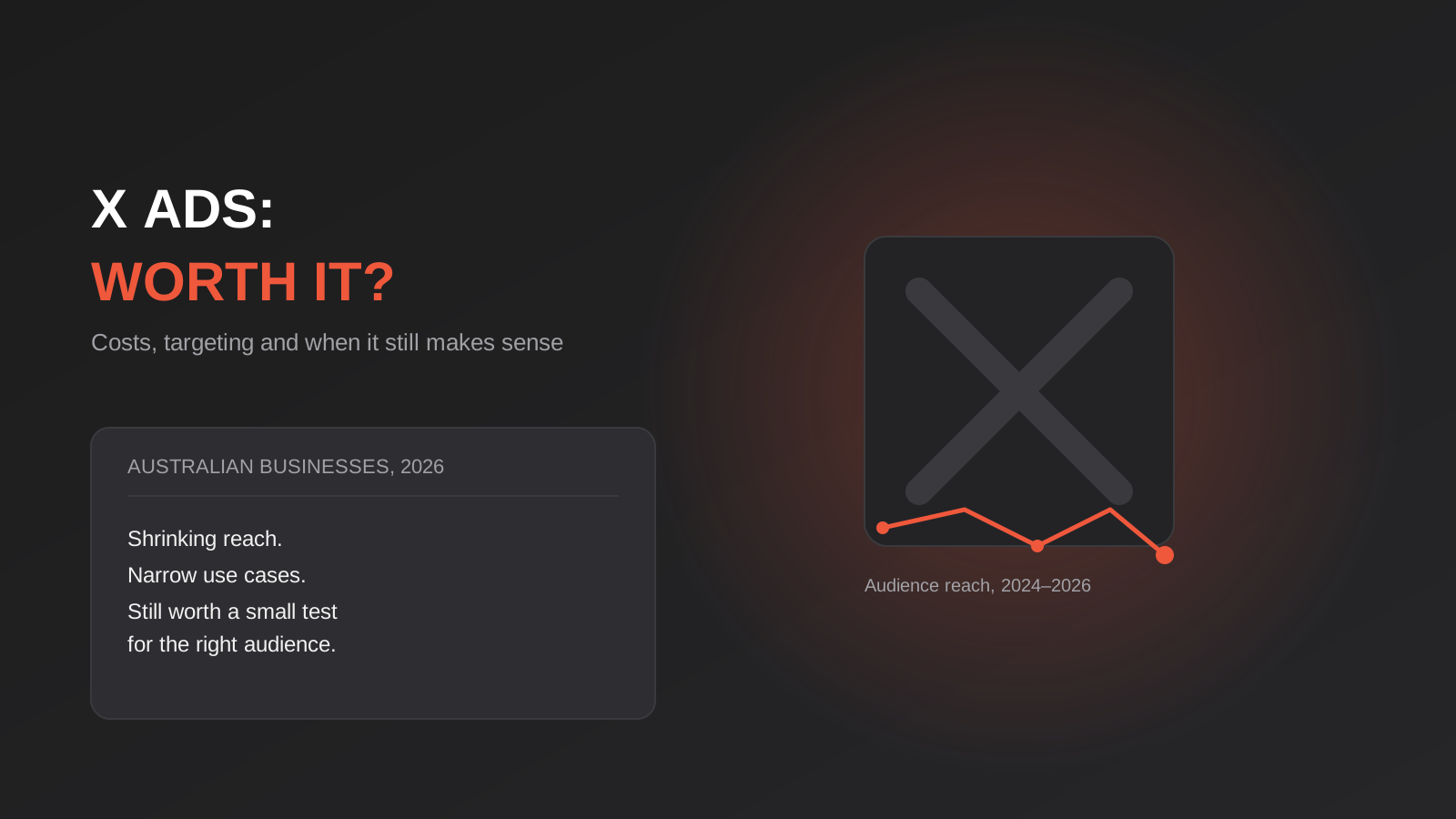
A prospect asked us last month whether they should be running ads on X. Not Meta, not TikTok, not even Google — specifically X, the platform most people still call Twitter in conversation even if nobody types the word into a browser bar anymore. It’s a reasonable question to ask in 2026, and it’s one we get often enough that it’s worth answering properly instead of waving it away.
The honest answer is complicated, because the platform itself is complicated right now. Ad spend has fallen sharply since the Musk takeover, several large advertisers have pulled back and stayed back, and the audience numbers depend on whose filing you believe. At the same time, X hasn’t disappeared, and for a specific, narrow slice of businesses — mostly B2B, mostly audience-specific — it can still do a job nothing else quite does as cheaply. The trick is knowing which slice you’re in before you spend a dollar on it.
This is a straight rundown of X Ads Australia pricing right now, how the targeting works, who it genuinely suits, and how to run a test without wasting a media budget finding out the hard way. No hype either direction — we’re not trying to talk you into it or out of it, just trying to save you the research we’ve already done.
Why X Ads Even Still Comes Up in 2026
If you haven’t followed the platform closely since the ownership change, it’s worth a quick, honest recap before any cost or targeting numbers mean anything, because the context changes what those numbers are actually worth.
What actually happened to the platform
Ad spend on X has been in a sustained decline since late 2022, and it hasn’t recovered the way some predicted it would once the initial advertiser boycotts settled down. Industry tracking has put year-on-year ad revenue declines in the high twenties percentage range as recently as mid-2025, and most reporting through 2026 describes brands spending well below their pre-takeover levels rather than returning to them. A number of the advertisers who paused spending in 2022 and 2023 simply never came back, and agency commentary generally agrees that a broad return isn’t expected soon.
The audience picture is murkier, and genuinely contested. The only audited figure that’s surfaced recently comes from a regulatory filing tied to SpaceX’s public offering process in March 2026, which put the combined monthly active user base of X and Grok at around 550 million — roughly eight percent below the 600 million Musk had previously claimed for X alone back in mid-2024. Independent analyses have also pointed out that Meta’s Threads now beats X on daily mobile usage in several markets, which would have been unthinkable a few years ago. Treat any specific user number you read, including ours, as a moving target rather than a settled fact.
X’s own pitch: Grok, better targeting, ads inside AI answers
X’s response to the decline has leaned heavily on Grok, its AI product, both as a standalone draw for users and as a new ad surface. The platform’s public position is that Grok-driven targeting delivers more relevant ads than the old system, and there’s been serious discussion of placing ads directly inside Grok’s conversational answers rather than only in the traditional feed. Whether that actually improves performance for advertisers is unproven from the outside — the claims so far come from X itself rather than independent measurement, and survey data has found a meaningful share of consumers uncomfortable with AI-generated advertising content specifically, which cuts against the idea that this is a straightforward win.
Who’s still advertising there, and why they haven’t left
The businesses still running X Ads in 2026 tend to cluster around a few predictable types: fintech and crypto brands whose audience genuinely still lives on the platform, B2B software and SaaS companies chasing a specific, vocal, tech-literate crowd, and brands whose category is inherently tied to real-time commentary — sport, breaking news, live events, politics-adjacent content. There’s also a smaller group of advertisers who’ve simply found that, because so many competitors left, the auction is less contested and cheaper than it used to be for the audience that remains. That’s a genuinely useful dynamic if your audience happens to still be there, and completely irrelevant if it isn’t.
X Ads Australia: What They Actually Cost
Here’s where we have to be upfront about a limitation: there’s no published, Australia-specific rate card for X Ads, and X’s own help documentation is global and deliberately vague on exact figures, since actual cost depends on auction dynamics that shift by audience, objective and time of year. What follows is the most reliable picture we could put together from current benchmarks, converted to a rough AUD equivalent, with the caveat that you should treat every figure here as a planning range, not a quote.
How billing actually works
X Ads run on an auction, the same model every major ad platform uses, and you’re charged based on the objective you pick rather than a flat rate. Choose Reach or Awareness and you’re billed on a cost-per-thousand-impressions basis (CPM). Choose Website Clicks and you’re billed per click (CPC). Choose Video Views and you’re billed per qualifying view. Engagement-focused campaigns bill per like, reply, repost or click, whichever counts as the defined engagement. X’s own published position is that there’s no mandatory minimum spend and you retain full control of your daily budget, though several third-party guides suggest a practical floor somewhere between $50 and $100 a day is needed before the auction has enough data to optimise sensibly. Those two things aren’t actually in conflict — you can technically spend less, you just won’t learn much from doing it.
Realistic cost ranges by objective
Based on the most recent 2026 benchmarks we could verify, converted from USD at a rough 1.5x rate, expect something like this for a reasonably well-targeted Australian campaign. These move constantly and vary heavily by audience competitiveness, so use them to sanity-check a quote or a budget plan, not as a guarantee.
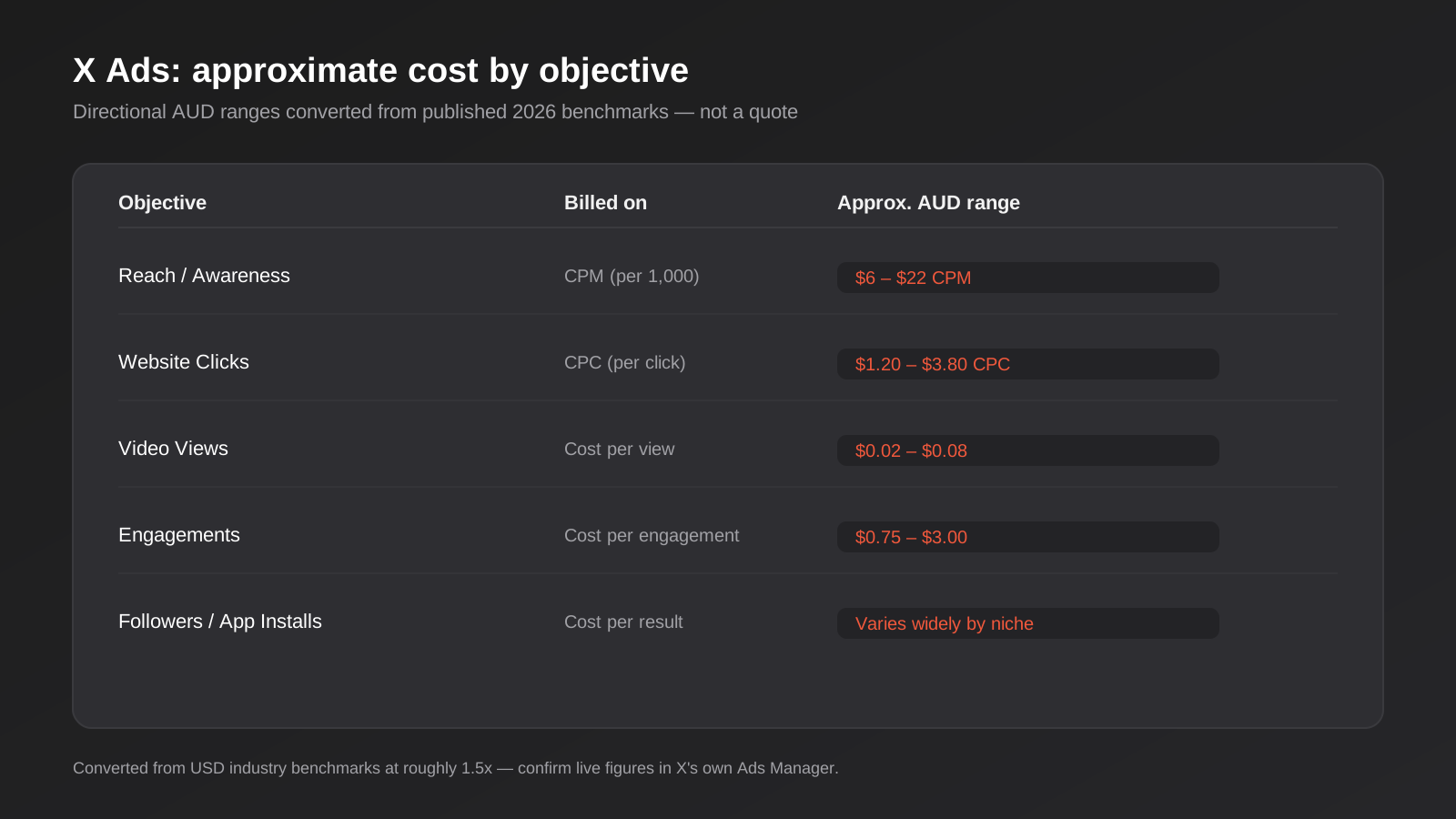
Finance, tech and other competitive B2B categories sit at the top end of every range above, since that’s where the advertisers who’ve stayed tend to concentrate. Niche or less-contested audiences can come in noticeably cheaper, which is part of the reason some advertisers report X working better for them now than it did in 2021 — less competition for the same impressions, provided your audience hasn’t also left.
Where the real cost actually sits: management, not media spend
Media spend is the easy number to quote and the smaller part of the real cost for most businesses. The bigger cost is the time it takes to build creative that works in X’s format (short, text-forward, comfortable looking native to the feed rather than like a banner ad), set up conversion tracking properly, and actually read the results against a benchmark that matters rather than just watching impressions climb. A business running this in-house for the first time typically underestimates that second cost significantly, which is a big part of why a small, defined test matters more here than throwing a few thousand dollars at a campaign and hoping. If paid social is one piece of a wider channel mix for you rather than a one-off experiment, our social media marketing team can help work out where a platform like this actually sits in the plan, rather than running it in isolation.
Targeting Options on X: What’s Actually Useful
X’s targeting toolkit is smaller than Meta’s or Google’s, but it has one genuinely distinctive option that’s worth understanding properly before you write it off as a legacy platform with nothing left to offer.
Keyword and conversation targeting: the one thing X still does that nobody else does quite the same way
X lets you target based on keywords people have recently tweeted, searched for, or engaged with, and on specific conversation topics happening in near-real time. No other major platform offers this at the same granularity, because no other major platform is built around short, public, searchable text posts the way X still is. For a brand that wants to show up next to a live conversation — a product category being complained about, a competitor being discussed, a breaking announcement in your industry — this is genuinely unique targeting that LinkedIn, Meta and TikTok simply can’t replicate. It’s also the single best reason to still consider the platform if your business lives or dies on being part of real-time commentary.
Follower look-alike and audience targeting
You can target people who follow specific accounts — a competitor, an industry publication, a well-known figure in your space — which functions similarly to a lookalike audience on other platforms but built around actual public follow relationships rather than inferred behavioural similarity. This tends to work well for B2B and niche consumer brands where there’s an obvious, identifiable set of accounts your buyers already follow.
Demographic and interest targeting
Standard demographic targeting (age, gender, location, language) and broad interest categories exist and work roughly as you’d expect, though the interest taxonomy is less granular than Meta’s and the audience pool it’s drawing from is smaller to begin with. If your strategy depends on precise interest-based segmentation, you’ll generally get a richer result from Meta or even from TikTok’s interest signals, both of which draw on a much larger and more actively engaged user base.
Custom audiences and retargeting via the pixel
X supports a conversion tracking pixel and custom audience uploads, so retargeting website visitors or matching a customer list against the platform’s user base is possible in the same way it is everywhere else. The catch is reach: because the overall user base has shrunk, the overlap between your customer list and X’s active users is often smaller than the same exercise run against Meta or even LinkedIn, so retargeting campaigns here tend to produce a noticeably smaller audience to work with.
What doesn’t work well anymore
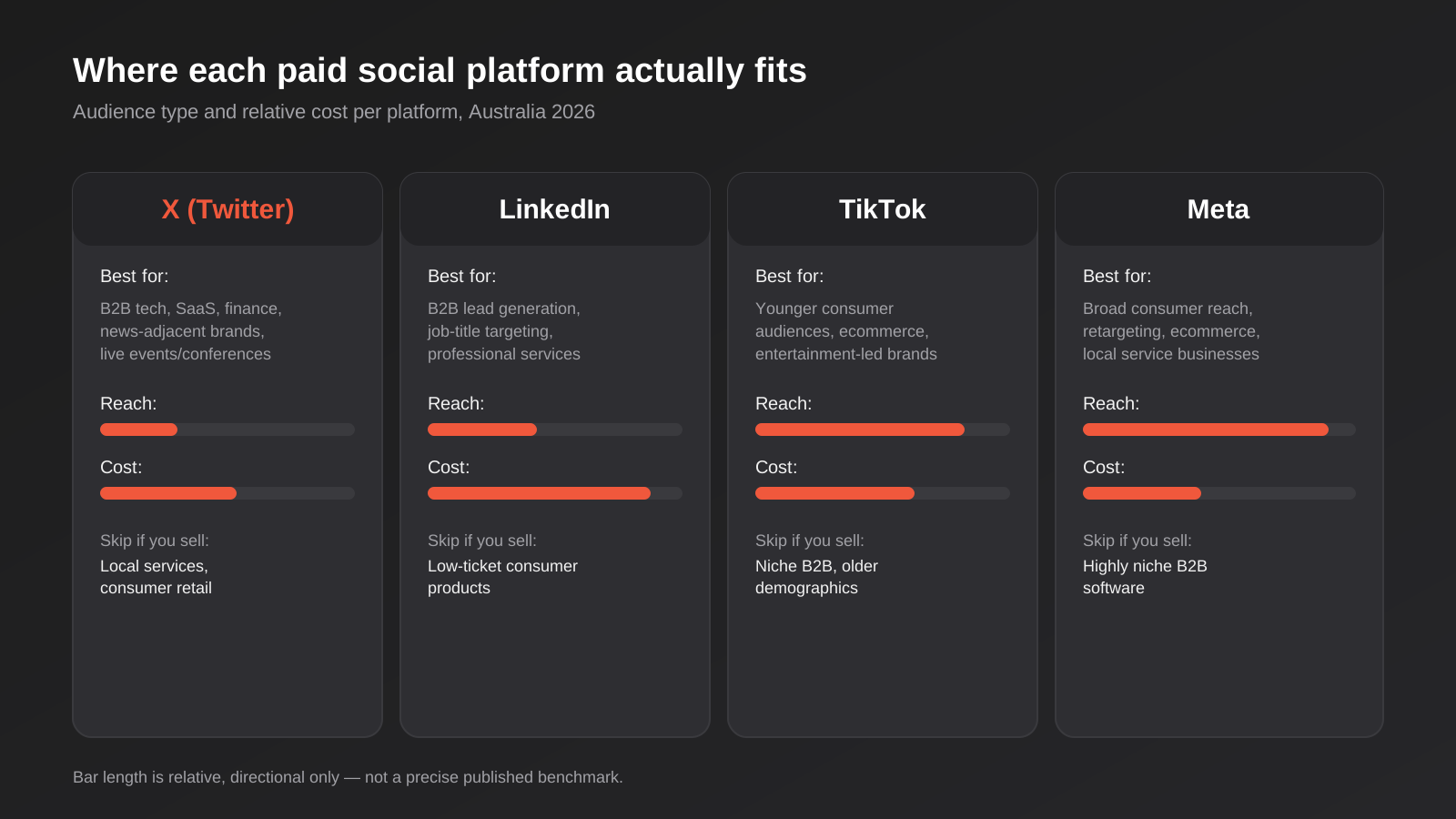
Broad brand awareness plays and consumer retail campaigns, the bread and butter of X advertising a decade ago, are generally the weakest fit for the platform today. The audience has skewed further toward tech, finance, media and politically engaged users, and away from the broad general-population reach that awareness campaigns need to be efficient. If your business sells to a mainstream consumer audience with no particular tech or finance lean, you’re very likely better served putting that budget into Meta or a platform with a larger, more representative user base. If you’re weighing up smaller, more niche advertising platforms generally, it’s worth reading alongside our breakdown of Reddit Ads, which sits in a similar category: a smaller audience, cheaper competition, and a strong fit for a specific niche rather than broad reach.
Ad Formats and Creative Specs on X
Before testing anything, it’s worth knowing what you’re actually allowed to build, because the format options are narrower than Meta’s and the native feel of the platform punishes creative that ignores that.
Promoted posts: text, image and video
The core unit on X is still the promoted post — a standard post boosted into more feeds, with the same character limits and layout as an organic one. Text-only posts work better here than on almost any other ad platform, because the format is built for them, but image and short video attached to a post are the more common choice for anything selling a product or driving a click. Posts with a single strong image or a short, captioned video consistently outperform plain text when the goal is clicks or conversions rather than pure engagement.
Carousel and collection ads
Carousel ads let you show two to six swipeable images or videos in a single post, each with its own link, which suits ecommerce catalogues or a business wanting to showcase a few distinct products or use cases in one placement. They see less use on X than on Meta, partly because the smaller, more text-literate audience here tends to respond better to a single clear message than a browsing experience.
Amplify pre-roll
Amplify places a short pre-roll video ad against premium publisher video content — sports highlights, news clips and similar — rather than in the regular feed. It’s a reasonable option if your audience is genuinely watching that kind of content on the platform, though it needs a larger budget to be worth setting up and isn’t something we’d recommend for a first test.
Practical specs worth knowing before you brief creative
Keep video under two minutes and ideally well under a minute for anything in the regular feed — attention drops fast, and the platform’s own guidance favours short-form. Square or vertical video (1:1 or 4:5) tends to perform better in-feed than horizontal, since most consumption happens on mobile. Captions matter more than you’d think, since a large share of video plays happen muted. And whatever you write, write it the way an actual account on the platform would phrase a post — this is covered further down, but it’s worth building into the creative brief from day one rather than fixing after a test underperforms.
Who X Ads Actually Make Sense For in Australia
Given everything above, the honest filter is narrower than most platform guides admit. Here’s where we’d actually recommend testing it, and where we’d steer a client somewhere else before they spend a dollar.
B2B tech, SaaS, finance and professional services
This is the clearest remaining fit. The audience that’s stayed active on X skews heavily toward people working in technology, finance and media, and keyword targeting lets you show up specifically when that audience is discussing something relevant to what you sell. A SaaS company targeting people tweeting about a competitor’s outage, or a fintech brand targeting conversation around a regulatory change, is using the platform for exactly what it’s still good at.
News-adjacent, crypto and politically engaged audiences
Brands operating in or adjacent to crypto, financial markets, or political and current-affairs commentary tend to find their actual buyers are disproportionately still active on X compared with other platforms, simply because that’s where those conversations still happen most visibly. If that’s genuinely your audience, the platform’s declining overall numbers matter less than whether your specific slice of it is still there, and for this group it usually still is.
Event and conference marketing, and real-time moments
Industry conferences, product launches timed to a live moment, and anything that benefits from appearing in a real-time conversation thread still get genuine value from X, mostly because the platform’s hashtag and conversation-following culture hasn’t gone anywhere even as overall usage has shrunk. A well-timed campaign around a major industry event can outperform what the same budget would do sitting in a static awareness campaign elsewhere.
Recruitment, talent and employer branding
Technical recruitment and employer branding is a smaller but genuinely effective use case, particularly for engineering, product and developer-facing roles. A lot of the hiring conversation in software and tech still happens publicly on X — people discussing their job search, commenting on company culture, reacting to industry news — and keyword targeting lets you show up next to exactly that kind of conversation. It’s a narrower audience than LinkedIn’s, but the people in it tend to be more actively engaged with real-time discussion than LinkedIn’s more passive browsing behaviour.
Who should skip it
Local service businesses, consumer retail, hospitality, and anything selling to a broad general-population audience with no particular tech, finance or news lean should generally look elsewhere first. The audience density just isn’t there anymore, and the same budget almost always goes further on LinkedIn for a professional buyer, or on Meta or TikTok for a consumer one. If you’re trying to decide between a handful of paid social options rather than committing to one, that comparison is worth doing properly before any of them before you spend a cent — it’s a far cheaper exercise than running and abandoning three platforms in sequence.
Setting Up a Test Campaign Without Wasting Budget
If you’ve read this far and you think your business might be in the narrow slice this actually suits, here’s how we’d structure a first test, assuming you want a genuine read on whether it works rather than a vague sense of “it did something.”
Start with one defined objective, not three
Pick a single, measurable objective — website clicks to a specific landing page, or a defined engagement goal — rather than running an awareness campaign alongside a conversion campaign and trying to read both at once. A test that tries to prove three things at once usually proves none of them clearly.
Budget and duration for a meaningful read
Based on the practical floor most guides converge on, budget for at least two to three weeks at $70 to $100 a day before judging results. Shorter than that and you’re mostly paying for the auction to calibrate rather than for a representative result. If that total test budget feels uncomfortable to commit without knowing the outcome, that’s a reasonable signal the platform isn’t the right first move for your business right now.
Creative that looks native, not like a banner ad
X’s feed is still text-forward and conversational, and ads that look like a conventional display banner tend to get scrolled past faster than ones written in the platform’s own voice — short, direct, closer to how a real account on the platform would phrase a post. This is a different creative discipline to Meta or LinkedIn, and reusing creative built for those platforms without adapting it is one of the more common ways a test campaign underperforms for reasons that have nothing to do with the platform itself.
Build a landing page for the test, not a detour to your homepage
Send traffic to a page built for the specific thing you promised in the ad, not your general homepage or a product page covering six other things. This matters on any platform, but it matters more on a smaller-audience one like X, where you don’t have the volume to average out a weak landing experience across a large enough sample. A tightly scoped landing page is also what makes the results of a small test actually mean something — if the page itself has multiple distractions, you can’t tell whether a flat result is the platform or the page.
Measurement and the attribution caveat
Treat in-platform conversion reporting the way you’d treat any ad platform’s self-reported numbers: directionally useful, not gospel. Set up proper server-side or GA4 conversion tracking independent of X’s own pixel reporting before you start, so you’re comparing performance against a consistent external measurement rather than trusting a platform to mark its own homework. This matters more on X than on better-resourced platforms, simply because less engineering attention has gone into its measurement tooling in recent years compared with Meta or Google.
Deciding whether to scale, adjust or kill the test
At the end of your test window, you want one of three honest outcomes, not a fourth option where you quietly let the campaign keep running because killing it feels like admitting it didn’t work. If cost per result is in line with or better than your other paid channels, scale the budget gradually and keep watching whether performance holds as spend increases. If it’s close but not quite there, try one variable at a time — new creative, a tighter audience, a different objective — rather than changing everything at once and losing track of what actually moved the number. And if it’s clearly worse than your other channels after a fair test, turn it off. A platform not working for your business isn’t a failure of the test; a test that drags on past its honest conclusion is the actual waste.
Common Mistakes We See With X Ads
- Running a broad awareness campaign on a shrinking, narrowing audience. The platform’s remaining reach is concentrated in specific niches, not spread evenly across a general population.
- Reusing Meta or LinkedIn creative without adapting it. Ads that look like display banners get scrolled past in a feed built around native-feeling text posts.
- Testing with a budget too small to clear the auction’s learning phase. A few dollars a day for a few days tells you almost nothing reliable about whether the platform works for you.
- Ignoring keyword and conversation targeting entirely. It’s the one genuinely distinctive tool on the platform, and skipping it to run only demographic targeting wastes the main reason to be there at all.
- Trusting in-platform attribution without an independent check. Self-reported conversion numbers from any ad platform deserve a sanity check against GA4 or server-side tracking before you believe them.
- Assuming the audience decline means it’s dead for everyone. It’s a bad fit for broad consumer brands and still a reasonable fit for specific B2B, finance and news-adjacent audiences.
- Not budgeting for creative and management time. The media spend is usually the smaller line item once you account for the time to build, monitor and adjust the campaign properly.
Frequently Asked Questions
Is X advertising still called Twitter Ads?
No, officially it’s X Ads, managed through X’s Ads Manager (ads.x.com). Most people still search “Twitter ads” out of habit, and the platform itself still functions the same way it always did — feed-based ads bought through an auction — just under a different name and ownership.
Is X Ads worth it for an Australian small business in 2026?
For most small, locally-focused businesses, no — the audience has shrunk and skewed toward specific niches that don’t match a general local customer base. For a B2B, fintech, SaaS or industry-event business whose actual buyers still use the platform, a small, carefully measured test can still make sense. The honest filter is whether your specific audience is still there, not whether the platform overall is growing.
How much should I budget to properly test X Ads?
We’d suggest at least two to three weeks at $70 to $100 a day as a minimum meaningful test, which lands somewhere around $1,000 to $2,000 in media spend before you draw any firm conclusions. Anything shorter or smaller mostly measures the auction calibrating rather than genuine campaign performance.
Does X Ads have a minimum spend requirement?
X’s own position is that there’s no mandatory minimum and you control your daily budget entirely. In practice, most guidance (including ours) suggests a practical floor of $50 to $100 a day is needed before the auction has enough data to run efficiently, even though the platform will technically let you spend less.
How does X Ads targeting compare to LinkedIn for B2B?
LinkedIn targets by job title, seniority, company and industry, which is more reliable for reaching a specific professional buyer directly. X’s advantage is keyword and conversation targeting — showing up next to a live discussion rather than a static profile attribute — which LinkedIn doesn’t offer. Many B2B advertisers use the two differently rather than choosing one: LinkedIn for direct targeting by role, X for riding a relevant live conversation. Our LinkedIn Ads team can help work out whether that combination, or LinkedIn alone, fits your budget better.
Will advertising on X hurt my brand given its reputation?
That’s a genuine business judgement call, not just a media-buying one, and it depends heavily on your audience and category. Some brands have decided the platform’s current reputation is a real risk to be near and have stayed away entirely; others have judged their specific audience doesn’t share that concern and kept advertising. There’s no universally correct answer here, but it’s worth deciding deliberately rather than defaulting into or out of the platform without thinking about it.
Where to Start
If you’ve read this and landed on “maybe, for a narrow reason,” that’s the right amount of certainty to start with. Run a small, properly measured test against one objective, give it two to three weeks, and judge it against your own tracking rather than the platform’s own numbers. If you land on “no, not for us,” that’s also a legitimate conclusion — plenty of genuinely good marketing strategies simply don’t involve this particular platform anymore, and there’s no prize for running ads somewhere just because the option exists.
Either way, X Ads rarely makes sense tested in isolation from the rest of your paid social plan. If you want a second opinion on whether it’s worth a test budget for your specific business, or where it would sit alongside platforms that might be a stronger fit, our social media marketing team is happy to have that conversation honestly, including telling you not to bother if that’s the straight answer. You can see how we structure and price paid social work generally on our pricing page.
Because we run lean as a specialist agency rather than carrying a large account-management layer, our fixed quotes for paid social management typically come in below the Australian averages covered in this guide. If you’ve already got a written quote from another agency for comparable scope, send it through and we’ll do our best to beat it.
Keep reading
Related posts
Snapchat Ads for Australian Businesses: Costs, Targeting and Whether It’s Worth Testing (2026)
What Snapchat Ads actually cost in Australia, how targeting and formats work, and which businesses should test it versus skip it in…
Pinterest Ads for Australian Businesses: Costs, Targeting and Whether It’s Worth Testing (2026)
Pinterest Ads cost and targeting for Australian businesses in 2026 — cheaper CPCs than Meta, planning-stage intent, and who should actually test…
Reddit Ads for Australian Businesses: Costs, Targeting and Whether It’s Worth Testing (2026)
What Reddit Ads actually cost in Australia, how subreddit and keyword targeting work, and a straight framework for deciding if it's worth…
Got a project you'd like to talk through?
Tell us what you're working on — we'll come back with a plan.
