
Snapchat Ads for Australian Businesses: Costs, Targeting and Whether It’s Worth Testing (2026)
 Jignesh Vagadiya
09/11/2026
21 min read
Every paid media conversation we have with a client eventually works through the same list: Google, Meta, probably TikTok, LinkedIn if they’re B2B. Snapchat almost never comes up. When it does, it’s usually one sentence, delivered with a slight laugh: “isn’t that just for teenagers sending each other filtered selfies?” That assumption is about eight years out of date, and for a specific kind of business — youth-skewing, visually led, mobile-first — dismissing it outright means skipping a channel with genuinely lower competition than Meta or TikTok right now.
If you’ve searched “Snapchat Ads Australia” looking for real numbers rather than a vendor pitch deck, that’s exactly what this guide gives you. It’s the Snapchat sibling to the cost and targeting breakdowns we’ve already written for Meta Ads and TikTok Ads. Same questions, different platform: what it actually costs to run in Australia, what you can and can’t target, which ad formats earn their place in a campaign, and — the part most platform guides skip — who should genuinely leave it alone.
We’re not going to pretend Snapchat is a hidden goldmine every business is missing out on. For plenty of the clients we work with, it isn’t the right channel, and we’ll say exactly why further down. But for the businesses it does fit, it’s worth a properly run test rather than a reflexive “no.” The gap between those two groups is narrower than most agencies let on, and it’s the thing this guide is actually trying to pin down — not a sales pitch for a platform we happen to manage.
One more thing worth saying upfront: almost nothing about Snapchat advertising is as settled as the equivalent Google or Meta playbook. The platform has a smaller, less mature advertiser base in Australia, which means less shared agency knowledge, less published local benchmark data, and more genuine trial and error involved in getting it right. That’s exactly why a cautious, properly measured test matters more here than it does on a platform you could run blind and still get a reasonable result from.
Who’s Still on Snapchat in Australia (and Why “Teens Only” Is Outdated)
Snapchat’s reputation problem is timing. The platform launched as a disappearing-photo app for teenagers in 2011, and for a lot of marketers, that’s where the mental model stopped. The user base has aged alongside the product since then, the same way early Facebook users didn’t vanish once their kids joined.
The Audience Snapchat Still Owns
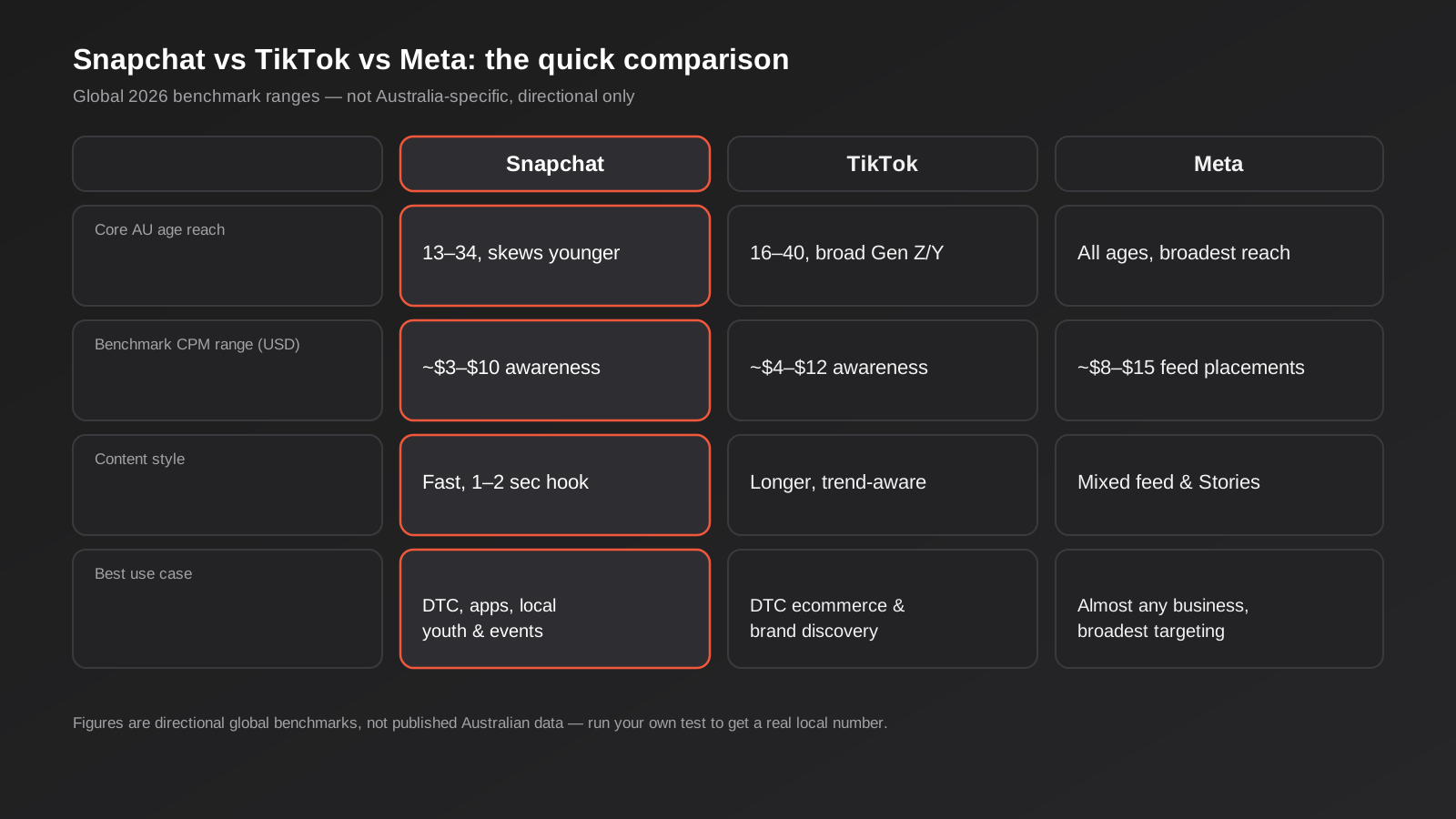
Snap has disclosed reaching around four million daily active users in Australia, and separately claims to reach a majority of 13-to-24-year-olds in the country — a cohort that’s genuinely hard to reach at volume anywhere else, since this age group has largely moved off Facebook and splits its attention between Snapchat, TikTok and Instagram Stories. What gets missed in the “teens only” take is that close to half of Australian Snapchatters are now reportedly over 25. The platform grew up. The daily habit — opening the app to message close friends, not to browse a public feed — stuck around as users aged into their twenties and thirties.
That messaging-first habit matters for advertisers because it changes what “attention” looks like on the platform. Snapchat isn’t a discovery feed you scroll for twenty minutes the way TikTok is. It’s a communication app people open dozens of times a day for a few seconds at a time, with ads sitting between Stories and Discover content. Short, frequent exposure beats long, considered viewing — which has real implications for the creative you build, covered below.
Why It Gets Written Off by Marketers Who Haven’t Looked Lately
Three things keep Snapchat off most Australian media plans. First, the sheer gravitational pull of Meta and TikTok — with finite time and budget, platforms with bigger obvious reach get tested first and Snapchat rarely gets a turn. Second, a genuine data gap: Snap doesn’t publish granular Australian benchmark data the way Google and Meta do, so planning a budget means working from global estimates rather than local certainty, which makes some media buyers nervous enough to skip it. Third, and honestly the biggest factor, is that it simply doesn’t fit most businesses — B2B services, considered high-ticket purchases and anything skewing toward an older customer base have no real reason to test it, and that’s a large share of the Australian SME market.
None of that means it’s dead. It means it’s a niche-fit channel that gets dismissed for the wrong reasons as often as the right ones. The rest of this guide is about telling the difference.
Snapchat Ad Formats and Where Each One Fits in Your Funnel
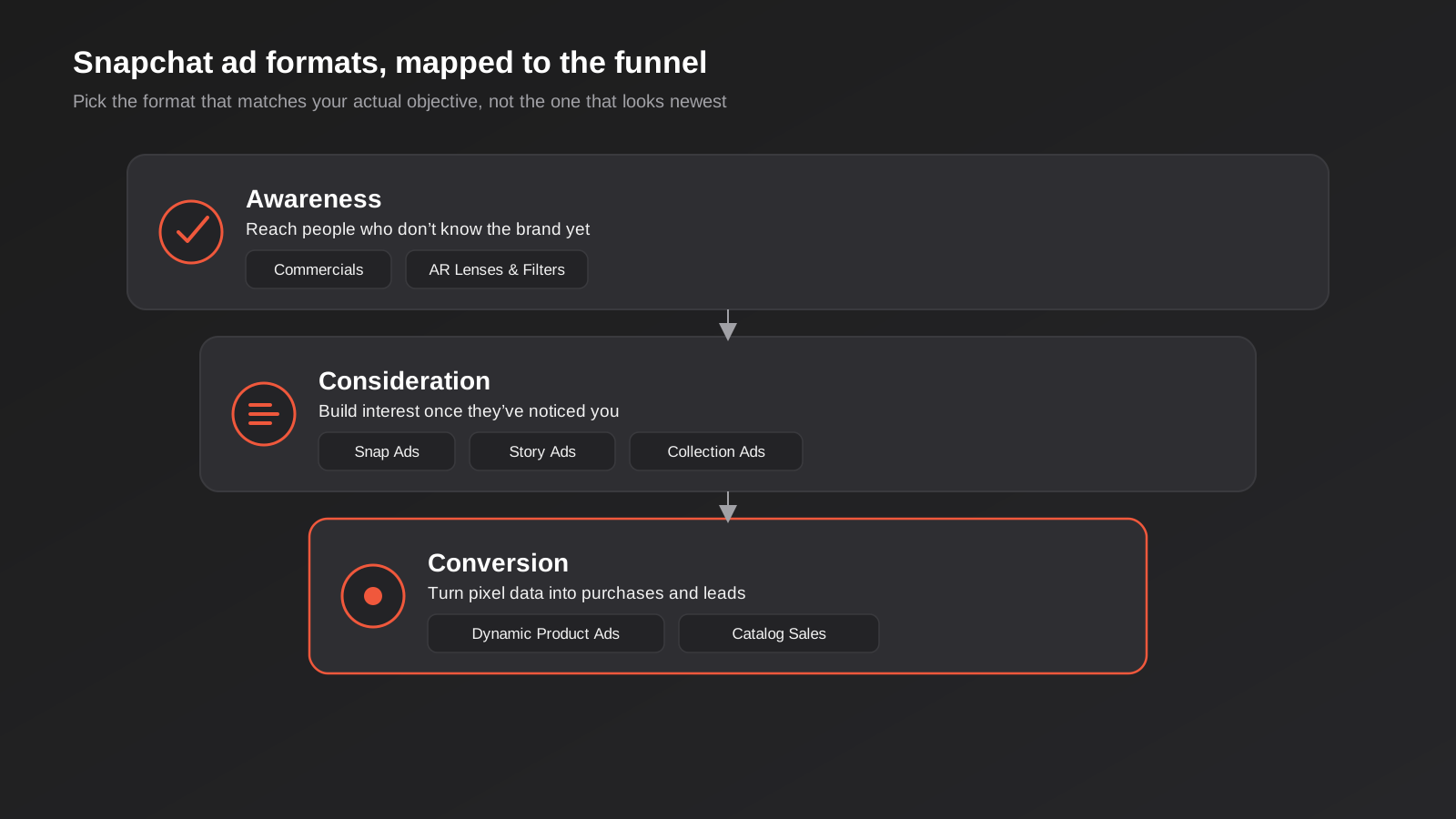
Snapchat’s Ads Manager groups formats loosely around objectives — awareness, consideration, conversion — the same three-stage logic as Meta and Google, just with platform-specific creative requirements. Getting the format-to-objective match right matters more here than on more forgiving platforms, because a slow-loading, horizontally-shot ad in a fast, vertical, sound-on environment gets skipped in under a second.
Awareness: Commercials, AR Lenses and Filters
Commercials are Snapchat’s long-form video unit, running up to three minutes with the first six seconds unskippable — a format borrowed directly from broadcast TV logic and placed inside Snap’s premium Discover content. They’re expensive relative to other formats and suit brands with an actual production budget and a message that needs more than a few seconds to land.
AR Lenses and Filters are the format genuinely unique to Snapchat. A branded lens that transforms someone’s face or surroundings, or a filter overlaid on a Snap, spreads because people use it and share it — not because they were served an ad in the traditional sense. For a visually distinct product (think a drink brand, a fashion label, an event) with the budget to get custom AR built properly, this is the format that earns genuine organic reach on top of paid impressions. It’s also the format we see businesses skip because the creative lift feels unfamiliar — which is exactly why it still works better than it should for the brands willing to do it.
Consideration: Snap Ads, Story Ads and Collection Ads
Single Image or Video Ads — what Snap still calls “Snap Ads” internally — are the bread-and-butter format: a full-screen vertical image or video between organic content, with an optional swipe-up action to a website, app install or longer-form video. Story Ads place a branded tile inside the Discover section that users tap into voluntarily, which tends to produce a more engaged (if smaller) audience than an interruptive placement.
Collection Ads show a hero image or video with a grid of smaller product tiles beneath it — functionally similar to Meta’s Collection format — and work well for ecommerce brands running a test with an actual product catalogue rather than a single hero SKU.
Conversion: Dynamic Product Ads and Catalog Sales
For ecommerce specifically, Dynamic Product Ads pull from a product catalogue (the same feed structure you’d already have set up for Meta or Google Shopping) and serve the right product to the right person based on pixel activity — browsed-but-didn’t-buy retargeting, essentially. This is where Snapchat’s advertising genuinely resembles Meta’s playbook most closely, and where having an existing catalogue feed makes the format cheap to stand up.
Targeting on Snapchat: What You Can Actually Dial In
Snapchat’s targeting stack is built around what it calls Snap Audience Match, and it splits into three practical layers once you’re in Ads Manager.
Snap Audience Match: Demographics and Lifestyle Categories
At the base level you can target by age, gender, location (down to postcode-level in Australia) and language. Layered on top are Lifestyle Categories — Snap’s own interest taxonomy, built from in-app behaviour and third-party data partnerships, grouping users into categories like “foodies,” “fashion and beauty enthusiasts” or “sports fans.” These are broader buckets than Meta’s granular interest targeting, which is a trade-off: less precision, but also less risk of starving a small campaign of volume by targeting too narrowly — a mistake we cover later.
Custom Audiences and the Snap Pixel
The Snap Pixel — installed on your website the same way you’d install a Meta Pixel or Google tag — tracks page views, add-to-carts, purchases and other events, which then feed Custom Audiences for retargeting. You can also upload a customer list (email or phone, hashed before upload) to build a Custom Audience from existing customers, the same mechanism Meta and Google both use. If you’re already running Meta Ads with a mature pixel and event setup, the technical lift to add Snap’s pixel is genuinely small — most of the work is tagging the same events again under a different SDK.
Lookalike Audiences
Once you have a Custom Audience of a reasonable size — Snap, like other platforms, needs a meaningful seed list before lookalike matching performs well — you can build Lookalike Audiences that expand targeting to new users who resemble your existing customers or pixel-tracked visitors. This is usually where a Snapchat test starts to perform better than its first two weeks, once there’s enough pixel data to build from.
Where Targeting Falls Short
What Snapchat doesn’t offer, and what rules out a chunk of businesses immediately, is any meaningful B2B or firmographic targeting — no job title, no company size, no industry vertical the way LinkedIn offers natively. If your customer is defined by their job rather than their age, interests or past purchases, Snapchat has no lever for reaching them specifically. That’s one of the clearer signals, covered in the fit section below, for ruling the platform out before spending a dollar on it.
What Snapchat Ads Actually Cost in Australia in 2026
This is the section where we have to be honest about the limits of what’s actually knowable, because most of what gets published as “Snapchat Ads cost” online is global benchmark data from US-heavy ad accounts, repackaged by agency blogs with an incentive to make the numbers look either very cheap or very lucrative depending on what they’re selling.
CPM, CPC and Realistic Ranges
Across the industry benchmark data we could find for 2026, awareness-objective CPMs on Snapchat tend to sit somewhere in the $3 to $10 range (in USD, since that’s how most of this data is reported), with conversion-objective CPMs running considerably higher — often two to three times the awareness rate — because you’re bidding against advertisers chasing a purchase rather than a view. Click-through rates in the benchmark data we reviewed cluster around 1%, broadly comparable to Meta’s feed placements. None of this is Australia-specific; Snap doesn’t publish country-level benchmark data, and we haven’t found a credible source that does either. Treat every number in this paragraph as a rough global planning range, not a quote.
Minimum Spend: Why the Old “Five-Figure Minimum” Advice Is Wrong Now
If you’ve read an older guide claiming Snapchat requires a $5,000 or $15,000 minimum campaign commitment, that’s a leftover from Snap’s early managed-service sales model around 2016 to 2018, when big-budget managed campaigns were effectively the only way in. Self-serve Ads Manager today has no such floor — you can run a campaign on a genuinely small daily budget, the same way you can on Meta. That doesn’t mean a tiny budget will produce a meaningful signal (it won’t, on any platform), but it does mean the barrier to testing is a lot lower than the oldest advice on the internet suggests.
Why Nobody Can Give You an Exact Australian Number (Including Us)
We’ll say this plainly because most agency content won’t: anyone quoting you a precise Australian CPM for Snapchat without having actually run a live account in your category is estimating, not reporting. Auction dynamics shift by industry, by season, by creative quality and by how many other Australian advertisers in your category are bidding in the same window. The only way to get a real number for your business is to run a modest, properly measured test and read your own account data — which is exactly what the test structure further down is built to produce.
Budgeting Snapchat Into Your Wider Paid Social Mix
Snapchat should almost never be the first paid social dollar a business spends, and for most of the brands we work with, it shouldn’t be the second either. The right way to think about it is as an incremental test layered on top of a channel mix that’s already working, not a replacement for Meta or Google while you figure out if it’s any good.
A Sensible Order of Operations
If you’re a youth-skewing ecommerce or app brand starting from scratch, the typical build-out looks like Meta first (broadest reach, most mature targeting and measurement), then TikTok once creative capacity exists to support it, then Snapchat as a smaller incremental test once both of those are stable and you have spare budget and spare creative bandwidth to dedicate to a genuine experiment. Running all three simultaneously from day one with a single junior staff member managing the lot is how every platform ends up under-resourced and none of them get a fair test.
What Share of Spend Is Reasonable
As a rough starting allocation, we’d suggest capping an initial Snapchat test at somewhere between 10% and 20% of your total paid social budget until you have enough of your own account data to justify more. That’s small enough that a disappointing result doesn’t meaningfully dent overall performance, but large enough — combined with the test duration suggested further down — to produce a real signal rather than a rounding error.
Measuring Results Properly: Attribution Windows and Overlap With Other Platforms
This is the part of running a multi-platform paid social test that trips up even experienced in-house marketers, and it matters more with a newer platform in the mix because the temptation to either oversell or write off a result is stronger.
Every Platform Will Claim Credit for the Same Sale
Snapchat’s own reporting, like Meta’s and TikTok’s, uses a last-touch or multi-touch attribution model within its own walled garden — which means if a customer sees a Snap ad, then later clicks a Meta retargeting ad and buys, both platforms will often claim that conversion in their own dashboard. Added together, your platforms will almost always report more conversions than actually happened. This isn’t a Snapchat-specific flaw; it’s true of every paid social platform’s self-reported numbers, and it’s exactly why comparing Snapchat’s dashboard number against your actual order data (not Snap’s dashboard against Meta’s dashboard) is the only honest way to judge a test.
Use a Consistent Attribution Window Across Platforms
Snap Ads Manager lets you set the attribution window for both view-through and click-through conversions. Match it to whatever window you’re already using on Meta for a fair side-by-side comparison — comparing a 7-day click Snapchat result against a 1-day click Meta result will make Snapchat look artificially strong, or weak, depending on which way you set it up without realising.
Watch Your Overall Numbers, Not Just the Platform Dashboard
The cleanest read on whether Snapchat added anything is a holdout approach: compare total site conversions and revenue for the period you’re running Snapchat against a comparable prior period where every other channel’s spend stayed roughly flat. If total conversions genuinely lifted beyond what Meta and TikTok alone would normally produce, that’s a real incremental result. If Snapchat’s dashboard shows conversions but your total business numbers didn’t move, you’re most likely looking at attribution overlap rather than incremental sales.
Who Should Actually Test Snapchat Ads
Fit matters more here than on almost any other platform we advise on, because the gap between a good result and a wasted budget tends to come down to whether the business profile matches the audience Snapchat actually has — not whether the campaign was built well.
Good-Fit Businesses
- Direct-to-consumer ecommerce brands with a visual product and a younger core customer — fashion, beauty, food and drink, accessories.
- Mobile apps and games, particularly anything with a casual or social hook, since Snap’s app-install objective and audience both skew toward exactly that use case.
- Event, festival, nightlife and hospitality brands targeting a local, youth-skewing audience with genuine urgency (a date, a location, a limited run).
- Brands already running TikTok successfully who want incremental reach among an adjacent but not identical audience, without rebuilding a creative strategy from scratch.
- Businesses with an existing Meta or Google pixel and catalogue feed already live, since most of the technical setup carries over with minor changes.
Poor-Fit Businesses
- B2B services and software, for the targeting reason covered above — there’s no reliable way to reach a buyer by their job rather than their age and interests.
- Considered, high-ticket purchases with a long research cycle — and finance, for instance — where Snap’s fast, low-dwell-time environment doesn’t suit the decision-making process.
- Businesses whose customer base clearly skews toward an older demographic, where the reach simply isn’t there in meaningful volume.
- Anyone without the budget to run a genuine multi-week test. A three-day, $200 “trial” on any platform produces noise, not a verdict, and Snapchat is no exception.
- Local service businesses with a small, highly specific geographic radius and no existing content or creative capacity — the platform rewards native-feeling vertical video, and a single static banner reused from a Google Display campaign won’t perform.
How to Run a Proper Test Campaign
If you’ve read this far and you fit the good-fit profile above, here’s how we’d actually structure a first Snapchat test, in order.
Step 1: Install and Verify the Snap Pixel Before Anything Else
Install the pixel, confirm key events (page view, add to cart, purchase or lead) are firing correctly in Ads Manager’s event diagnostics, and let it collect data for at least a few days before launching paid traffic. Launching a campaign on day one with an unverified pixel is the single most common reason a Snapchat test produces unreliable results — you end up optimising toward an event that isn’t actually tracking.
Step 2: Set a Budget and Timeframe That Can Actually Produce a Signal
As a rough planning figure, we’d suggest treating anything under roughly $750 to $1,500 AUD spread over two to three weeks as too small to draw a real conclusion from, given the CPM ranges discussed above. That’s not a magic number — it’s the point at which most accounts have accumulated enough impressions and conversions to tell signal from noise rather than a lucky or unlucky few days.
Step 3: Pick One Objective and One Format to Start
Resist running three objectives and four formats in week one. Pick the objective that matches your actual goal (traffic, app install, catalogue sales, lead generation) and one or two ad formats suited to it, then expand once you have a baseline. Testing everything at once with a modest budget just splits your data too thin to learn from.
Step 4: Build Creative for the Platform, Not Repurposed From Somewhere Else
Vertical 9:16, sound-on, with the message landing in the first one to two seconds — Snapchat users are moving fast between Snaps and Stories, and a slow build or a horizontally-shot ad reads as an obvious, skippable advertisement. If your creative team is already producing vertical video for TikTok, that production workflow adapts to Snapchat with minor edits rather than a from-scratch shoot. Snap keeps its current spec sheet on its own advertiser site, worth a check before you brief anyone, since exact resolution and file-size limits do shift between updates.
Step 5: Send Traffic Somewhere Built to Convert It
A swipe-up that lands on a slow, generic homepage wastes the click you just paid for. A dedicated campaign landing page that matches the ad’s promise and loads fast on mobile will consistently outperform sending Snapchat traffic to a page built for a different purpose.
Step 6: Measure Against a Real Baseline, Not a Vibe
Compare cost per result against your existing channels over the same period, not against a published benchmark from a US blog. If Snapchat lands a cost per purchase or lead within a reasonable range of what you’re already paying on Meta or TikTok for a comparable audience, that’s a genuine result worth scaling. If it’s double or triple, you’ve still learned something valuable — just not the thing you hoped to learn.
Common Mistakes We See Businesses Make With Snapchat Ads
- Reusing square or landscape creative built for Meta or Google Display instead of shooting native vertical video.
- Launching paid traffic before the Snap Pixel has had time to verify events, then drawing conclusions from unreliable conversion data.
- Judging an entire platform off a three- or four-day test with a few hundred dollars of spend.
- Targeting so narrowly on Lifestyle Categories and location that the ad set can’t exit the learning phase at all.
- Expecting B2B or considered-purchase results from a platform built around fast, casual, visual engagement.
- Ignoring AR Lenses and Filters entirely because they feel unfamiliar, when they’re often the one format on this platform that genuinely outperforms a straight paid impression.
- Comparing Snapchat’s cost per result directly against Google Search, which is a fundamentally different type of demand to begin with.
Frequently Asked Questions
Is Snapchat still worth advertising on in Australia in 2026?
For the right business, yes — specifically visually led, youth-skewing or mobile-app brands with the budget to run a genuine multi-week test. For B2B, considered purchases or older-skewing audiences, there’s rarely a strong case, and your budget is almost always better spent elsewhere.
How much should I budget to properly test Snapchat Ads?
As a rough planning figure, treat anything under about $750 to $1,500 AUD over two to three weeks as too small to draw a reliable conclusion from. Below that, you’re more likely to be reading noise than a real result.
What’s the real difference between Snapchat Ads and TikTok Ads for my business?
They overlap in audience age but differ in behaviour — TikTok is a discovery feed people browse for extended sessions, while Snapchat is a messaging app opened frequently for short bursts. That changes what “good creative” looks like: TikTok rewards longer, trend-aware content; Snapchat rewards an instant hook in the first second or two. Our TikTok Ads service covers that platform’s specifics in full if you’re weighing both.
Can I reuse my existing Meta Pixel setup for Snapchat?
Not directly — Snapchat requires its own Snap Pixel installed and verified separately, though if your website already has clean, well-tagged events for Meta, replicating the same event structure for Snap’s pixel is usually a small technical job rather than a rebuild.
Can B2B businesses use Snapchat Ads at all?
Technically yes, nothing stops you launching a campaign, but the platform has no firmographic or job-title targeting, so there’s no reliable way to reach decision-makers specifically. For almost every B2B business we’ve advised on this, the honest answer is to put that budget into a channel built for it instead, such as LinkedIn or Google Search.
What creative specs does Snapchat actually require?
Vertical 9:16 video or image, generally capped around a 1080×1920 resolution for video, with MP4 or MOV files encoded in H.264. More important than the technical spec is the pacing — the message needs to land in the first second or two, since users move through Snaps quickly.
Where to Start
If you’ve read this and you fit the good-fit profile — visual product, younger audience, a real budget to test with — Snapchat is worth a properly structured campaign rather than a permanent “maybe later.” If you don’t fit that profile, the honest advice is to leave it alone and put the budget into a channel built for your actual customer, which is a conversation we’re happy to have either way.
We scope paid social work — Snapchat included — the same way we scope every channel: based on your actual catalogue, audience and existing pixel data, not a generic package. You can see how we price comparable search and social work on our pricing and packages page before you ever talk to us.
We don’t publish a flat “Snapchat Ads” package, because test budgets and creative requirements vary too much from one brand to the next to make a fixed number honest. What we can tell you is that because we run lean as a specialist agency rather than carrying a large account-management layer, our fixed quotes typically come in below the Australian averages covered in this guide. If you’ve already got a written quote from another agency for comparable scope, send it through and we’ll do our best to beat it.
Keep reading
Related posts
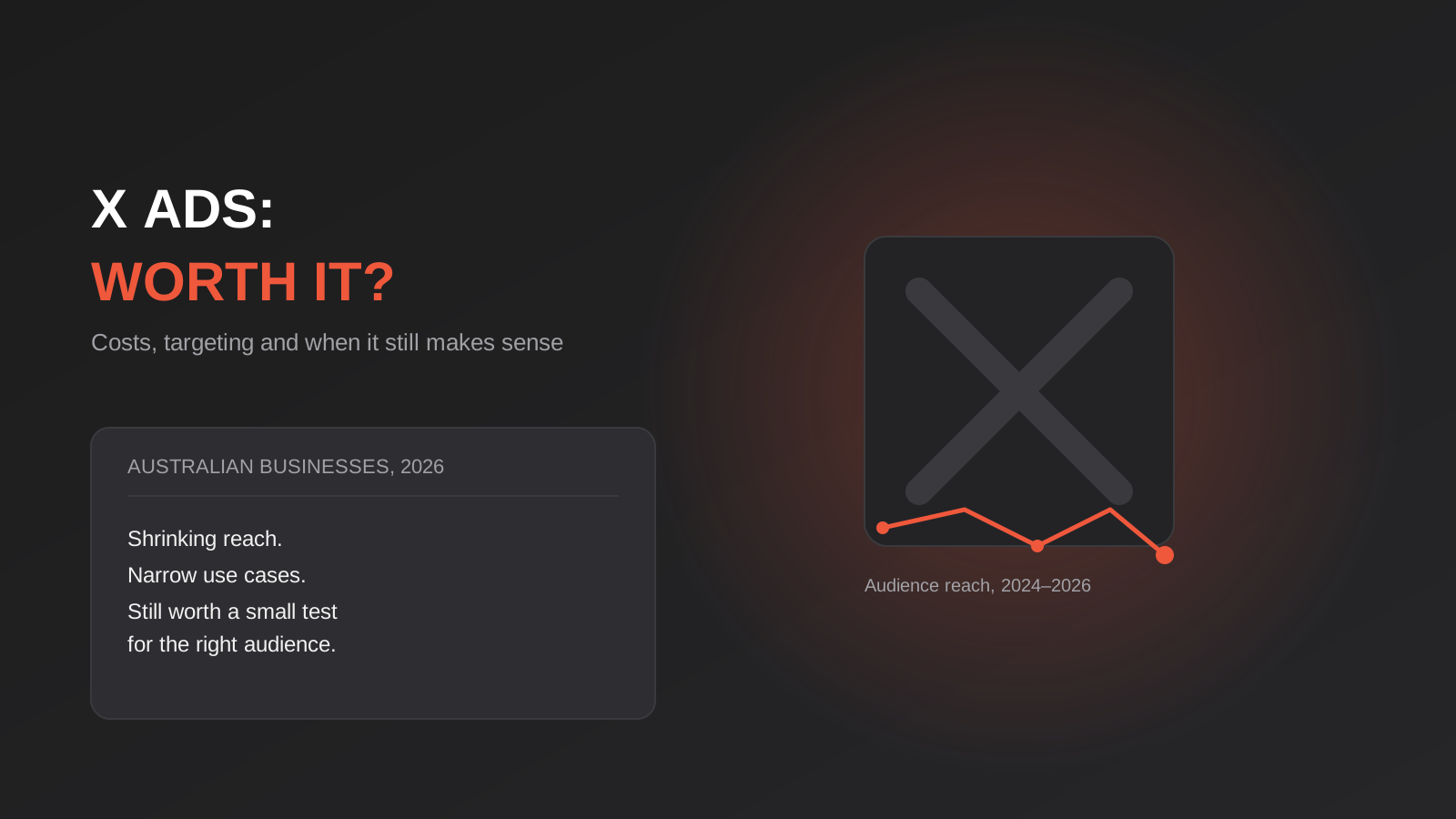
X Ads for Australian Businesses: Costs, Targeting and Whether It’s Worth Testing (2026)
What X (formerly Twitter) Ads cost in Australia, how targeting works, and whether it's actually worth testing for your business in 2026.
Pinterest Ads for Australian Businesses: Costs, Targeting and Whether It’s Worth Testing (2026)
Pinterest Ads cost and targeting for Australian businesses in 2026 — cheaper CPCs than Meta, planning-stage intent, and who should actually test…
Reddit Ads for Australian Businesses: Costs, Targeting and Whether It’s Worth Testing (2026)
What Reddit Ads actually cost in Australia, how subreddit and keyword targeting work, and a straight framework for deciding if it's worth…
Got a project you'd like to talk through?
Tell us what you're working on — we'll come back with a plan.
