
How Much Does an AI Chatbot Cost in Australia? A 2026 Pricing Guide
 Jignesh Vagadiya
22/10/2026
22 min read
A business owner rings three vendors about an AI chatbot for their website. One says $300 a month and you can be live by Friday. Another says $18,000 plus a monthly fee. The third says they can’t give a number until they’ve seen your systems. All three are telling the truth, and that’s the problem: they’re quoting for three different things and calling all of them “a chatbot”.
We build these for Australian businesses, and the most common thing we do in a first conversation is work out which of those three things the customer actually needs. Sometimes a $200-a-month subscription is the right answer and we say so. Sometimes the bot has to read from a CRM, quote from a price book and hand over to a human inside your helpdesk, and then the subscription tools stop being enough. The price follows the job, not the label.
This guide sets out what AI chatbots cost in Australia in 2026, split into the three tiers that matter, plus the running costs people forget to ask about, the things that push a quote up or down, and how to read a proposal. We haven’t put Growth Digital’s own numbers in the body, because automation work here is scoped and quoted individually. Our automation pricing page explains how that works. What you’ll find below is the market, so you can judge any quote, ours included.
How Much Does an AI Chatbot Cost in Australia? The Real Ranges
Published Australian figures for custom chatbots are messy. Most come from agencies and software vendors with something to sell, they use different definitions of “chatbot”, and many don’t say whether they mean AUD or USD. We went through a spread of them this month and the overlap is more useful than any single number. Treat everything below as a planning range rather than a price list, and note that most figures are quoted before GST.
Tier one: a subscription platform you configure yourself
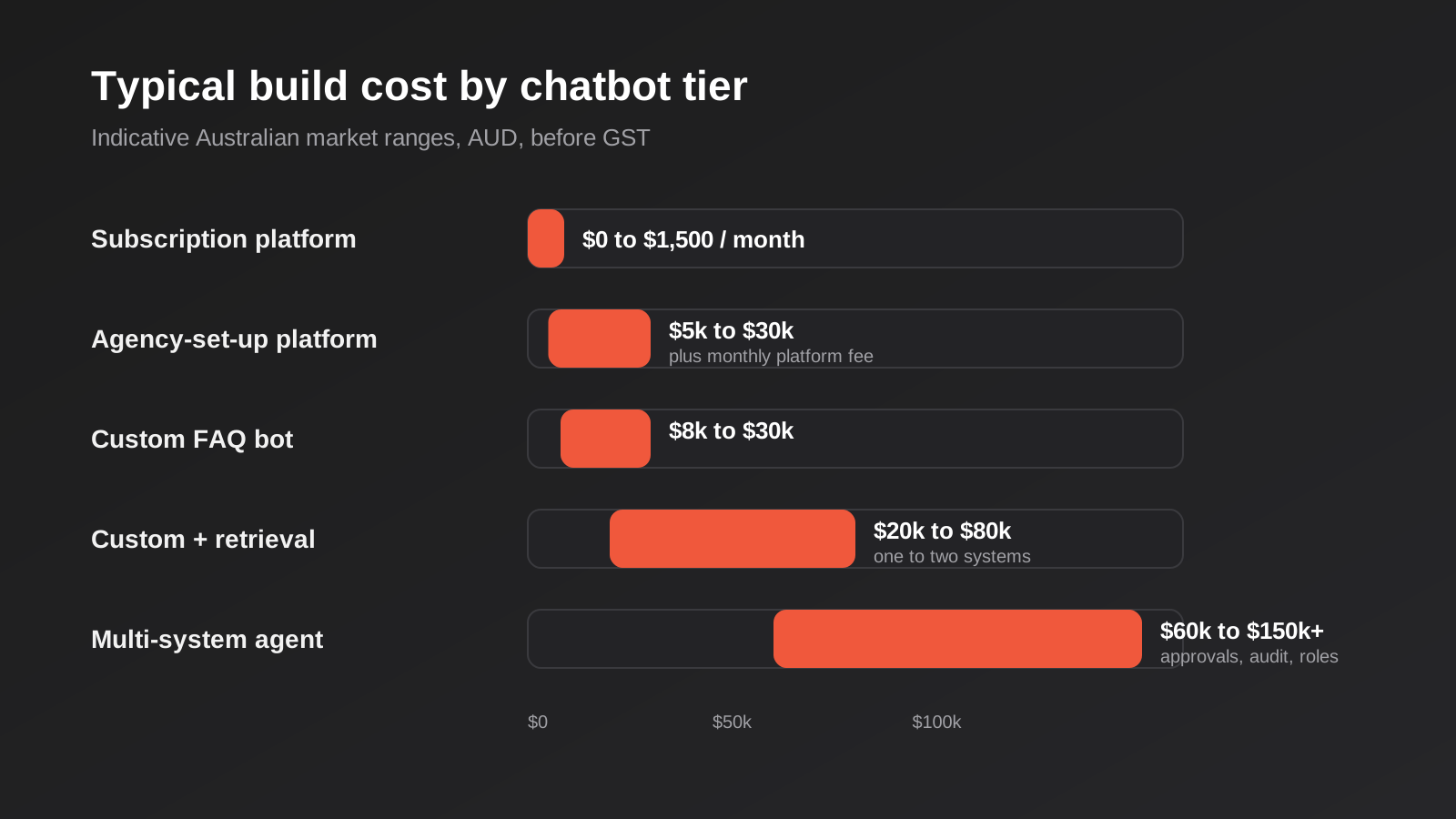
This is the Tidio, Chatbase, Intercom or Zendesk end of the market, where you pay a monthly fee, upload your help articles or point the tool at your website, and paste a snippet onto your site. Monthly costs in the sources we reviewed run from free plans up to roughly $150–$1,500 a month in Australian dollars, depending on conversation volume and which features sit behind the paywall. If you do the setup yourself, that is the whole bill, plus your time.
Some platforms charge per outcome rather than per seat. Intercom’s Fin agent, for example, lists $0.99 for each conversation it resolves, with a monthly minimum, and charges considerably more for outcomes like lead qualification. Per-resolution pricing sounds cheap until you work out what a busy month looks like, which we cover below. The platform comparison we published recently goes through six of these tools in detail.
Tier two: a platform, configured and connected by an agency
Here you still use a subscription platform, but someone else sets it up properly: structuring the knowledge base, writing the escalation rules, connecting it to a booking tool or helpdesk, and testing it before it faces customers. Agency fixed fees for this kind of build start at around $5,000 in the lower end of the guides we read, and commonly run into the low tens of thousands once integrations are involved. The monthly platform fee still applies on top.
This tier is where most small and mid-sized Australian businesses should be looking. The software is cheap; the expensive part is the thinking about what the bot should say, when it should stop talking and who picks up the conversation.
Tier three: a custom-built assistant
A custom build means your own application layer sits between the customer and a language model. It can read from your CRM or ERP, retrieve from a large document set, take actions such as creating a job or issuing a quote, and log everything for audit. Australian agency guides put a simple scripted or FAQ-style custom bot somewhere between $8,000 and $30,000. Bots that retrieve from documents and talk to one or two business systems cluster between about $20,000 and $80,000. Multi-system agents with approvals, role-based access and strict audit requirements run from $60,000 to well beyond $150,000, and a couple of sources go past $200,000 for enterprise scope.
Those bands overlap on purpose. A bot that reads a well-organised knowledge base and a bot that reads a messy one are different projects even if the screenshot looks identical.
A few things should make you cautious about any single number you see published, including these. Vendor blogs tend to anchor high or low depending on whether they sell the expensive service or the cheap one. Few distinguish between the build cost and the running cost. And almost none say how much of the budget goes on testing, which in our experience is where cheap quotes quietly save money.
The Running Costs Nobody Puts in the Headline
The build is a one-off. The chatbot is not. Once it’s live you are paying for several things that don’t show up in the proposal summary, and a quote that doesn’t mention them isn’t wrong so much as incomplete.
Model and usage fees
Every answer a custom bot generates costs a small amount in model usage, billed by the volume of text going in and out. For a small FAQ bot on a lightweight model, the sources we looked at put this at tens of dollars a month. For a busy customer-service bot that retrieves long documents for every answer, estimates stretch into the hundreds or low thousands. Usage cost is driven by how much context you feed the model per conversation, so a bot that stuffs your entire policy library into every request costs far more than one that retrieves only the relevant paragraph.
Hosting and infrastructure
A custom bot needs somewhere to run, a database for conversation logs and often a vector store for retrieval. For most small deployments this is modest, though it scales with traffic and with data residency requirements. If your policies or your customers’ expectations mean data should stay in Australian regions, say so before the quote, because it narrows the hosting options and can affect which model providers you can use.
Monitoring and maintenance
This is the line that gets cut first and regretted later. Answers drift when your prices, policies or products change. Models are updated and behave slightly differently. Customers ask things nobody anticipated. Common rules of thumb put annual maintenance at 15 to 25 per cent of the build cost, and one Australian breakdown for mid-tier bots puts monitoring and refinement at a few thousand dollars a month. You can choose to run lighter than that, but you should choose it deliberately rather than discover it.
Platform fees that scale with success
Per-resolution and per-conversation pricing deserves its own mention because it behaves oddly. If a bot resolves 3,000 conversations a month at roughly a dollar each, that is a real cost line, and it grows precisely when the bot is working well. That can be perfectly reasonable compared with the cost of a person handling the same volume, but you should do the sum before you sign up rather than after the first invoice. Also check how the vendor defines a “resolution”. Some count any conversation where the customer simply stops replying.
What Drives the Price Up or Down
When two vendors quote the same brief at wildly different numbers, the difference almost always sits in one of the following.
Number and type of systems connected
A bot that only answers from a help centre is cheap. A bot that looks up an order in Shopify, checks stock in an ERP and raises a ticket in your helpdesk is not, because each connection means authentication, field mapping, error handling and testing. If you’re unsure what your systems expose, our MCP development work is built around giving AI assistants structured access to business tools without a pile of one-off glue code, which is worth knowing about before you scope a multi-system bot.
Read-only versus take-action
Answering a question is low risk. Changing a booking, issuing a refund or updating a customer record is not. Anything that writes to your systems needs permissions, confirmation steps, logging and usually a human approval path for edge cases. That is a different project from a bot that only talks.
Quality and tidiness of your source content
Retrieval-based bots are only as good as the documents behind them. If your policies contradict each other, your price lists live in three spreadsheets and your help articles are two years old, someone has to fix that before the bot is any good. Agencies handle this in different ways: some include content clean-up, some assume it’s done and bill for it later when the bot gives wrong answers. Ask which.
Channels
A website widget is the baseline. Add WhatsApp, Messenger, SMS or voice and each channel brings its own approval processes, formatting quirks and costs. WhatsApp Business messaging, for instance, carries per-conversation charges from the platform on top of whatever you pay the builder.
Testing depth
A bot tested against fifty questions by the person who built it is a very different thing from a bot tested against several hundred real customer questions, including the awkward ones, with pass marks agreed in advance. Proper evaluation takes time and so it costs money. We wrote up what that process involves in how to test an AI chatbot before launch, and it’s a good checklist for what a serious proposal should contain.
Compliance and data handling
If the bot collects personal information, the Australian Privacy Principles apply, including the rules on sending personal information overseas when a model provider processes it offshore. Regulated sectors such as health, finance and legal add their own obligations. Compliance work isn’t glamorous, but reviewing what the bot collects, where it’s stored and how long it’s kept adds hours that a quote needs to account for.
Handover to humans
The most underrated feature is a good escalation. A bot that knows when to stop, passes the full conversation to a person in your helpdesk and tells the customer what happens next is worth more than a clever bot that bluffs. Building that cleanly takes design and integration work, and it’s the first thing cut from budget proposals.
Pricing Models You’ll Be Offered
Chatbot work is sold in a handful of ways, and each shifts risk differently.
Fixed-price build plus a monthly support fee
The most common arrangement for tier two and three work. You get a scoped build for a fixed fee and then a monthly retainer for hosting, monitoring and small changes. It’s easy to budget and easy to compare, provided the scope document is specific about channels, integrations, languages and the number of test cases. Watch for vague phrases like “integration with your systems” that don’t name the systems.
Time and materials
You pay for hours worked, usually with an estimate. This suits genuinely uncertain projects, such as a bot built on top of a legacy system nobody has documented. The risk is on you, so ask for a cap or for the project to be split into a short discovery phase followed by a fixed quote for the build. Hourly rates for AI and automation specialists in Australian guides range widely, so compare hours and seniority rather than the rate alone.
Pure subscription
Tier one. Predictable monthly cost, low commitment, and the vendor’s roadmap decides what you can do. The risk is lock-in of a different kind: your knowledge base, conversation history and tuned behaviour live inside the vendor’s tool, so check what you can export.
Usage or outcome-based
Priced per conversation, per resolution or per message. It aligns the vendor’s revenue with the bot being used, which is fair, but it makes your costs variable. Model a quiet month and a peak month before you agree.
Managed service
A single monthly fee covers the platform, the build, the monitoring and iterations. It can work well for businesses that don’t want to think about the technology, and it’s worth comparing the total over twelve months against a build-plus-support quote, because the two often come out closer than the headline numbers suggest.
What a Proper Chatbot Quote Should Include
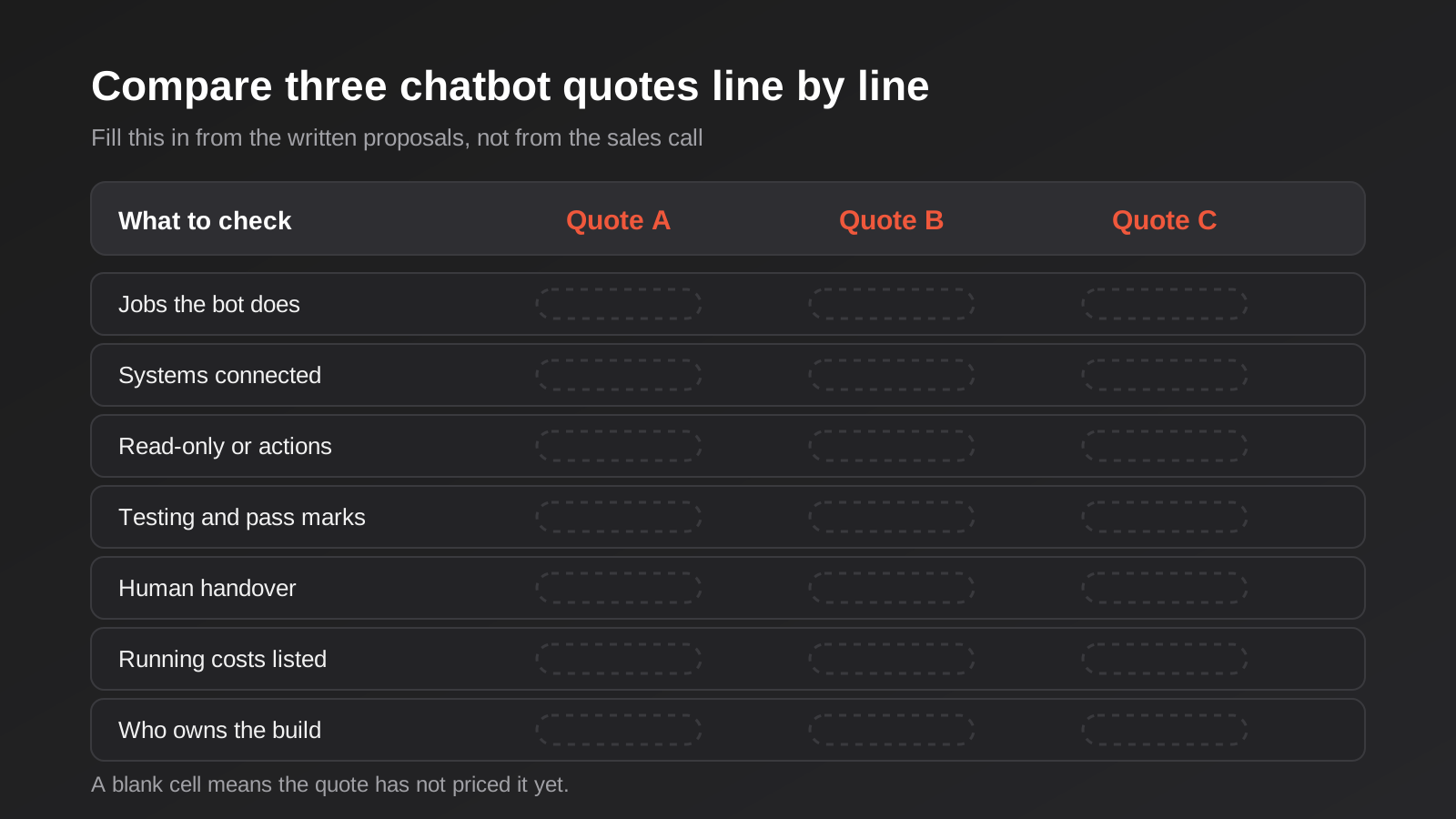
You can learn a lot from a proposal before you talk to anyone. A quote worth taking seriously will normally spell out the following.
- The specific jobs the bot will do, written as tasks such as “answer delivery and returns questions” or “book a standard consultation” rather than “improve customer experience”.
- Which systems it connects to, and whether each connection is read-only or can change data.
- Where your content comes from, who prepares it, and who keeps it current after launch.
- The channels covered at launch and which are extra.
- How it hands over to a person, including what the human sees when they take over.
- How it will be tested before launch, with a rough number of test conversations and the pass criteria.
- Where data is stored and processed, which model providers are involved, and how that fits with the Privacy Act.
- What happens after launch: monitoring, who responds when it gives a bad answer, and how often content and behaviour are reviewed.
- Running costs separated from build costs, with an estimate of model usage fees based on your expected volume.
- Ownership: who owns the prompts, the retrieval setup, the code and the conversation logs if you part ways.
If a proposal covers only the first two of those, it’s pricing a demo rather than a product.
Why Quotes for the Same Brief Come Back So Different
The spread between vendors usually has four causes. The first is that they’ve scoped different things without saying so. One has assumed a bot that answers questions; another has assumed it also books appointments and updates the CRM. The second is overhead: a large consultancy with account managers and a project office will price the same engineering differently from a small specialist team. The third is how much testing and clean-up is included. The fourth is that some quotes are built to win the deal and rely on change requests later to recover margin.
None of those make a cheaper quote dishonest. They do mean the number alone doesn’t tell you much. Put the proposals side by side against the list above and the explanation is usually visible within a few minutes.
What a cheap quote usually leaves out
From taking over half-finished projects, the same gaps appear again and again. Testing is thin or absent, so the first real customers become the test group. Escalation is a link to a contact form rather than a proper handover. There is no plan for keeping content current, so the bot’s answers age quietly. Usage costs aren’t estimated, which produces a surprise bill once traffic grows. And ownership terms are vague, leaving you dependent on the vendor to change anything.
How Much to Budget at Each Stage of Business
These aren’t promises, just the shape of spend we see make sense at different sizes. They assume Australian dollars and exclude GST.
- Sole trader or very small team with a simple website: start with a subscription tool and spend your effort on the content it reads from. Paying for custom development before you know what customers actually ask is usually premature.
- Established small business with a helpdesk, a booking tool or an ecommerce store: a configured and connected platform (tier two) is typically the sweet spot. The budget goes into integrations, escalation and testing.
- Mid-sized business with multiple systems and a support team: this is where custom work starts to pay for itself, particularly if you’re handling thousands of conversations a month or the bot needs to take actions in several systems.
- Regulated or high-stakes environment: budget for compliance review, approvals and audit logging from day one. These requirements are cheaper to design in than to retrofit.
Whatever the size, the sensible sequence is the same. Start with a narrow job, measure what happens, then widen it. A chatbot that does three things well is easier to fund, easier to test and easier to trust than one that tries to do thirty.
Is It Worth the Money? A Quick Way to Check
The honest test is boring arithmetic. Count how many conversations your team handles per month that are repetitive: order status, opening hours, pricing questions, booking changes. Estimate how long each takes. Multiply by the loaded cost of the person doing it. Then ask what share a bot could realistically resolve without making customers angrier. If a bot resolves a third of those conversations well, what is that worth per year, and how does it compare to the first-year cost, meaning build plus twelve months of running costs?
Be conservative with the resolution rate. Vendors quote impressive figures from their best customers, and those customers usually have clean content, narrow use cases and years of tuning. A first-year resolution rate well below the headline figure is normal. If the sum only works at an optimistic resolution rate, the project is marginal and a tier-one tool is probably the better first step.
There are also benefits that don’t show up in a spreadsheet, such as answering at 10pm or capturing leads that would have bounced. Count them if you can measure them, and leave them out if you can’t.
Australian Details That Change the Bill
A few local factors rarely appear in the US-centric pricing pages that dominate search results, and they can move your real cost by a noticeable amount.
Currency is the first. Many platforms price in US dollars and bill your card at the day’s exchange rate, so a plan advertised at US$99 a month is not $99 and fluctuates. Usage-based fees move the same way. Ask whether a vendor invoices in Australian dollars, and whether the quote includes GST, since agency proposals often show ex-GST figures while platform pricing pages may not make it clear.
Support hours are the second. A tool whose support team sleeps through your business day is a risk if the bot breaks during a promotion. Agencies based here can usually respond within your trading hours, which is a practical benefit that rarely appears as a line item but does matter when something goes wrong at 9am on a Monday.
Data location is the third. If you operate in a sector where customers expect their information to stay onshore, confirm where the platform stores conversations and which regions the model provider processes them in. Some vendors offer Australian hosting on higher plans only, which changes the price comparison between tiers. Ask for this in writing.
Finally, check the consumer-law side of what the bot says. Anything it states about price, refunds or availability is a representation made by your business. If the bot quotes a price you didn’t intend, Australian Consumer Law doesn’t care that a machine wrote it. That’s an argument for keeping the bot’s access to pricing tied to your actual price data and for testing those answers specifically, which again points to testing budget as money well spent rather than overhead.
Build, Buy or Both?
Framing this as build versus buy hides the more useful option, which is to buy first and build the parts that matter. Most of the businesses we speak to end up in a hybrid: a platform handles the conversation layer and the basic knowledge retrieval, while a small amount of custom work connects it to the two or three systems that make the answers specific to the customer, such as order status or appointment availability.
That approach keeps the monthly platform fee predictable, keeps the custom build small enough to quote with confidence, and lets you swap the conversation layer later if a better or cheaper tool turns up. It also means you can start with a modest budget and add integrations one at a time as the data shows which ones customers use. If you find yourself being quoted a large custom build for a problem that a connected platform would solve, it’s worth asking the vendor why.
The reverse also holds. If a vendor pushes a subscription platform for a job that needs to write into several back-office systems with approvals and audit trails, you’ll hit the platform’s limits within months and pay twice. The decision isn’t ideological; it’s about how many systems the bot touches and how much it is allowed to change.
Common Mistakes When Buying an AI Chatbot
- Comparing a subscription price with a custom build price as though they were the same product, then being surprised when the cheap one can’t read your CRM.
- Budgeting for the build and forgetting the running costs, which commonly add up to a meaningful fraction of the build every year.
- Letting the vendor define “resolved” without checking how it’s counted, then paying per resolution for conversations where the customer just gave up.
- Launching without a test set, so customer complaints become the quality assurance process.
- Feeding the bot messy, contradictory content and expecting it to sort things out. It won’t.
- Giving the bot write access to systems before it has proven it can answer reliably in a read-only role.
- Skipping the human handover design, which is where most customer frustration lands.
- Ignoring where data goes. Offshore model processing isn’t automatically a problem, but you do need to know about it and be able to explain it in your privacy policy.
- Treating launch as the finish line. The first month after launch is when you learn what customers really ask.
Frequently Asked Questions
How much does an AI chatbot cost in Australia?
It depends which tier you mean. Subscription platforms you set up yourself generally run from free plans to roughly $150–$1,500 a month. Agency-built bots on those platforms usually start from around $5,000 and rise with integrations. Custom-built assistants that connect to your systems commonly sit between $20,000 and $80,000, with complex multi-system agents going above $100,000. These are published market ranges from several Australian sources, and they vary, so use them as a sanity check rather than a quote.
What are the ongoing costs of running an AI chatbot?
Four main ones: model usage fees, hosting, platform subscriptions or per-resolution charges, and monitoring and maintenance. For a small FAQ bot the usage and hosting costs can be modest, while a busy customer-service bot costs considerably more. A common rule of thumb for maintenance is 15 to 25 per cent of the build cost per year, though lighter arrangements are possible if you accept less active tuning.
Is it cheaper to use a platform like Tidio or Intercom than to build a custom chatbot?
Almost always at the start, yes. A platform gets you live in days at a low monthly cost. Custom becomes worth considering when the bot needs deep access to your systems, when conversation volume makes per-resolution fees expensive, or when you need control over data handling and behaviour that platforms don’t offer. Many businesses start on a platform and move to custom later, which is a sensible path as long as you can export your content.
Why do chatbot quotes vary so much between vendors?
Because “chatbot” covers very different scopes. Quotes differ in which systems are connected, whether the bot only answers or also takes actions, how much testing and content clean-up is included, which channels are covered and what support follows launch. Overhead and sales approach also play a part. Comparing the written deliverables line by line usually explains the gap.
Does an AI chatbot need to comply with the Privacy Act?
If it collects or handles personal information and your business is covered by the Privacy Act, yes, the Australian Privacy Principles apply. That includes being transparent about collection, securing the data, and taking care when personal information is disclosed to overseas providers, which can happen when a hosted model processes conversations. The detail depends on your business and sector, so it’s worth getting advice if the bot will handle health, financial or other sensitive information.
How long does it take to build an AI chatbot?
A configured platform bot can go live in a few weeks, most of which goes on content preparation and testing. Custom assistants that integrate with business systems commonly take two to four months from scoping to launch, longer if the systems are poorly documented or approvals are involved. Timelines slip most often because content isn’t ready or system access is delayed, not because of the AI itself.
Where to Start
The most useful first step is cheap: write down the ten questions your customers ask most often and where the answers currently live. If the answers are clear and in one place, a subscription tool might be all you need. If they sit across your CRM, your inventory system and a few people’s heads, you’re looking at a connected build and the quote should reflect that.
If you’d like a second opinion on a proposal or a rough scope before approaching vendors, our AI chatbots and assistants service page describes what we build, and the automation pricing page explains how we scope and quote, with one fixed number agreed before any work starts. We’re happy to look at what you have and tell you honestly which tier fits.
Worth putting a number on it: because we run lean as a specialist agency rather than carrying a large account-management layer, our fixed quotes typically come in below the Australian averages covered in this guide. If you’ve already got a written quote from another agency for comparable scope, send it through and we’ll do our best to beat it.
Keep reading
Related posts
How Much Does a WooCommerce to Shopify Migration Cost in Australia? A 2026 Price Guide
What a WooCommerce to Shopify migration costs in Australia in 2026: real price ranges by store complexity, hidden costs and how to…
How Much Does Custom Software Development Cost in Australia? Build Cost vs Five Years of Licences (2026)
What custom software development costs in Australia in 2026: ranges by project type, integration costs, running costs, and how the build compares…
How Much Does It Cost to Build an App in Australia? A 2026 Price Guide
What it costs to build a mobile app in Australia in 2026: realistic ranges by complexity, what drives the price, cross-platform vs…
Got a project you'd like to talk through?
Tell us what you're working on — we'll come back with a plan.
